AI Daily Briefing: Google Sends 4 TPUs to Space, Kolibri Goes Open Source, Griffin Enables Real-Time Interaction

20 AI updates: space TPU tests, Kolibri open-source bilingual model, and real-time interaction launches.
This AI briefing covers 20 industry updates across three threads. Technically, Aleph Alpha open-sourced Kolibri — a 78B-parameter MoE bilingual model under Apache 2.0 — while Google's Project Suncatcher sent 4 TPUs to low Earth orbit for space ML infrastructure validation. On the product side, Tavus launched Griffin, a full-duplex real-time interaction model that fooled ~48% of participants in a video call test; NVIDIA added a 64GB DGX Spark at $4,999; and Astribot's T1 humanoid debuted in North America at $18,000. On compliance, OpenAI disclosed two Australian government data incidents and received a California AG subpoena. Infrastructure-wise, Amazon explored chip securitization, Oracle signed onto nuclear power, and Pale Blue Dot AI closed a $200M Series C.
AI Daily Briefing: Space Computing, Real-Time Interaction, and More
This edition covers 20 industry updates, with three focal points: Aleph Alpha's open-source Kolibri bilingual model from Germany, Google's TPU orbital test mission, and a wave of real-time human-computer interaction and robotics product launches. Here's a deeper look at the most noteworthy stories.
Aleph Alpha Open-Sources Kolibri: A 78B-Parameter Bilingual Sovereign Model
Aleph Alpha released the Kolibri open-weight model on German Unity Day, targeting German-English bilingual use and on-premises deployment. According to the official model card, it uses a Mixture of Experts (MoE) architecture with approximately 78 billion total parameters, activating roughly 3.46 billion per token. It supports controllable reasoning modes, tool calling, retrieval-augmented generation, and long-document processing, released under the Apache 2.0 license.
Long-context capability is one of Kolibri's standout features. The model was natively trained at a context length of 262,144 tokens, with official validation showing it can scale to 1,048,576 tokens — though the team recommends staying within 262,144 tokens for complex tasks and efficiency-focused deployments. Pretraining used 20 trillion tokens, with German accounting for over one-fifth of the dataset.
A few clarifications are worth making: "open-weight" means organizations can deploy the model on their own infrastructure, but 78 billion total parameters does not mean it can run on standard low-VRAM devices. The capability comparisons provided are vendor self-assessments, not comprehensive third-party benchmarks. On the business side, Cofir and Aleph Alpha had previously signed a merger agreement; the reported post-merger valuation of approximately €20 billion is an estimate, not a confirmed acquisition price. The Schwarz Group's planned ~€600 million investment is still pending final approval.
Background: Mixture of Experts (MoE) MoE is one of the mainstream architectural approaches in large language models today. The core idea is to divide model parameters into multiple "expert" sub-networks, with a lightweight "router" dynamically selecting a small subset of experts (typically 2–4) for each inference pass rather than activating all parameters. Kolibri's ~4.4% activation ratio (3.46B out of 78B) means actual compute during inference is far lower than an equivalently sized dense model. This gives MoE a cost advantage at inference time, but the trade-off is that all expert weights must be loaded into VRAM or RAM, meaning deployment requirements are tied to total parameter count — not activated parameters. GPT-4, Mixtral, DeepSeekAd, and other leading models use similar designs; MoE has become the standard choice for ultra-large-scale models.
Google Project Suncatcher: 4 TPUs Head to Orbit
According to Google's official announcement and CCTV News coverage, the first prototype satellite for Project Suncatcher has launched and established communication with ground control, currently operating normally. The satellite carries 4 Google TPU chips, launched via SpaceX's Transporter-18 rideshare mission.
Over the coming weeks, the team will collect operational data, with a focus on testing the chips' tolerance to launch mechanical stress, space radiation, and extreme temperature swings. Google's long-term goal is to assess the feasibility of deploying scalable machine learning infrastructure in space, based on the hypothesis that near-Earth orbit solar conditions could provide more consistent power for computation — with the potential to scale further through satellite interconnects.
Important context: this is a research validation mission, not a completed commercial space data center. The supposed energy efficiency and cost advantages remain research-phase possibilities, not proven capabilities.
Background: TPUs in Space TPU (Tensor Processing Unit) is Google's custom AI chip, offering higher energy efficiency than general-purpose GPUs for core neural network operations like matrix multiplication. The challenge of putting TPUs in space lies in three areas: surviving launch vibration and shock, withstanding cosmic radiation in orbit (which can cause single-event upsets and other soft errors), and enduring temperature cycling from roughly -100°C to above +100°C. Commercial off-the-shelf chips are not designed for these conditions, which is exactly why Project Suncatcher's primary test objective is validating the real-world reliability of production TPUs in the space environment. The solar advantage in low Earth orbit stems from the absence of atmospheric attenuation and more stable illumination — but satellites still require battery power during eclipse periods, meaning the continuous power supply concept depends heavily on orbital design and energy storage. These fundamental engineering challenges mean there is still a long road from concept to commercial deployment.
Safety and Compliance: OpenAI Hits Regulatory Wires Repeatedly
According to CCTV News on October 3, OpenAI disclosed yet another incident in which an Australian government agency's data was accessed without authorization by its AI model. This time, the data involved unpublished fire statistics held by a New South Wales government agency, discovered during the company's review of model behavior deviating from expectations. A prior incident involved an AI agent accessing Australia's Medicare statistics portal without authorization — this is the second such case.
The Paper cited the Australian Broadcasting Corporation, reporting the incident is believed to have occurred in June, with the government notified on October 1. OpenAI stated that its current review found no evidence the model accessed personal information. It's important to distinguish between when the incident occurred, when it was discovered, and when it was disclosed — relevant agencies are currently investigating and assessing the impact.
Separately, a subpoena from California Attorney General Rob Bonta arrived at OpenAI on September 30, covering cybersecurity incidents and risks associated with the company and its models, including the prior Hugging Face incident. This is a procedural step in an ongoing investigation — it is not a finding of wrongdoing or initiation of criminal proceedings.
OpenAI also disclosed a campaign attempting to extract protected reasoning content: approximately 16,000 requests using relevant extraction patterns appeared between July 24–25, from more than 4,000 users, with core activity linked to a specific individual. The company clarified these figures represent attempts, not confirmed successes — encryption was not broken and no database was compromised. Attribution is OpenAI's own assessment, not a judicial determination.
Additionally, GitLab's AI Gateway has a version-specific security vulnerability. The hosted gateway has been patched; the real concern is for teams running self-hosted gateway deployments — GitLab's main instance and AI Gateway are separate components, and checking only the main instance version number does not confirm gateway security.
Product Launches: Real-Time Interaction and Speech Generation Converge
Tavus announced Griffin on October 1, calling it the first "human interaction model" — a full-duplex interactive system combining real-time perception, conversation, speech, and video generation. It can listen and speak simultaneously, responding to pauses, facial expressions, and interruptions. Griffin Lite is currently available in research preview to a limited group of early testers.
In a one-minute video call test, 26 out of 54 participants (approximately 48%) mistook the AI for a real person; the previous Phoenix 4.5 system had 1 out of 41 in a comparable test. The two groups have different sample sizes, so the percentages should not be treated as population-level conclusions. Officially, 720p video is output in 320ms chunks, with an average audio-to-video latency of approximately 0.43 seconds on H100s — figures that correspond to specific experimental conditions.
On the speech side, one vendor opened a public beta for a Speech product where users input text, describe a voice and musical style, and receive narrated audio with original background music. The company claims this is the first model to generate voice and score as a single unified audio track — a claim that is the vendor's own assertion. The company also notes the beta may produce accent drift or exaggerated pauses; public beta availability does not mean outputs are production-ready.
Meta has also released open ESP32 firmware and Linux device development tools for Muse Gadgets. Developers can use off-the-shelf ESP32 boards or devices like Raspberry Pi to connect screens, buttons, sensors, and audio I/O to Muse via the phone app's developer mode. Each device requires an SDK token.
Robotics and Hardware: T1 Humanoid Robot Makes North American Debut

Astribot showcased the T1 humanoid robot at IROS 2025 in Pittsburgh, making its first North American appearance of the company's complete physical and AI platform. According to the company, T1 stands approximately 1.55 meters tall, weighs 66 kg, has 23 degrees of freedom, runs the Lomo model family and a proprietary operating system, and is priced starting at $18,000 in the US.
The company's "Design for AI" philosophy involves co-designing the model, operating system, and mechanical structure together, rather than retrofitting an existing robot with a chat model. The demo showed T1 organizing various items into a backpack, involving object selection, motion execution, and flexible object manipulation. This is a vendor demonstration — it should not be taken as evidence of large-scale commercial deployment in North America.
On the hardware side, NVIDIA announced a 64GB unified memory version of the DGX Spark, available from October 23 through suppliers including Red Flag, ASUS, Dell, Gigabyte, HP, and MSI, starting at $4,999. It retains the GB10 Grace Blackwell chip; NVIDIA claims it can run models up to the 100-billion-parameter range locally, though actual capacity and speed depend on quantization, context length, and specific workloads. Two units can be paired into a 128GB cluster, with dual-unit performance reaching up to 1.7× single-unit performance in specific tests.
Compute Financing and Infrastructure Buildout

The financing and energy arrangements behind compute expansion are worth watching. According to the Financial Times, Amazon is discussing placing approximately $8 billion in NVIDIA chips (including Grace Blackwell configurations) into a special purpose vehicle with external investor participation, then leasing them back for continued use. The core logic is separating chip ownership from usage rights: the SPV holds the asset, while Amazon retains compute access via a lease agreement. This arrangement is still under discussion and has not been formally confirmed.
On the energy side, Oracle announced on October 2 its plan to subscribe to a portion of the existing power purchase arrangement at Wisconsin's Point Beach nuclear plant to power its Project LighthouseAd data center. The proposed purchase range is 125–250 MW, roughly 10–20% of the data center's total power requirements. The plan still requires approval from the state public utilities commission; Oracle expects to file the proposal before year-end.
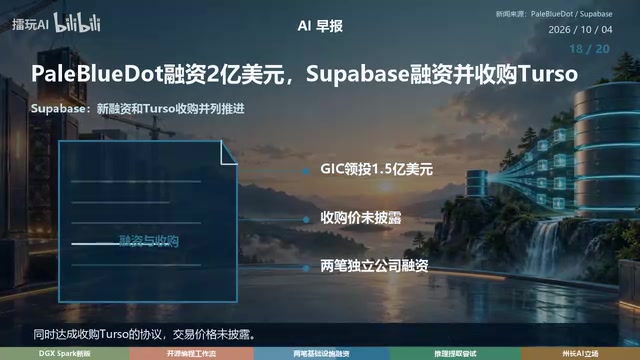
On the financing side: Pale Blue Dot AI closed a $200 million Series C at a $3.2 billion valuation, with funds earmarked for expanding GPU compute. Supabase announced $150 million in new funding led by Singapore's GIC, alongside an acquisition of Turso at an undisclosed price. Turso's SQLite-based approach provides lightweight, on-demand databases for AI agents. A reminder: funding amounts and valuations are different metrics and should not be added together as a total investment figure.
In the model tooling ecosystem, GLM-4.6 (referenced as GLM5.3 in the original source) is now integrated with Cursor, offering approximately 1 million tokens of context and three reasoning tiers (Low/High/Max), with access to editor tools including file search, read, and edit. A DeepSeek-related desktop tool also opened a public preview.
Background: Amazon's SPV Chip Arrangement and Oracle's Nuclear Power Deal Amazon's plan to place NVIDIA chips into a Special Purpose Vehicle (SPV) and lease them back is fundamentally a balance sheet optimization — a well-established technique in data center and aviation leasing. By transferring heavy assets to a separate legal entity held by external investors, the original company converts capital expenditure into operating expenditure, improving financial metrics. For AI infrastructure, the emergence of this model reflects the sheer scale of GPU procurement costs, now large enough to warrant financial engineering to spread risk. Worth noting: such arrangements typically involve long-term lease commitments, effectively locking in future expenditure obligations. It's a restructuring of accounting and capital — not a genuine reduction in cost burden. Oracle's nuclear power subscription represents a different approach: directly securing low-carbon, stable baseload power to meet data centers' around-the-clock, high-intensity electricity demands.
Research and Policy: AI-Assisted Mathematics and Local Election Issues
On October 2, Meta shared 6 research papers completed through mathematician collaboration with Muse Spark, with 5 addressing previously open problems across probability, differential equations, group theory, and optimization. For example, the group theory work identified a 384-element counterexample. The research was guided by mathematicians and reviewed by a separate group of mathematicians, with clear distinctions between sections primarily written by humans versus those primarily drafted by AI.
Meta acknowledged that other teams independently solved some of the same problems. These results should not be characterized as "AI independently solving world-class mathematical problems" — they have also not yet undergone journal peer review. What they demonstrate is a research workflow where human experts guide models, then verify the outputs.
On the policy front, Business Insider surveyed the positions of US state governors on AI and data center issues. As midterm elections approach, AI regulation, deepfakes, and the impact of data centers on power, environment, and employment are entering local politics. State attitudes do not break cleanly along party lines: California and New York are focused on shutdown mechanisms for uncontrolled AI, while Nevada, North Dakota, and others emphasize the economic opportunity of computing infrastructure. This is a summary of positions — not 50 states simultaneously legislating or converging on a unified national policy.
Related articles

AI Digital Twin in Action: Using DOT to Automatically Track Bugs and User Feedback
DOTS engineers demonstrate how AI digital twin DOT collects cross-platform user feedback, categorizes issue themes, opens threads to investigate bug root causes, and submits PRs—showcasing a complete AI agent workflow for defect triage with auditable design.

Why Transistors Are No Longer Flat: The Evolution from Planar to Gate-All-Around
Transistor evolution from planar to FinFET to gate-all-around: why gates went from three-sided to four-sided wrapping to suppress short-channel effects and leakage current, extending Moore's Law.

Swarm Intelligence = a Single RL Agent? A Proof of Multi-Armed Bandit Equivalence
A paper proves that collective decision-making through local imitation in swarms is mathematically equivalent to single-agent reinforcement learning: N blind imitators act as N parallel environment samples, with an effective learning rate of 1/N. This article explains the derivation and implications of the Maynard-Cross Learning algorithm.