Swarm Intelligence = a Single RL Agent? A Proof of Multi-Armed Bandit Equivalence

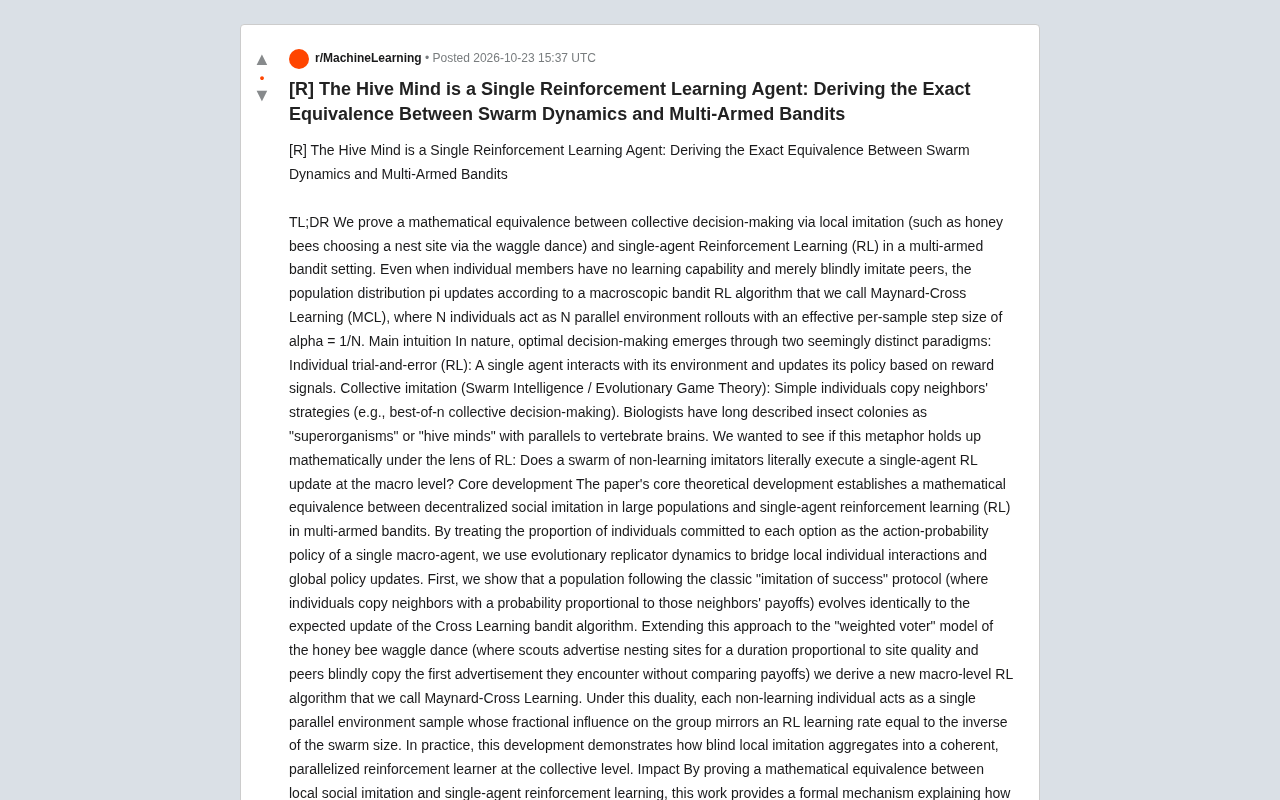
The paper proves that collective decision-making by blind imitators is mathematically equivalent to single-agent multi-armed bandit reinforcement learning.
The paper proves that the collective decision-making of a population of individuals with no learning ability, who merely blindly imitate their neighbors, is strictly mathematically equivalent to single-agent reinforcement learning in the multi-armed bandit setting. The researchers first establish the correspondence between the "imitate the successful" protocol and the classic Cross Learning algorithm, then derive a new algorithm, Maynard-Cross Learning, for the bee-waggle-dance-style weighted voter model. The core of the equivalence is that N individuals correspond to N parallel environment samples, and an individual's influence on the population distribution corresponds exactly to a learning rate of α=1/N—the larger the population, the slower but more stable the learning. This result formalizes the "swarm intelligence" metaphor mechanistically and can be used to analyze social imitation dynamics and guide the design of decentralized swarm robots, though it is currently limited to stateless multi-armed bandit environments.
In nature, bees choose nest sites through the waggle dance, and ant colonies find the shortest path through local imitation—these simple organisms, lacking individual learning ability, can nonetheless make optimal decisions at the collective level. Long described by biologists as a "superorganism" or "swarm intelligence," this phenomenon now has a rigorous mathematical explanation: a population of blind imitators is, at the macroscopic level, equivalent to a single agent performing reinforcement learning updates.
From Metaphor to Mathematics: The Equivalence Between Swarm Intelligence and Reinforcement Learning
According to a discussion thread on Reddit about the paper, the researchers proved a mathematical equivalence: collective decision-making through local imitation (such as bees choosing a nest site via the waggle dance) is exactly equivalent to single-agent reinforcement learning (RL) in the multi-armed bandit setting. Even if individual members have no learning ability and merely blindly imitate their peers, the update of the population distribution π still follows a macroscopic bandit RL algorithm.
The core intuition behind this finding is that optimal decision-making in nature emerges through two seemingly different paradigms—trial-and-error learning by a single agent (RL), and collective imitation in which simple individuals copy their neighbors' strategies (swarm intelligence / evolutionary game theory). Biologists have long described insect colonies as "superorganisms," but this metaphor previously lacked rigorous mathematical support. The question the paper seeks to answer is: does a group of non-learning imitators really perform single-agent RL updates at the macroscopic level?
From Cross Learning to Maynard-Cross Learning
The paper's theoretical development unfolds along two lines. First, the researchers prove that a population following the classic "imitate the successful" protocol (individuals copy a neighbor's strategy with a probability proportional to that neighbor's payoff) has an evolutionary trajectory that exactly matches the expected update of the Cross Learning bandit algorithm. This step builds a bridge between social imitation and a known RL algorithm.
The researchers then extend the approach to the "weighted voter" model of the bee waggle dance—scout bees advertise in proportion to nest-site quality, while followers blindly copy the first advertisement they encounter, without any payoff comparison. In this setting, they derive a new macroscopic RL algorithm, which they name Maynard-Cross Learning (MCL).
Under this duality, N non-learning individuals correspond to N parallel environment rollouts, and each individual's fractional influence on the population corresponds exactly to an RL learning rate equal to 1/N. In other words, the larger the population, the smaller the effective step size of any single individual, and the more the behavior of the whole population resembles that of a cautious and stable learner.
Cross Learning is a classic online learning algorithm for the multi-armed bandit problem, systematically analyzed by Auer et al. around 2002. Its core mechanism is: in each round, the actor selects an arm (i.e., a strategy), observes the reward obtained, and then updates the weight of that arm by an amount proportional to the reward, while the weights of unselected arms remain essentially unchanged. More specifically, if the current strategy distribution is π and selecting arm i yields reward r∈[0,1], the update is π_i ← π_i + r·(1−π_i), with the other arms updated as π_j ← π_j − r·π_j. The expected update of Cross Learning can be written as a linear dynamical system over the strategy distribution, and precisely this property allows it to correspond exactly to the population dynamics of "imitate the successful," making it the bridge in the paper between social imitation and reinforcement learning.
Multi-armed Bandit is the simplest decision model in reinforcement learning: at each step the agent can choose only one of a fixed set of K actions ("slot-machine arms"), receives an immediate reward, and aims to maximize cumulative reward. There are no state transitions, so it does not involve "delayed rewards" or "allocation of strategies across states." The paper restricts itself to this setting because it is mathematically the easiest in which to establish a one-to-one correspondence with the population dynamics of "individuals copying their neighbors' strategies"; extending to a full Markov decision process (MDP) would require individuals to imitate not only "which action to choose" but also "in which state to choose it," which would considerably complicate the correspondence.
The weighted voter model originates from the "voter model" in probability theory and population genetics: each individual in a population randomly selects a neighbor and copies its state, which at the macroscopic level manifests as a process of opinion diffusion. Nest-site selection via the bee waggle dance is a biological instance—the "advertising intensity" of scout bees is proportional to nest-site quality, while follower bees do not compare the payoffs of multiple nest sites but simply copy the first dance they encounter. This mechanism of "weighting by quality, but with copiers making no payoff comparison" differs at the microscopic-rule level from the classic "imitate the successful" (in which individuals compare payoffs and copy the best), yet it still yields a macroscopic RL update—and this is precisely the key respect in which MCL differs from the Cross Learning correspondence.
Why This Equivalence Matters
According to the authors' explanation on Reddit, the impact of this work manifests at three levels. At the biological level, it provides a formal mechanism for "swarm intelligence" and collective intelligence—how simple, non-learning individuals can produce trial-and-error learning behavior at the population level through local interactions—thereby offering mathematical evidence for evolutionary theories of collective cognition.
At the methodological level, the framework provides a new tool for analyzing imitation dynamics in social and economic systems. Real-world fashion trends, herd behavior in investing, and technology adoption curves can all be reformulated as some kind of macroscopic RL process, and thus analyzed and predicted in the language of RL.
At the engineering level, this result offers direct inspiration for designing scalable decentralized swarm robotics algorithms. If blind imitation is already equivalent to parallel RL, then when designing swarm robots one may not need to equip each individual with a complex learning module—it may suffice to design good local imitation rules, and learning ability at the swarm level will emerge naturally.
Environment rollout (parallel sampling) in reinforcement learning refers to independently executing a policy in the environment multiple times and collecting trajectory samples to estimate expected returns. The paper's statement that "N individuals correspond to N parallel rollouts" means that each blind-imitating individual independently "tries" a strategy and brings back a payoff signal, and the population aggregates these signals with weight 1/N to update the strategy distribution—an effect equivalent to a single learner performing N parallel samples and averaging them. This explains why the population size N appears in two places at once—it is both the number of individuals and, through 1/N, the learning rate: the more samples, the smoother each update and the lower the variance, but the slower the response.
Learning rate is the hyperparameter in RL that controls the step size of each update, denoted α. Too large an α causes updates to oscillate and fail to converge; too small an α leads to slow convergence. Here α=1/N is a learning rate "set automatically" by the population structure rather than the result of manual tuning—the more individuals there are, the smaller the marginal influence of any single individual on the population distribution, and the macroscopic update step size is naturally diluted. This perspective directly links "population size" with "learning stability" and also provides a quantitative analogy for understanding why large organizations make conservative decisions.
Notable Details and Limitations
This equivalence rests on specific assumptions: the imitation protocol takes the form of "imitate the successful" or the weighted voter model, and the environment is a multi-armed bandit rather than a full MDP. This means the conclusions currently apply mainly to static or near-static decision problems; whether the equivalence holds for complex environments requiring sequential decision-making still requires further study.
Another intriguing corollary concerns the learning rate: α=1/N means that the larger the population, the slower but more stable the macroscopic learning. This explains why large-scale populations often exhibit a conservative decision-making style—their "learning rate" is diluted by their size. This observation also offers insight into the decision-making inertia of large organizations.
The paper's code is open-sourced on GitHub, and the project page provides reproducible experimental details; readers interested in swarm intelligence or RL theory can verify this equivalence for themselves.
Markov Decision Process (MDP) is the standard problem framework in reinforcement learning, consisting of a state set, an action set, transition probabilities, and a reward function; the agent must make sequential decisions across different states, and rewards may be delayed. The multi-armed bandit can be viewed as a degenerate MDP with only a single state (no state transitions). Thus, the paper's equivalence currently covers only "one-shot, stateless" decisions; extending the conclusion to a full MDP would require handling the correspondence of "in which state an individual copies which strategy," as well as the credit-assignment problem of strategies across different states, which is far from trivial technically. This also explains why the authors position the current result as a proof of principle rather than an engineering solution directly applicable to complex sequential tasks.
One-line Summary
The paper proves that collective decision-making by blind imitators is mathematically equivalent to single-agent multi-armed bandit reinforcement learning.
Paragraph Summary
The paper proves that the collective decision-making process of a population composed of individuals with no learning ability who merely blindly imitate their neighbors is strictly mathematically equivalent to single-agent reinforcement learning in the multi-armed bandit setting. The researchers first establish the correspondence between the "imitate the successful" protocol and the classic Cross Learning algorithm, then derive a new algorithm, Maynard-Cross Learning, for the bee-waggle-dance-style weighted voter model. The core of the equivalence is that N individuals correspond to N parallel environment samples, and an individual's influence on the population distribution corresponds exactly to a learning rate of α=1/N—the larger the population, the slower but more stable the learning. This result formalizes the "swarm intelligence" metaphor mechanistically and can be used to analyze social imitation dynamics and guide the design of decentralized swarm robots, though it is currently limited to stateless multi-armed bandit environments.
Related articles

M&M's Spent Millions Replacing Artificial Blue Dye — Why Is It So Hard?
Mars spent millions trying to replace artificial blue dye in M&M's with spirulina, but thick material clogs pipes and residue risks mold, forcing a full production-line rebuild. Here's the engineering behind the reformulation.
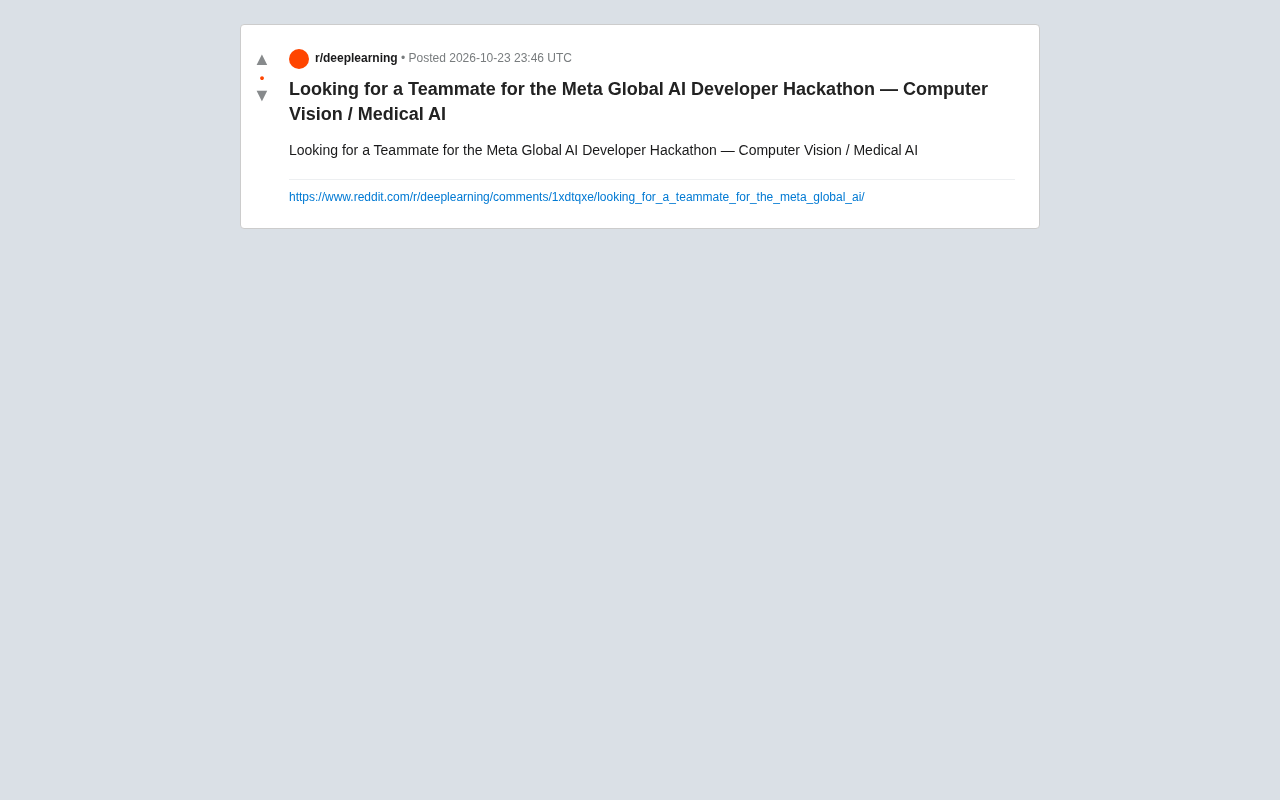
Teammate Wanted for Meta Global AI Developer Hackathon: Computer Vision & Medical AI
A Reddit developer seeks teammates for the Meta Global AI Developer Hackathon, focusing on computer vision and medical AI. This article analyzes the track logic, skills-complementarity needs, and topic selection strategy behind this teaming signal.
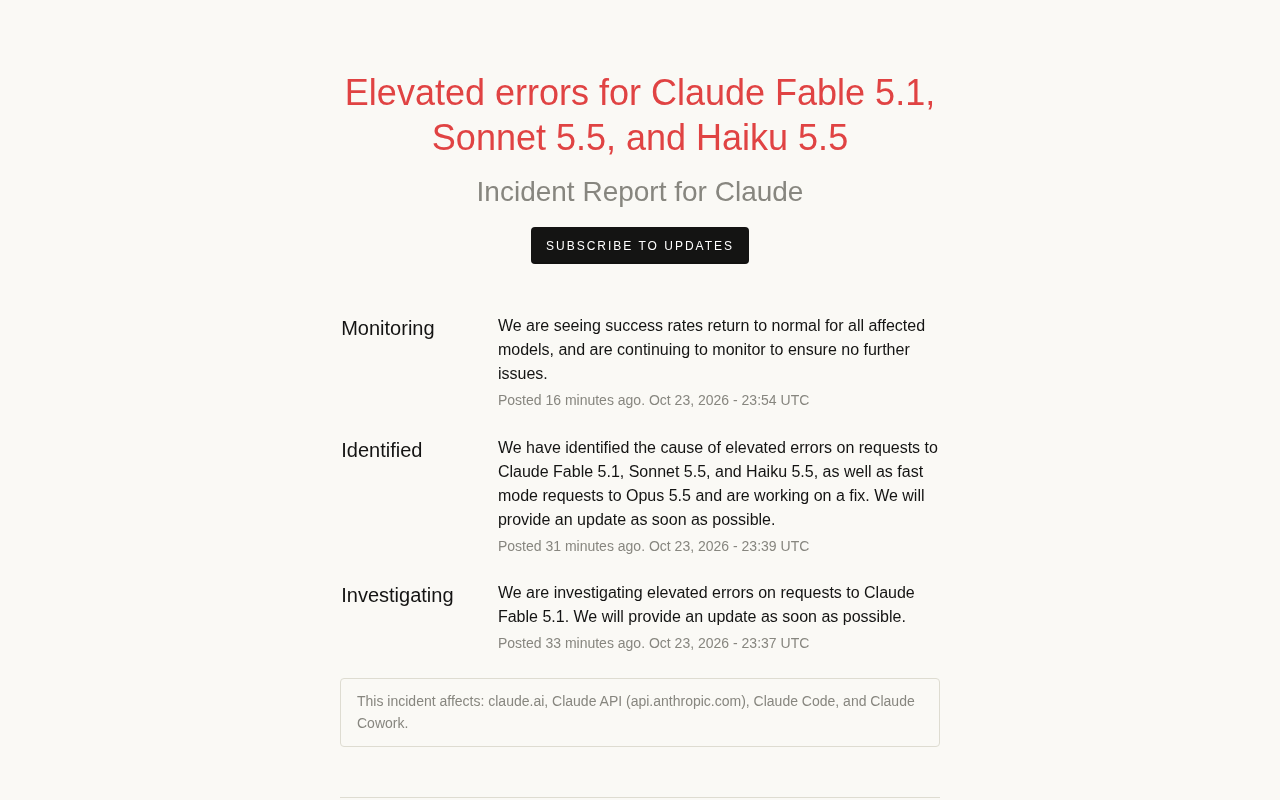
Multiple Claude Models Hit by Errors: A Postmortem of Fable 5.1, Sonnet 5.5, and Haiku 5.5
Claude Fable 5.1, Sonnet 5.5, Haiku 5.5, and Opus 5.5 fast mode saw elevated errors; Anthropic identified and resolved the issue in 17 minutes. This postmortem covers the timeline, the technical reasons for the multi-model cascading failure, and practical lessons for retry and degradation strategies.