AI Daily Briefing: Mistral Large 4 Launches, Major Players Roll Out Dense Model and Tool Updates

Mistral, Google, Anthropic, and OpenAI ship major updates as AI paid adoption and security risks come into focus.
A packed week in AI: Mistral's Large 4 uses a sparse MoE architecture with 1T total / 49B activated parameters, hitting an Intelligence Index score of 38 and set to be open-sourced. Google updated its image model and released the lightweight multimodal EmbeddingGemma 2. Anthropic launched Claude for Google Workspace and moved Claude Code's inference and VMs fully to the cloud. OpenAI simplified API tiers, opened the Decisions API, and launched a meeting notes plugin. A16Z data shows only 4.5% of Americans pay for AI subscriptions, with the top 1% of users driving nearly 20% of spend. GitHub's Git events doubled year-over-year, and security researchers flagged both AI courtroom video risks and an agent log-tampering vulnerability.
Mistral Large 4: The Strongest Model Outside the US and China
Mistral has released a research public preview of Mistral Large 4, scoring 38 on the Artificial Analysis Intelligence Index — tied with GPT-6 Luna at the top tier — making it the highest-scoring model from any vendor outside the United States and China. This result puts Mistral back on the competitive front line in a landscape increasingly dominated by major players.
On the technical side, Mistral Large 4 uses a sparse mixture-of-experts architecture with 1 trillion total parameters and 49 billion activated parameters, supporting a 512K context window. The model is available in public beta on OpenRouter, with a 50% discount on both input and output during the first two weeks — $0.68 and $2.09 per million tokens respectively — and has entered Arena's agent and coding leaderboards. Most notably, Mistral plans to open-source the model weights by the end of this month, meaning a weight set approaching top-tier closed-source model quality will become fully available to the community.
Sparse Mixture of Experts (Sparse MoE) has become the dominant scaling strategy for large models in recent years. Unlike traditional dense Transformers, MoE models split the feed-forward network layer into multiple parallel "expert" sub-networks, with only a few activated during each inference pass — typically selected dynamically by a router based on input token characteristics. The benefit: total parameter count (representing the model's "knowledge capacity") can be made very large, while the number of parameters actually computed in each forward pass (activated parameters) remains much smaller, enabling greater model capacity at lower computational cost. Mistral Large 4's roughly 20:1 ratio between 1 trillion total and 49 billion activated parameters is a textbook example of this design. By comparison, GPT-3 was a 175B fully-activated dense model, while Mixtral 8×7B was Mistral's earlier MoE product activating around 13B parameters per pass. The main challenges of MoE architecture include expert load balancing, communication overhead (experts may be distributed across different devices during multi-GPU training), and VRAM usage during inference — even though fewer parameters are activated, all expert weights still need to be loaded into memory.
Google's Dual Update: Image and Embedding Models
Google has officially released the image model Gemini Nano Banana 2.1, with improvements across visual quality, prompt adherence, multi-turn character consistency, and text rendering. It adds ultra-wide and panoramic aspect ratios with resolution coverage from 1,000 to 4,000 pixels. The previous-generation image model it replaces has entered deprecation and will be shut down on October 29.
Separately, Google DeepMind has open-sourced the multimodal embedding model EmbeddingGemma 2, built on the Gemma 4 architecture with 740 million parameters and released under the Apache 2.0 license. It maps text, code, images, video, and audio into a unified embedding space, enabling cross-modal retrieval on-device. Google claims it improves on the previous generation by nearly 10 points on code retrieval benchmarks. The combination of a small parameter count and an open license makes this type of model well-suited for deploying cross-modal search capabilities locally or on edge devices.
Multimodal Embedding refers to projecting data from different modalities — text, images, audio, video — into a single high-dimensional vector space, where semantically similar content is placed close together regardless of its original form. The core idea draws from contrastive learning, with representative work like OpenAI's CLIP model, which trains on large volumes of image-text pairs to align their vector representations. In this unified space, you can query images with text (or vice versa), and perform cross-modal similarity calculations and clustering. EmbeddingGemma 2 extends this approach to code, video, and audio, making it suitable for building unified vector databases that support semantic search, recommendation systems, and RAG (Retrieval-Augmented Generation) applications. At 740M parameters, it can run locally on edge devices or consumer-grade GPUs, and the Apache 2.0 license permits commercial use and redistribution — making it genuinely deployable in privacy-sensitive or offline scenarios.
Anthropic: From Workspace Integration to Cloud-Based Claude Code
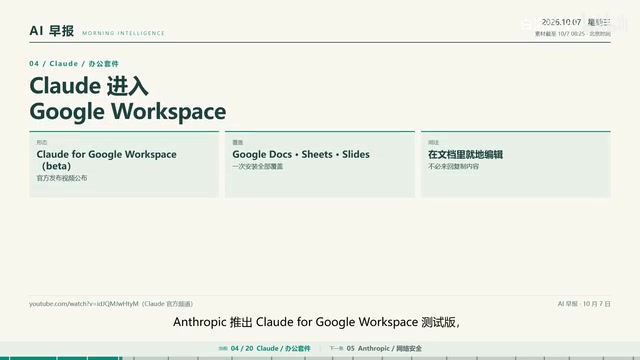
Anthropic has launched a beta of Claude for Google Workspace, which installs once and covers Google Docs, Sheets, and Slides, allowing users to have Claude edit content directly within their documents.
On the security front, Anthropic has merged Project Glasswing with its existing cybersecurity verification program into an expanded offering, issuing cybersecurity capabilities in three tiers: defensive, red team, and specialized. Qualified security teams can apply for higher tiers with fewer restrictions. All three tiers cover Claude Opus 5.0, Sonnet 5.5, and Haiku 5.1, with the specialized tier involving case-by-case review in partnership with the US government.
There's also a major architectural change. Anthropic engineer Felix Riesberg explained the evolution of Claude Code: the old version ran a local virtual machine on the user's computer, with significant disk, battery, and performance overhead, and work would stop when the laptop was closed. The new version moves both model inference and virtual machines to the cloud, with an isolated sandbox for each task. The desktop app handles only tool calls that require local access, such as file operations. Each task runs in its own VM — repositories are cloned to a new branch and can be started and tracked from the web, mobile, desktop, or terminal. When complete, it leaves a branch ready to convert into a PR. Cloud machines are not billed separately and are included in Pro, Max, Team, and Enterprise plans.
OpenAI: Simplified Pricing Tiers and Multiple New Features
OpenAI has simplified its API billing tiers from five down to three — Build, Launch, and Grow — with cumulative top-ups of $5, $100, and $500 required to access each tier respectively, and monthly usage caps of $500, $5,000, and $200,000. Codex lead Tibo noted that the change was aimed at reducing friction when building on the API.
On the feature side, OpenAI's Decisions API is now in public beta for all developers. It uses GPT-6 Luna to directly return decision probabilities, fixed options, or scores for predefined questions — reportedly about 10x faster than calling Luna via the Responses API — and is billed only on input tokens at $0.10 per million. ChatGPT has also launched a Meetings plugin that records meeting notes on the user's behalf and saves personalized summaries and next steps in ChatGPT Space, drawing on ChatGPT's understanding of the user and their work. Notes can be kept private or shared with a team. It's currently in beta for Pro and Business users on the macOS desktop app.
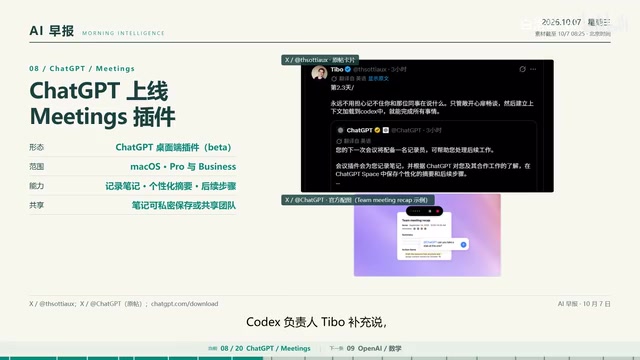
Tibo added that loading meeting context into Codex lets you continue getting things done. OpenAI also published a set of new mathematical results produced by internal frontier models, available in a GitHub repository with paper revisions and citation guidelines. Many proofs have been formalized in Lean for computer verification, and OpenAI says the average compute per result is roughly equivalent to three hours of ChatGPT Pro thinking.
Tibo's Poll and the "Reset" Controversy
One notable side story: Tibo posted a two-option poll on X under the heading "Honestly speaking," asking whether the recent releases deserved positive reviews or warranted a reset. At the time of the screenshot, around 16,000 people had voted, with 78.4% choosing "needs a reset." He posted the same day that the following day would bring either four updates, a reset, or both. The move — directly polling the community on product direction — reflects the complex attitudes users have toward the current pace of rapid releases.
Industry Data and Infrastructure: AI's Real Adoption Rate
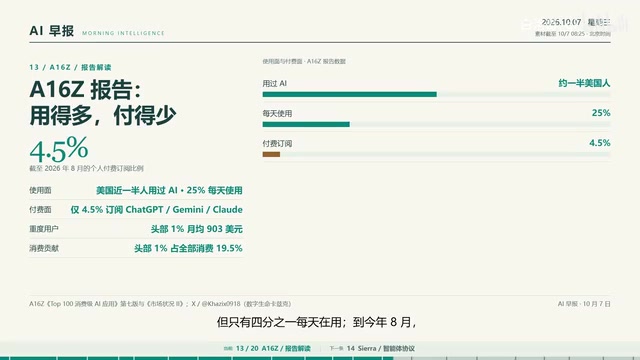
Blogger Katzke analyzed two a16z reports painting a realistic picture of AI adoption: nearly half of Americans have tried AI, but only a quarter use it daily; as of August, just 4.5% of people paid for a ChatGPT, Gemini, or Claude subscription. The payment structure is even more striking — the top 1% of users spend an average of $903 per month, accounting for 19.5% of total spending. This points to an extremely top-heavy AI consumption pattern, with a long road ahead for mainstream paid conversion.
On the infrastructure side, GitHub announced a rebuild of its Git infrastructure to handle agent-scale development workloads. Monthly Git events hit 473.3 billion in August, more than doubling year-over-year. In September, developers and agents generated 7.38 billion commits — more than 5x the figure from a year ago. The new architecture decouples storage and compute, with internal benchmarks showing write throughput improvements of up to 35x. These numbers make the real infrastructure pressure from "agentic coding" immediately tangible.
On the protocol front, Sierra and Meta, along with Genesis, Shopify, Stripe, Walmart, and others, have released the Personal Agent Protocol — an open standard defining how personal agents interact with enterprises. Built on OAuth, consumers decide whether to grant agents read-only or write access; enterprises decide whether agents complete tasks through websites, APIs, or their own agents. The V0.1 spec is expected to be published later this month.
OAuth (Open Authorization), the standard underlying the Personal Agent Protocol, is a widely deployed open authorization framework — the current mainstream version being OAuth 2.0. Its core mechanism: the resource owner (user) requests a limited-permission access token from an authorization server, which a third-party application (the agent) then uses to access the resource server — all without exposing the user's credentials. Tokens carry fine-grained permission scopes (e.g., "read-only contacts" or "write to calendar") and expire automatically. The significance of bringing OAuth into agent protocols is that it provides a mature, auditable permission delegation mechanism, allowing users to explicitly grant or revoke an agent's access to a given enterprise service. Enterprise systems can integrate using existing identity infrastructure without designing a trust model from scratch. Compared to the coarse-grained authorization of traditional API keys, this approach offers substantially better security and control in multi-agent, multi-platform scenarios.
Open-Source Models and Security Warnings
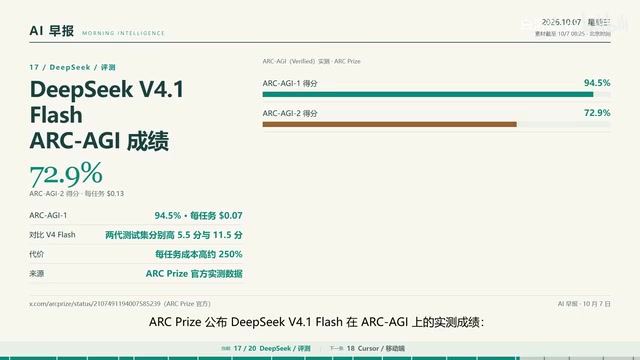
ARC Prize has published benchmark results for DeepSeekAd V4.1 Flash on ARC-AGI: 94.5% on the first generation and 72.9% on the second — up 5.5 and 11.5 points respectively from the best scores of the previous V4 Flash — though at roughly 250% higher cost per task.
Reflection has released the open-source coding model Beam, with 501 billion total parameters and 23 billion activated, targeting coding, agent, and scientific tasks. Trained from scratch, the full weights will be released under Apache 2.0 this month. The company claims a score of 80.9 on SWE-Bench Verified; third-party evaluations place it roughly at the level of GLM 5.2, still trailing the latest frontier open-source models from Chinese developers.
Two security-related stories merit attention. The Arizona Court of Appeals ruled that an AI-generated victim video used in sentencing for a manslaughter case carried excessive emotional weight; the manslaughter conviction was upheld, but the sentence must be reconsidered. Separately, a researcher demonstrated a proof-of-concept using the Inspect evaluation framework's log viewer: with the help of an AI agent, they found a front-end injection vulnerability in about 10 minutes that allowed an agent to rewrite the logs visible to a reviewer, while the actual execution trace remained intact in the database. The team behind Inspect patched the issue within a day of receiving the report and recommended treating AI system outputs as untrusted inputs and approaching observability as safety-critical infrastructure.
SWE-Bench Verified is a benchmark developed by Princeton University specifically for evaluating code agents' ability to solve real-world software engineering tasks. It samples real GitHub Issues and their corresponding Pull Requests, requiring models to automatically generate patches that pass all unit tests given a codebase context and problem description. The "Verified" subset is filtered by human annotators to include only samples with clear problem descriptions and thorough tests, reducing noise. Since tasks come directly from production-grade open-source repositories and involve complex operations like bug localization, understanding call chains, and modifying multiple files, it is considered one of the more demanding benchmarks for practical code agent capability. A score of 80.9 means the model can independently resolve approximately 81% of such real-world software defects. The current top closed-source models peak at around 85%, and leading Chinese open-source frontier models have approached or exceeded that level — providing the quantitative context behind the report's assessment that Beam "still trails the latest Chinese open-source models."
Related articles

M&M's Spent Millions Replacing Artificial Blue Dye — Why Is It So Hard?
Mars spent millions trying to replace artificial blue dye in M&M's with spirulina, but thick material clogs pipes and residue risks mold, forcing a full production-line rebuild. Here's the engineering behind the reformulation.
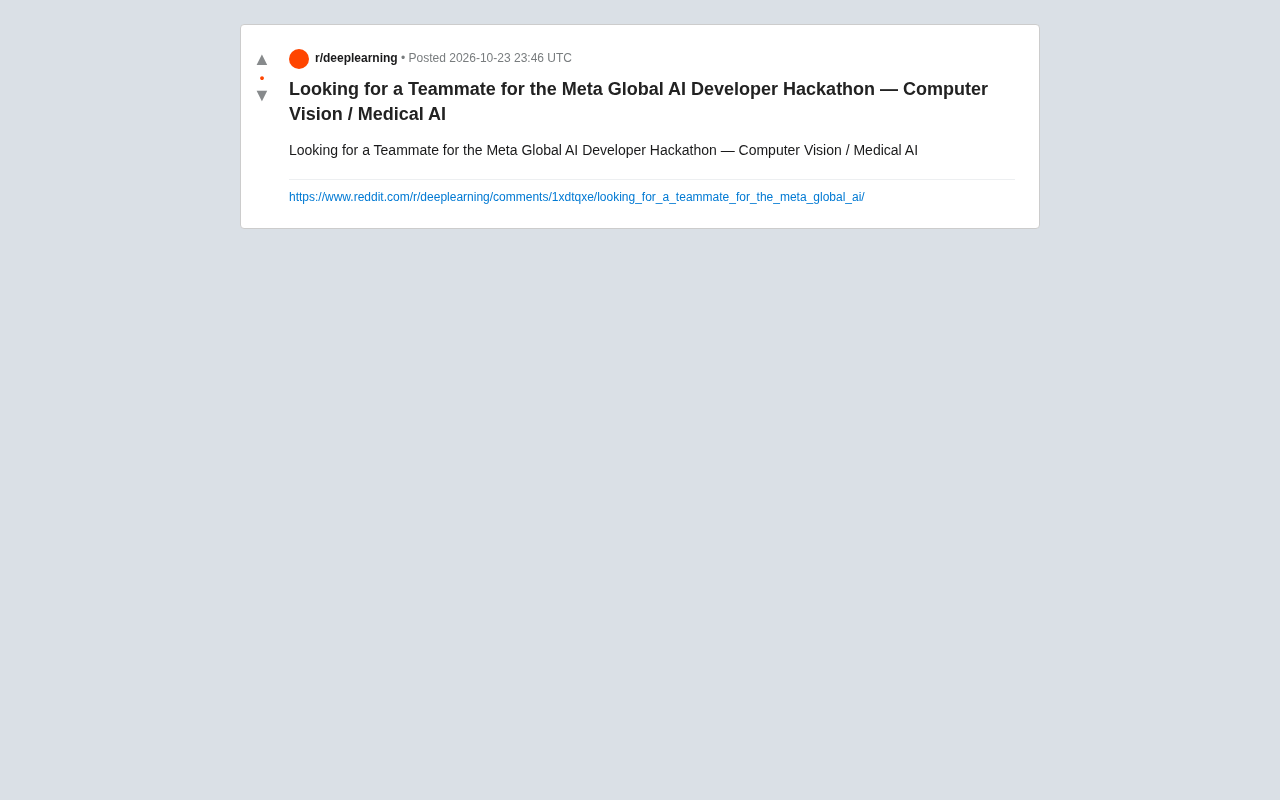
Teammate Wanted for Meta Global AI Developer Hackathon: Computer Vision & Medical AI
A Reddit developer seeks teammates for the Meta Global AI Developer Hackathon, focusing on computer vision and medical AI. This article analyzes the track logic, skills-complementarity needs, and topic selection strategy behind this teaming signal.
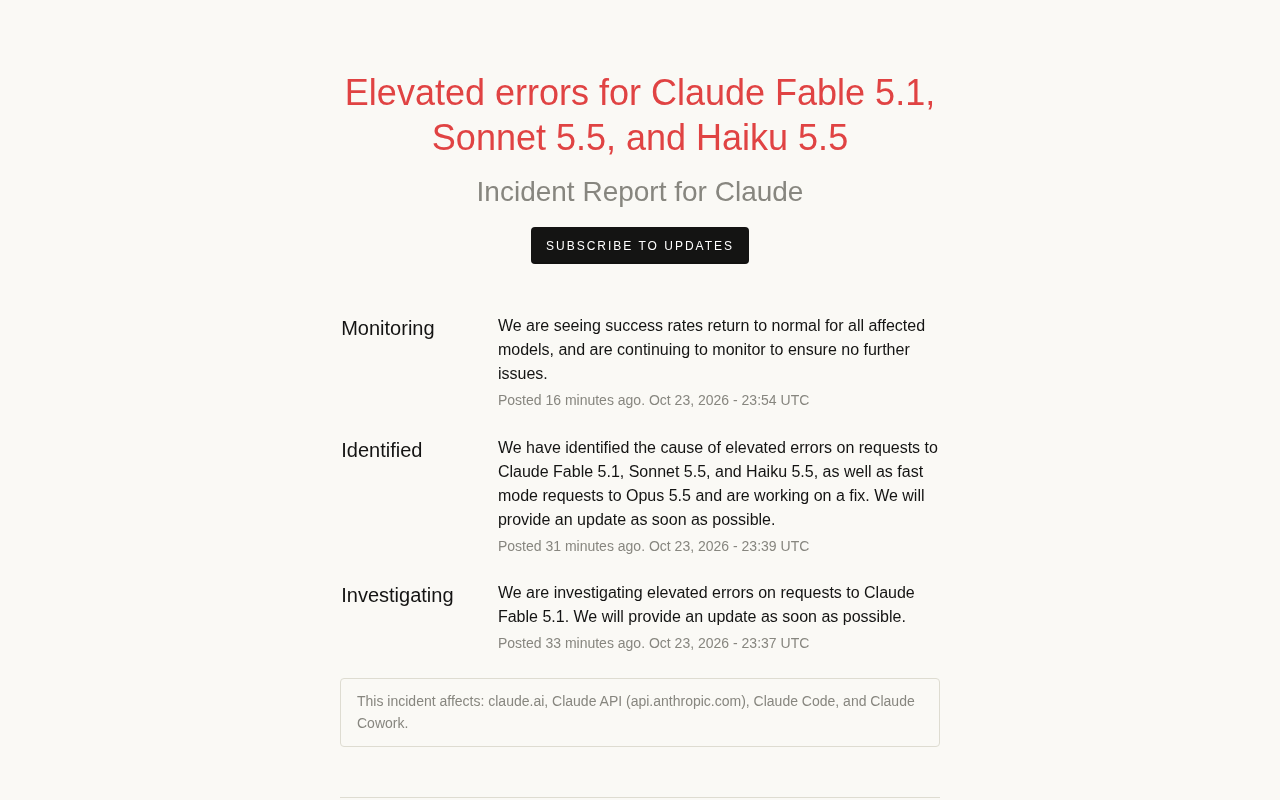
Multiple Claude Models Hit by Errors: A Postmortem of Fable 5.1, Sonnet 5.5, and Haiku 5.5
Claude Fable 5.1, Sonnet 5.5, Haiku 5.5, and Opus 5.5 fast mode saw elevated errors; Anthropic identified and resolved the issue in 17 minutes. This postmortem covers the timeline, the technical reasons for the multi-model cascading failure, and practical lessons for retry and degradation strategies.