AI Daily: GLM Gives Away 100M Tokens, GPT Cuts Prices 20%, AI Agents Enter Feishu Workspace

AI vendors compete with token giveaways, price cuts, and agent integration into workplace tools.
On August 22, the AI industry saw intense competition across multiple fronts: ZCode offered 100M free GLM tokens, OpenAI cut GPT API prices by 20%+, DeepSeek launched a multimodal model, and Kimi's AI colleague Mira embedded directly into Feishu. Image generation gained consistent editing and transparent backgrounds, while NVIDIA released a 550B teacher model and Google's AlphaEvolve improved matrix multiplication bounds.
Introduction: AI Tool Competition Reaches Fever Pitch
The AI industry news on August 22nd was dense and information-rich, spanning model capability upgrades, developer benefits, multimodal breakthroughs, and agent ecosystem expansion — with leading vendors pushing forward on multiple fronts simultaneously. This article distills the day's most valuable developments and analyzes the underlying industry trends: a new phase driven by "usage subsidies," "price wars," and a "multimodal capability race" is arriving.
Usage Subsidies and Price Wars: Vendors Compete for Developers
The most eye-catching developments this period involve aggressive moves on the cost front. ZCode announced it would give new registered users a total of 100 million GLM-5.3 Tokens for free, on a first-come-first-served, limited-time-and-quantity basis (Pacific Time, August 21–23).
Tokens are the basic billing unit for large language models. One token is roughly equivalent to 3/4 of an English word or 1–2 Chinese characters. Models consume tokens when processing user input (prompts) and generating output, so token count directly determines API call costs. While 100 million tokens sounds massive, for enterprise-level applications (such as large-scale document processing or code generation), it may only last a few days. This "large token giveaway" is essentially a classic customer acquisition subsidy, lowering the barrier for new users to try the platform and capture developer mindshare. The strategy borrows from the free-tier acquisition logic of AWS and Google Cloud in cloud computing's early days — once developers build applications on a platform and form dependencies, migration costs ensure long-term retention.
Meanwhile, OpenAI announced that API prices for GPT-5.6 Sol developers will drop by more than 20% over the next three months. A notable detail: in token-based plans, user credits last longer in Codex, while subscription-included quotas remain unchanged — meaning OpenAI's price cut is more geared toward incentivizing heavy API callers rather than regular subscribers.
Even more aggressive is Aux (Auxo)'s stealth model GLM, which claims to open for free next week, supporting 1 million context, multimodal capabilities, and zero data retention, with generous rate limits that allegedly allow processing of 100 trillion tokens per day for near-unlimited use. The context window refers to the length of text a model can "remember" in a single inference pass. Early GPT-3.5 supported only 4K token context, while 1 million tokens of context means the model can process approximately 750 pages of English text or an entire medium-sized book in one go. Achieving ultra-long context requires overcoming the quadratic complexity problem of attention mechanisms in the Transformer architecture, with common technical approaches including Sparse Attention, sliding window attention, and extrapolation optimization of RoPE positional encoding. Zero data retention means the platform commits to not storing users' input and output data, which is critical for enterprise users handling sensitive business information.
When "nearly free" becomes the strategy for some vendors, we can expect AI inference costs to decline far faster than previously anticipated.
Multimodal and Reasoning Capabilities Continue to Break Through
DeepSeekAd launched its experimental multimodal model V4-Flash-Vision-EXP on its API platform. Its text capabilities match V4 Flash, covering agents, reasoning, and world knowledge, while achieving significant improvements on multimodal agent benchmarks compared to V4 Flash, with performance approaching Opus 4.8 levels. This marks the transition of multimodal agents from "being able to see images" to the practical stage of "being able to execute tasks based on vision."
NVIDIA released a 550B parameter instruction-following teacher model on Hugging Face, emphasizing its strength in constraint following, structured output, and format control, making it particularly suitable for distillation and data generation. Knowledge Distillation is a model compression technique proposed by Hinton et al. in 2015, whose core idea is to use the output distribution of a large "teacher model" to guide training a small "student model," allowing the student to retain as much of the teacher's capability as possible despite having far fewer parameters. The strategic significance of NVIDIA releasing a 550B parameter teacher model is that developers can use it to generate high-quality synthetic training data, or directly distill models at 70B or even 7B scale for production deployment, thereby reducing inference costs by one to two orders of magnitude. Instruction-following capability is particularly critical for teacher models, as it determines whether the generated training data strictly conforms to expected formats and constraints.
Additionally, Google released TIPS-VR, available in four scales, each equipped with a general image-text encoder and a DPT version for dense visual tasks, under the permissive Apache 2.0 license. Zero-shot Segmentation refers to a model's ability to accurately segment target objects in images without having seen specific category training samples, requiring strong vision-language alignment capabilities. DPT (Dense Prediction Transformer) is a method that applies the Transformer architecture to dense prediction tasks (such as depth estimation and semantic segmentation). The Apache 2.0 license is one of the most permissive open-source licenses, allowing commercial use, modification, and redistribution. The model achieves SOTA on all four zero-shot segmentation benchmarks and ranks in the top two across multiple image-text and image-only evaluations, demonstrating that open-source vision models are rapidly approaching closed-source levels.
Agent Ecosystem: From "Conversation" to "Digital Colleague"
In this period's developments, the product form of AI agents is undergoing a qualitative shift — evolving from passive conversational interfaces into "digital colleagues" that actively participate in workflows.
Kimi's AI colleague Mira has officially entered Beta testing, with its biggest highlight being its residency within Feishu (Lark), requiring no app switching. Team members can assign tasks to her just like @mentioning a real colleague, and she continuously organizes messages in the background, performs scheduled checks, follows up on projects, and sends task reminders. This "embedding into existing collaboration tools" approach represents an important paradigm shift for AI agents: from "users actively visiting AI" to "AI actively integrating into users' existing workflows." Slack's AI features and Microsoft 365 Copilot follow similar logic — rather than requiring users to learn new tools, inject AI capabilities into the tools they already use. The ability to run continuously in the background and perform scheduled checks means such agents need long-term memory management, task scheduling, and event-driven triggering capabilities, essentially functioning as a persistent asynchronous agent system far beyond traditional single-turn dialogue models.

OpenAI launched an Apple Messages plugin — after connecting ChatGPT Work and Codex desktop, ChatGPT can directly search message history on Mac, summarize chat records, identify people and items needing follow-up, and even draft and send replies on behalf of users. This move signifies AI penetrating into OS-level daily communication scenarios.
On the coding agent front, Google DeepMind introduced remote control functionality for its Anti-Gravity programming agent, allowing developers to manage and monitor their agents across devices through a standard web browser, currently available only to Ultra users.
Two Major Pain Points in Image Generation Solved: Consistent Editing and Transparent Backgrounds
Two highly practical updates emerged in the image generation domain. Microsoft AI released the image model MyImage 2.6, capable of modifying image colors, styles, and visual details while maintaining consistency across multiple iterations. Consistent Editing refers to modifying certain attributes of an image while keeping other elements (such as subject identity, spatial layout, and lighting relationships) unchanged. This is technically extremely challenging because the generation process of Diffusion Models is inherently stochastic — even with identical text prompts, each generation produces different results. Solutions typically include Image Inversion (mapping the original image back to latent space for editing), Attention Injection (maintaining structural consistency), and ControlNet-based conditional control. MyImage 2.6's ability to maintain consistency across multiple iterations suggests it may incorporate identity anchoring or reference image conditional generation mechanisms — addressing precisely the biggest shortcoming of generative image editing to date.
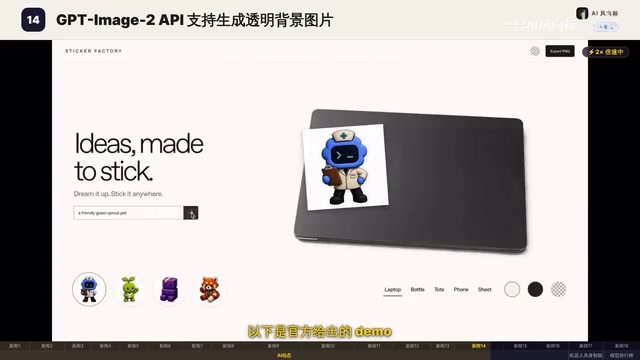
OpenAI's GPT Image 2 API added support for generating images with transparent backgrounds, allowing developers to directly obtain transparent channel assets without manual background removal. The community has long complained about insufficient transparent background support, and this feature is highly significant for product photography, web design mockups, and marketing posters — generated images can be directly layered onto different backgrounds.
Additionally, DeepSeek launched a free Files API where images only need to be uploaded once and can be repeatedly referenced via File ID, significantly saving request bandwidth — a major benefit for developers making high-frequency multimodal API calls.
Frontier Research and Hardware Developments
Worth highlighting separately, Google DeepMind used AlphaEvolve to improve the best-known theoretical bounds for matrix multiplication. Matrix multiplication is the core operation in virtually all scientific computing and deep learning. The naive algorithm has O(n³) time complexity; in 1969, Strassen first proved it could be done in sub-cubic complexity, and researchers have spent decades since pushing down the upper bound of the matrix multiplication exponent ω. The theoretical lower bound of ω is 2 (linear complexity), with the previous best record at 2.371339. The AlphaEvolve system repeatedly modifies and optimizes researchers' code, automatically exploring the algorithm improvement space through evolutionary search strategies, helping find better matrix multiplication bounds than the previous record — further compressing the matrix multiplication exponent Omega. Even improvements in the fourth decimal place can translate to significant computational savings in ultra-large-scale matrix operations. This is another milestone in AI-assisted mathematical research, demonstrating that AI doesn't replace mathematicians but rather finds optimization paths in vast search spaces that humans cannot manually exhaust.
On the open-source data front, OpenBMB released UltraFineWeb, an open English web corpus for LLM pre-training, totaling over 1 trillion tokens and approximately 1.14 billion documents, all sourced from Common Crawl and released under the Apache 2.0 license. Common Crawl is an open web crawl dataset maintained by a nonprofit organization that has continuously crawled internet content since 2008, currently storing over 250PB, serving as the upstream source for the vast majority of open-source LLM pre-training data. UltraFineWeb's value lies in its fine-grained cleaning and deduplication processing, offering significantly higher quality compared to raw Common Crawl data.
In robotics, Yushu Technology released its first product after IPO — a bionic seven-axis robotic arm equipped with dexterous hands, starting at 9,900 RMB (approximately $1,471 USD), featuring high-precision seven-axis bionic joints. Two coordinated arms can achieve material sorting and assembly, with open programming interfaces. The seven-axis design adds one redundant degree of freedom compared to the six-axis arms common in industry, enabling it to perform delicate operations while avoiding obstacles like a human arm — critical for executing complex tasks in confined spaces.
Model Capability Rankings: Multiple Powers, No Single Dominance
On the latest AI model capability rankings, competition has reached fever pitch:
- Agent Ranking: Cloud Opus 5 Max, GLM-5.3, and Grog 4.6 tie for first place at 59 points — no single model dominates;
- Intelligence Ranking: Cloud Opus 5 Max tops with 63 points, Cloud Fable 5 follows with 62, while GPT-5.6 Sol and Grog 4.6 tie for third at 61.
The rankings reveal that capability gaps between top models are narrowing — the "one superpower, many strong" pattern has been replaced by "multiple powers standing equal." The underlying reason for this trend is that as model architectures (Transformer and variants), training methods (RLHF/DPO alignment), and data scales all converge toward homogeneity, vendors' differentiation advantages are shifting from "base model capability" to engineering and product dimensions like "inference efficiency," "tool integration," and "ecosystem lock-in."
Conclusion
Synthesizing the day's developments, the AI industry is exhibiting three clear storylines: continued cost reduction (token giveaways, API price cuts, near-free inference), multimodal and agent-centric capabilities (visual agents, AI colleagues embedded in collaboration tools), and rapid catch-up by the open-source ecosystem (NVIDIA teacher model, Google TIPS-VR, UltraFineWeb corpus). For developers, this means both lower barriers to entry and more intense technology selection decisions — in an era where model capabilities are converging toward homogeneity, API stability, ecosystem toolchain completeness, and long-term pricing commitments are becoming the key factors in platform selection.
Key Takeaways
Related articles

Apple HomeView Hands-On Review: Is the $300 Smart Home Hub Worth It?
Apple HomeView hands-on: a $300 smart home hub with facial recognition for quick account switching, but no App Store or voice recognition. Is the wall-mounted version worth it? Should you buy the first generation?

Meta Muse Wonder Launch: What It Means for Meta's Return to the Frontier AI Race
Meta releases Muse Wonder and WonderFull, benchmarks reach the frontier, community feedback is polarized. An in-depth look at Meta's return to the frontier AI race, its personal agent strategy, and Zuckerberg's different path.

Apple Home Smart Home Lineup Leaked: LG and Schneider Team Up, UWB Door Lock on Board
Apple Home ecosystem gains new LG and Schneider devices: UWB smart lock with proximity unlock, 2.5K dual-camera doorbell, privacy indoor camera, and AirPods-like seamless pairing.