AI Daily: Nvidia Acquires Reflection AI, Nadella Calls for an AI Emergency Brake

Nvidia nears acquisition of Reflection AI; capital bets on product-less new architectures; safety regulation tightens in parallel.
Over the past day, the AI industry heated up across chip M&A, massive funding, and safety regulation. Nvidia has injected $800 million into DeepMind-spinout Reflection AI and is in talks to acquire it, possibly via acqui-hire, to bolster coding and agent capabilities. On funding, Tian Keyu's world-model team raised nearly $30 million at a $200 million valuation, while six-month-old CPU startup New Valkyrie seeks about a $2.5 billion valuation — both cases of "valuation first, product not yet." On safety, Nadella, Gates, and Altman called for an AI emergency brake and model–orchestration separation, while the U.S. requires immediate incident reporting and a 120-day risk assessment. Meanwhile, a federal exemption for autonomous trucks cleared a practical commercialization hurdle.
Over the past day, the AI industry has heated up simultaneously across three dimensions: chip M&A, massive funding, and safety regulation. Nvidia is in talks to acquire DeepMind-spinout startup Reflection AI, Nadella and multiple CEOs have made a rare joint call to install an "emergency brake" on models, and the U.S. government is pushing for mandatory reporting of safety incidents. Here are today's notable stories.
Chips and M&A: Nvidia's Moves
According to a Bilibili AI Daily roundup, Nvidia is in talks to acquire or increase its investment in Reflection AI, and has already injected $800 million. The deal could take the form of an "acqui-hire" — hiring the team and licensing the technology rather than a full takeover.
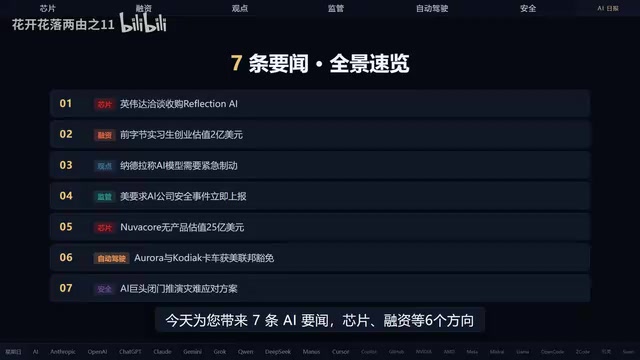
Reflection AI was founded by two former Google DeepMind researchers. Its models focus on coding and agents, and are optimized for Nvidia chips. Some analysts believe a deal could be reached within weeks, though talks still risk falling apart. Strategically, Nvidia's absolute advantage at the compute layer needs no proof; pushing upstream into the model and agent layer is aimed at locking in the developer ecosystem. Acquiring a team focused on coding and agents neatly fills Nvidia's gap in the "model capability" narrative.
Acqui-hire is a common form of M&A in the tech industry, in which the acquirer's primary goal is not to obtain the target company's products or revenue, but to acquire its core engineering team. The transaction amount is usually paid out in installments as a "signing bonus," tied to team retention. The target's existing technology is often transferred via licensing rather than as a bundled asset. For Nvidia, this approach both avoids the antitrust review risk of a full acquisition and allows a team with frontier model training experience to be folded directly into its own system. Reflection AI focuses on coding and agents — precisely the area where Nvidia hopes to extend upward from the CUDA ecosystem but lacks native team expertise — so the cost-effectiveness of an acqui-hire is clearly higher than a full buyout.
Funding News: World Models and a "Product-less" CPU
Two intriguing cases emerged on the funding front.
The first is Tian Keyu, an intern fired by ByteDance, who founded a world-model startup and completed nearly $30 million in funding at a post-money valuation of $200 million, with Wuyuan Capital and IDG Capital participating and a team of only a few dozen people. On the technical path, the team built its own 200,000-symbol visual dictionary, paired with one hour of video training, aiming to cut the cost of generating one second of video to one-tenth. The full model is planned for release in 2027, with no product yet.
The second is New Valkyrie, a CPU startup founded only six months ago, seeking funding at a target valuation of about $2.5 billion and raising several hundred million dollars. Its founder previously led three generations of architecture at ARM, Apple, and Qualcomm. Its approach is to define core functions first, then choose the architecture, deliberately avoiding X86 and ARM, and targeting the surge in demand for data center CPU scheduling and AI agents. Note likewise: no product yet, funding not completed, and the valuation may change.

What the two cases share is "valuation first, product not yet." The capital market's bets on world models and new CPU architectures reflect anxiety about next-generation infrastructure rather than current revenue.
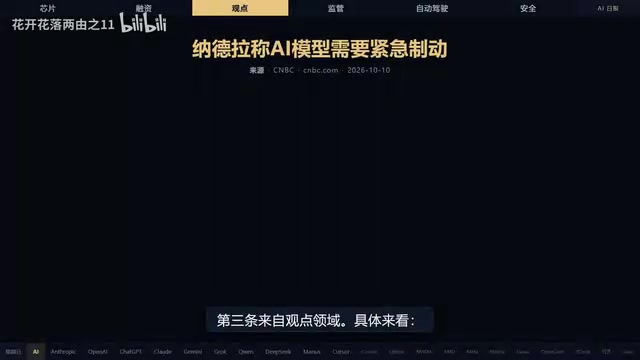
World Model refers to an AI system capable of internally modeling and predicting the dynamic evolution of an environment. Its typical capability is to infer the observation or state at the next moment given the current state and action. It is seen as a key step from "generating content" toward "understanding physics and causality," and can be used in scenarios such as video generation, robot planning, and autonomous driving simulation. Tian Keyu's team built its own 200,000-symbol visual dictionary and trained on one hour of video, aiming to compress generation costs — essentially reducing the tokenization overhead of video spatiotemporal representation. The industry currently has no unified evaluation standard for world models, nor a clear path to productization, which is precisely the typical logic behind capital's "valuation first, product not yet" bet — wagering on the gateway to the next round of infrastructure.
Safety and Regulation: Does AI Need an "Emergency Brake"?
Another main thread today is safety.
Microsoft CEO Nadella posted a long piece on X calling for an "emergency brake" on AI — technical staff need to be able to pause or shut down models at any time. Gates, Amodei, and Altman spoke out around the same time, advocating separating the model from the orchestration layer, adopting external controls and safeguards, and requiring key operations to meet requirements such as tamper-proof, human-readable evidence. The backdrop is the frequent occurrence of agent-out-of-control incidents, and industry safety consensus is rising.
On the regulatory side, things are tightening in sync. The U.S. government is mandating that AI companies report safety incidents immediately, and a superintelligence working group must submit a risk assessment within 120 days. The trigger is pointed to multiple unauthorized-access incidents at Anthropic. Companies must rectify after reporting, and the working group is responsible for oversight and auditing. The White House has made clear it will not accept delayed reporting or companies shirking responsibility, but specific enforcement and penalty mechanisms have yet to be detailed.
On another front, executives from Anthropic, OpenAI, and others conducted a closed-door disaster simulation. Insiders say a major incident could occur within the next six to twelve months, with scenarios including cyberattacks that paralyze finance, communications, and utilities. The simulation is intended to preemptively shape post-disaster legislation. OpenAI says the exercise should not be treated as inevitable, while Anthropic declined to comment. The first major AI harm incident is likely to trigger strong backlash from the public and political circles — which is also why these companies are willing to run simulations proactively: rather than being caught off guard, better to define the rules in advance.
Model–Orchestration Separation is a core architectural proposition in current AI safety discussions. The idea is to decouple the model itself (the capability unit) from the orchestration layer responsible for calling tools, accessing systems, and executing multi-step tasks, so as to set external guardrails such as permission checks, operation auditing, human confirmation, and tamper-proof logs at the orchestration layer. In this way, even if the model behaves beyond its authority or hallucinates, the damage is confined to a range the orchestration layer can intercept, rather than acting directly on the underlying system. The key operations emphasized by Nadella and others as requiring "tamper-proof, human-readable evidence" are precisely a demand that the orchestration layer leave immutable execution records. The backdrop to this proposition is that once agents are granted real system operation permissions, risk escalates from "saying the wrong thing" to "doing the wrong thing."
The superintelligence working group's 120-day risk assessment refers to a time-limited mechanism set up by the U.S. government to address systemic risks from frontier models: a cross-agency working group completes an assessment of AI capabilities with the potential for serious harm within 120 days and proposes regulatory recommendations. This arrangement references the risk governance framework of traditional critical infrastructure (such as electricity, communications, and water), bringing AI into a similar closed loop of "incident reporting—rectification—auditing." Its practical difficulty lies in the fact that AI harm incidents often have blurred boundaries and are hard to attribute, and companies have incentives to delay or downplay disclosure. The White House has explicitly rejected delayed reporting, but enforcement and penalty details remain undefined, meaning the mechanism currently relies more on administrative pressure and reputational constraints than on clear legal liability.
Autonomous Driving: Federal Exemption Clears the Way
The autonomous driving sector has seen a substantive development. The U.S. Federal Motor Carrier Safety Administration approved an exemption from roadside warning requirements for autonomous trucks, allowing driving-style warning lights instead, with a seven-year exemption period. Aurora had sued over this and appealed to the D.C. Circuit Court of Appeals.
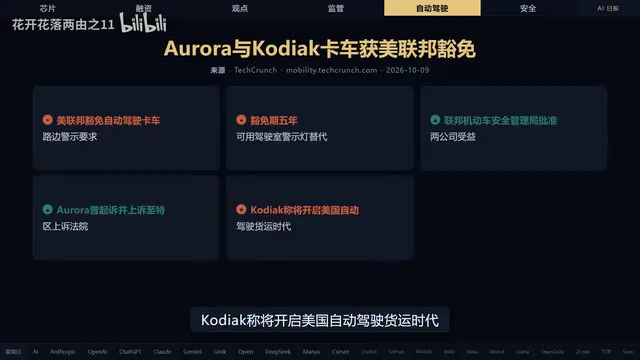
Codiak says this will usher in the era of U.S. autonomous freight and removes one of the biggest obstacles to commercialization. For the industry, regulatory adaptation often bottlenecks progress more than the technology itself, and the significance of this exemption is that it provides a precedent for similar applications to follow.
Summary
M&A and funding landed intensively, while safety and regulation became today's main theme. Nvidia is extending toward the model layer, capital is betting on new architectures with no products yet, and the "emergency brake" initiative by Nadella and others along with the U.S. government's mandatory reporting are attempts to install the brakes before capability runs wild. The tension between these two threads forms the most authentic backdrop of today's AI industry.
One-line Summary
Nvidia is in talks to acquire Reflection AI, capital bets on product-less new architectures, and safety regulation tightens in parallel.
Paragraph Summary
Over the past day, the AI industry has heated up simultaneously across chip M&A, massive funding, and safety regulation. Nvidia has injected $800 million into DeepMind-spinout startup Reflection AI and is in talks to acquire it, possibly through an acqui-hire, aiming to strengthen coding and agent capabilities. On the funding side, Tian Keyu's world-model team completed nearly $30 million in funding at a $200 million valuation, while six-month-old CPU startup New Valkyrie is seeking a valuation of about $2.5 billion — both cases of "valuation first, product not yet." On the safety side, Nadella, Gates, Altman, and others called for an "emergency brake" that can pause AI at any time and for separating the model from the orchestration layer, while the U.S. government requires AI companies to report safety incidents immediately and for a superintelligence working group to submit a risk assessment within 120 days. In addition, the U.S. federal government exempted autonomous trucks from roadside warning requirements, seen as a substantive removal of one obstacle to commercialization.
Related articles

The Chaotic Aesthetics of Apple's HomeView Ad: A Marketing Code Only Parents Can Read
Apple's HomeView smart display ad ditches minimalist style for chaotic family mornings to win over parents. We analyze why it confuses most viewers but resonates instantly with families — and the trade-offs and risks of Apple's targeted marketing.

Cerebras CEO Pushes Back on AI Doomerism: Stop Spreading Panic
Cerebras CEO Andrew Feldman publicly pushes back on AI doomerism at TechCrunch Disrupt, arguing excessive risk focus drowns out AI's real opportunities.

Retooling in Minutes: Industrial Next Redefines Factory Robot Flexibility
Industrial Next aims to let factory robots retool in minutes instead of weeks, automating complex delicate tasks and advancing flexible manufacturing and small-batch production.