AI Evening Report: DeepSeek Coding Plan Rumors and FlashTopK Open-Source Speedup

DeepSeek plan rumors, giant agent payment clashes, and FlashTopK open source shape a new AI landscape
Today's AI news is dense: DeepSeek's web frontend code showed quota reminders and competition numbering, sparking coding plan speculation, though there is no official confirmation and an alternative explanation of reverse-proxy rate limiting; OpenAI launched ChatGPT Wallet and Google Gemini connected to Google Wallet, forming agent payment closed loops on the same day; Tencent Hunyuan and the University of Edinburgh open-sourced FlashTopK, cutting sparse attention TopK selection time from 5.32 seconds to 1.62 seconds, about a 70% speedup. In addition, Claude Code multi-thread collaboration and Google AntiGravity dynamic workflows iterated rapidly; the Coding Agent Index 2.1 shows Claude's two models tied for first, while DeepSeek V4.1 Flash costs only about $0.30 per task, nearly 10 times cheaper than Kimi, and the proactive agent benchmark reveals a cost gap of about 430 times.
Today's AI Quick Look: From Rumors to Hardcore Open Source
Today's AI world is packed with high-density information: DeepSeekAd is rumored to possibly launch a coding plan, OpenAI and Google clashed on the same day in the agent payment scenario, and Tencent Hunyuan teamed up with the University of Edinburgh to open-source the FlashTopK operator, cutting the sparse attention bottleneck time by about 70%. These developments all point to one trend—AI tools are shifting from single-capability competition to an all-around battle over cost, payment closed loops, and underlying efficiency.
DeepSeek Coding Plan Rumors: Developer Anticipation Mixed with Cool Skepticism
Community reports indicate that developers found complete quota synchronization, exhaustion reminders, reset notifications, and server-side rate-limit warnings in DeepSeek's web frontend code. On the same day, a domestic offline competition page showed the text "DeepSeek V4.1 Flash 1114," and combined with the fact that V4.1 Flash 1017 had been released for a full four weeks, many netizens speculated that DeepSeek might launch an official coding plan.
This speculation is not unfounded. DeepSeek previously offered only token-billed APIs and free chat, while third-party coding plans had already stuffed over $100 worth of V4.1 Flash usage into the $10 tier. If DeepSeek enters the fray with a monthly coding subscription, it would inevitably rewrite the cost landscape of AI coding tools.
However, cool skepticism quickly emerged in the community. Some tech bloggers believe that the frontend's 5-minute polling and alert pop-ups may simply be used to limit web chat and prevent reverse-proxy abuse of compute, and the scale may not support a monthly plan; others pointed out that the "1114" number is merely the name of a shared instance deployed by the competition organizing committee. As of press time, DeepSeek has not released any plan announcement, and its pricing page still only retains pay-as-you-go billing.
Agent Payment Closed Loop: OpenAI and Google Clash on the Same Day
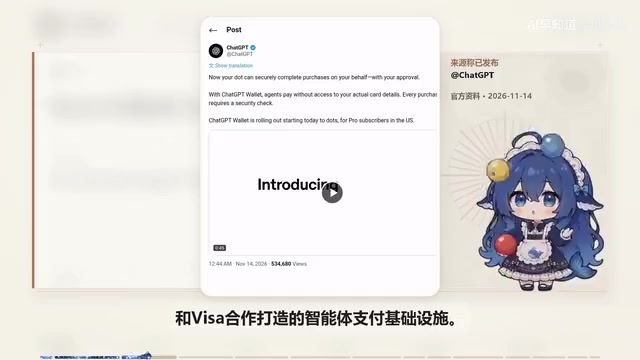
OpenAI officially announced the launch of the ChatGPT Wallet. After users authorize and approve its Dots agent, the agent can place orders and complete checkout on their behalf. The core mechanism lies in full-chain isolation: the agent never has access to the real bank card number, and every purchase must pass a security verification step. The feature is first rolling out to Dots for Pro subscribers in the United States. OpenAI's president revealed that this is agent payment infrastructure built in partnership with American Express, Mastercard, and Visa.
On the very same day, Google announced that Gemini's personal intelligence feature now connects to Google Wallet, directly available to all Gemini users in the United States. Users can also link credit cards and bank accounts through Plat, allowing Gemini to provide personalized spending analysis and financial advice based on real transaction data. The two giants facing off on the same day in the agent consumption scenario means that personal assistants are moving from read-only Q&A to account management and secure payments, and the commercialization gateway is rapidly taking shape.
Tokenization and Authorization Delegation in Agent Payments: Letting AI place orders on behalf of users—the core difficulty is not calling the payment API, but how to complete identity and quota verification without letting the agent touch the real card number. The industry-standard approach is tokenization: the card network or payment service provider issues a one-time or limited-amount virtual credential, the agent holds only that token, and the merchant side verifies with the issuer. Combined with OAuth-style user authorization delegation, this enables "user authorizes once, agent pays autonomously within agreed limits and merchant scope," while retaining per-transaction secondary verification (such as biometrics) as a risk-control gate. OpenAI's emphasis on building infrastructure with Amex, Mastercard, and Visa is exactly a manifestation of this layer.
GPT-6.2 Suspected Delay: Official Documentation Edits Spark Speculation
Blogger ZX0603 dug up a timeline comparison: on November 10, OpenAI's official API documentation page still stated "applicable to 6.2-level updated models," but by November 13, all 6.2-related wording on the same page had been completely removed and rewritten. Around the same time, a large number of users in the Linux.do community reported that their 6.2 SOUL and Astra gray-test permissions had been revoked.
Various speculations have circulated in the community: one leak summary claims that Astra was postponed and sent back for rework due to performance falling short of expectations, and may be directly renamed GPT-6.5, while SOUL is still proceeding as planned; another theory guesses it is related to the upcoming IPO timing competition between the two giants, with new moves expected before November 19. The blogger also warned developers not to spend money on so-called 6.2 APIs at relay stations, as testing shows they are not genuine. None of the above rumors have been officially confirmed.
High-Density Iteration of Developer Tools: Claude Code and AntiGravity
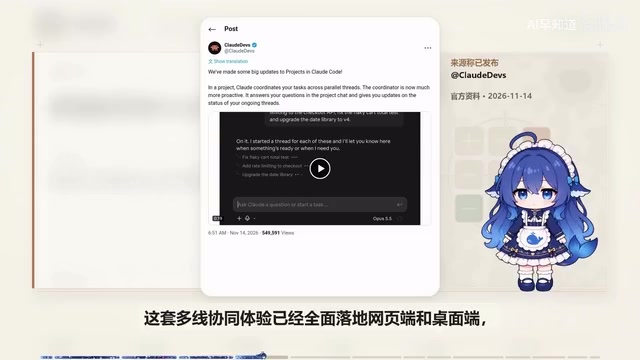
Anthropic officially announced a major upgrade to Claude Code project features. The coordinator that originally managed multiple parallel threads is now more proactive, answering questions directly in the project chat box and syncing progress across threads. Users can also directly invoke the slash BTW and slash Fork commands within a project; when an ad-hoc task comes up, they only need to open a separate thread without interrupting the current mainline at all. Pinned artifacts and read-only share links have been added at the top of threads. The multi-thread collaboration experience is now fully available on web and desktop, and mobile has also received a brand-new interface design, with project settings and local folder authorization flows significantly simplified. At the same time, the desktop version of Claude Code has opened up module-based custom themes—developers can describe desired color schemes or dynamic backgrounds in natural language, or load vision plugins, to directly customize the interface. Local drawing is currently supported and will soon extend to the cloud. Both official announcement posts have exceeded 540,000 views.
Google's developer tool AntiGravity, meanwhile, unveiled a new solution for out-of-control multi-agent systems, officially launching dynamic workflows. When developers enter the slash Run Workflow command, the agent automatically writes a Python script to orchestrate parallel and serial sub-agents and complete structured task handoffs. This design replaces error-prone prompt drift with deterministic code control flow; users can review the script content before running and can directly save templates for repeated execution at any time.
Alongside the toolchain upgrade, Gemini 4 Hydrogen accelerated its push into mainstream developer ecosystems the same day. GitHub Copilot's app command line and VS Code have fully integrated Hydrogen, and the GitLab Duo agent platform has also introduced Gemini 4 Carbon Hydrogen, Kimi K3.1 Pro, and Claude Mythos 5.2 for business-logic security analysis. Official documentation shows that Hydrogen will offer four levels of thinking intensity to free and Plus users. Multiple bloggers reported that AntiGravity reset Gemini quotas again after about 7 days, and AI Ultra users testing three fourth-generation models in a row even approached exhausting their weekly quota for the first time.
Coding Agent Leaderboard Shuffle: Staggering Cost Gap
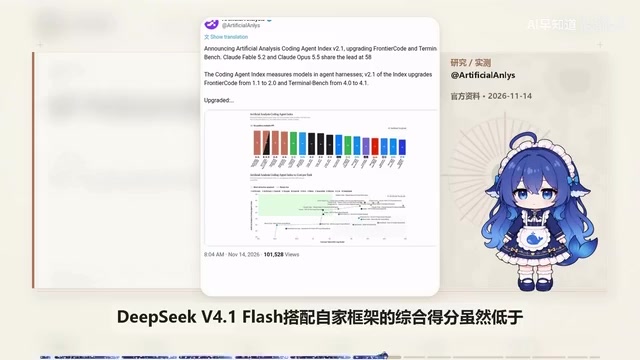
Artificial Analysis officially released version 2.1 of the Coding Agent Index, upgrading Frontier Code to 2.0 and the terminal benchmark to 4.1, specifically assessing the real engineering combat power of large models when placed inside agent frameworks. In the latest rankings, Claude Fable 5.2 and Claude Opus 5.5 tie for first place overall with 58 points each, firmly holding the top tier of high-end coding agents.
But shifting to the cost-effectiveness dimension, domestic models show a staggering cost gap among themselves. In the included domestic comparison, DeepSeek V4.1 Flash paired with its own framework scores lower overall than Kimi K3.1 Pro with Kimi Code and GLM 5.3 with OpenCode, but it pushes average per-task cost down to about $0.30, nearly 10 times cheaper than Kimi's $2.94, making it highly attractive to teams running automated tickets at scale.
Coding agents are also extending toward full application hosting. Cognition officially announced Dywin Apps, allowing developers to run private, secure, and shareable web apps directly in Dywin's cloud computer environment. According to the official positioning, these apps can be used to build internal enterprise tools and preview deployments, and can also in turn extend Dywin's own capability boundaries. The announcement post has reached about 160,000 views. Competition for browser-entry agents is also heating up: leak account Testing Catalog found that Meta's MUSE personal agent is about to launch a Chrome browser extension that can directly operate on the web page the user currently has open—filling out forms, comparing product prices, and even following up on order refunds—while emphasizing that control always remains in the user's hands.
Evaluation Logic of the Coding Agent Index: Unlike traditional code completion benchmarks, this type of index embeds models in real agent frameworks to run—the model must autonomously read and write files, execute commands, iterate and fix based on test feedback, and is ultimately scored by task pass rate. Therefore, scores reflect both model capability and the engineering quality of the accompanying framework (tool-calling format, context management, retry strategy); the scores of different vendors' "model + own framework" combinations cannot be simply equated with raw model strength. This is also why the leaderboard simultaneously tracks average per-task cost: in multi-turn tool-calling scenarios, token consumption per task can reach tens of thousands to hundreds of thousands, and unit price differences are magnified exponentially.
FlashTopK Open Source: Sparse Attention Bottleneck Sped Up by About 70%
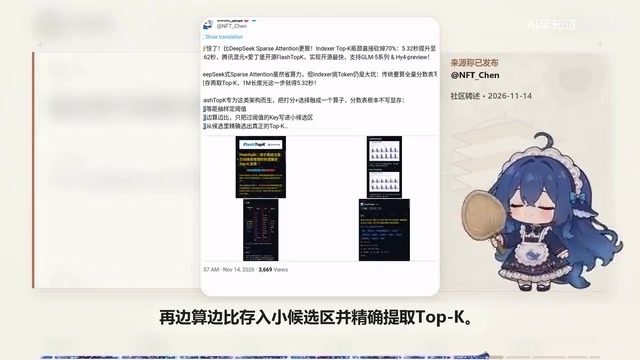
Underlying operator optimization welcomed a hardcore open-source result today. Tencent Hunyuan, together with the University of Edinburgh, officially open-sourced FlashTopK, specifically targeting the TopK selection bottleneck caused by DeepSeek-style sparse attention. The traditional approach must compute the full score table, write it to GPU memory, and then pick out the high-scoring items—this step alone takes 5.32 seconds; FlashTopK cuts that time by about 70% to 1.62 seconds, claiming to be the fastest open-source implementation currently available.
Its speed comes from fusing scoring and selection into a single operator, so the massive score table is never written back to GPU memory: first, a threshold is determined through equidistant sampling, then comparisons are made on the fly while storing into a small candidate area, and TopK is extracted exactly.
According to measured data in the repository, this solution is 1.7 to 3.8 times faster than similar mainstream implementations during inference, and 1.3 to 2 times faster in absorption training. It currently supports the GLM5 series and the Hunyuan Hi4 preview version.
Sparse Attention and TopK Selection: Standard self-attention needs to compute similarity scores for every query against all keys; the longer the sequence, the score matrix (GPU memory usage) expands quadratically. Sparse attention (such as the approach adopted by DeepSeek) retains only the K keys with the highest scores for each query in subsequent computation, reducing complexity from O(n²) to approximately O(n·K). But "selecting TopK" itself is not free: traditional implementations must first compute the complete score table and write it back to GPU memory, then perform sorting or threshold filtering. This read-write round trip becomes a significant bottleneck for long sequences and is the core problem FlashTopK aims to solve.
Kernel Fusion: Every independent kernel launch on a GPU incurs scheduling overhead and GPU memory reads/writes. Kernel fusion merges scoring, threshold determination, candidate writing, and exact selection into a single kernel, keeping intermediate results in on-chip registers or shared memory and avoiding falling back to high-latency HBM. FlashTopK's speedup mainly comes from this idea, combined with equidistant sampling to estimate quantile thresholds, enabling a single-pass scan that "computes and filters on the fly."
Safety Evaluation and Proactive Agent Benchmarks
With model capabilities surging, safety evaluation standards have become a must-answer question for big tech. Anthropic published an engineering blog post offering 10 systematic recommendations for designing, running, and reporting large-model safety evaluations. The company emphasized that safety evaluation is by no means a formal review before releasing a model, but directly determines whether a model is ready for deployment, what safeguards it should have, and where the next stage of training and research should focus. The blog post has exceeded 160,000 views.
The DeepNOT research team launched a proactive agent benchmark specifically testing whether agents residing in Slack group chats can judge when to proactively intervene. Results show that GPT-6 Luna scored 6.38 with a cost of only $0.007 per task; Claude Fable 5.1 scored 7.50 but cost as much as $3.02 each time. Luna trails by only about 1.1 points but is about 430 times cheaper. If a proactive assistant burns $3 every time it scans messages, enterprises clearly cannot afford it—a reminder to the industry not to look only at passive Q&A leaderboards.
Desktop Agent Collaboration Lands
Perplexity officially announced that its Teammates agents have officially arrived on the Mac desktop app, first available to Mac subscribers. These digital teammates can take on work individually or collaborate in relays with other teammates, directly handling real business such as quality testing, customer service, in-depth research, and growth marketing. The arrival of desktop agent collaboration means AI assistants are moving from chat windows to orchestrated workflow nodes.
One-line Summary
DeepSeek plan rumors, giant agent payment clashes, and FlashTopK open source shape a new AI landscape
Paragraph Summary
Today's AI news is dense: quota reminders and competition numbering appeared in DeepSeek's web frontend code, sparking coding plan speculation, but there is no official confirmation and an alternative explanation involving reverse-proxy rate limiting; OpenAI launched ChatGPT Wallet and Google Gemini connected to Google Wallet, forming agent payment closed loops on the same day; Tencent Hunyuan and the University of Edinburgh open-sourced FlashTopK, reducing sparse attention TopK selection time from 5.32 seconds to 1.62 seconds, a speedup of about 70%. In addition, Claude Code multi-thread collaboration and Google AntiGravity dynamic workflows iterated rapidly; the Coding Agent Index 2.1 shows Claude's two models tied for first, while DeepSeek V4.1 Flash costs only about $0.30 per task, nearly 10 times cheaper than Kimi, and the proactive agent benchmark reveals a cost gap of about 430 times.
Related articles

Zed Editor Releases v1.29.2: Observations on a Routine Version Iteration
Zed editor releases patch v1.29.2, version bump by @JosephTLyons, commit verified via GitHub signature. This article covers the release's basic info, what a patch version means, and practical upgrade advice for users.

Anthropic IPO Questioned: Hacker News Debates Timing of Going Public
A Hacker News post titled "Just say no to Anthropic's IPO" sparks debate on the timing of Anthropic's public listing and AI capitalization, touching on valuation bubbles and mission independence.

Hands-On with the Genie 4 World Model: Directing Worlds in Real Time Like a Puppeteer
Google DeepMind's Genie 4 world model in depth: Special Guest X's hands-on demo of real-time scene direction via prompts, custom interactive apps in Project Genie, and prompts-as-seeds reproducibility.