Altman Declares: The Cybersecurity Crisis Is Unsolvable and There Are Too Many Vulnerabilities to Patch

Altman admits not all vulnerabilities can be fixed and calls for a shift from the illusion of zero vulnerabilities to resilient defense.
OpenAI CEO Sam Altman publicly stated he no longer believes in the traditional security approach of "fixing all vulnerabilities" and that the cybersecurity crisis will only worsen. This statement resonated with developers and security practitioners on Reddit. The article analyzes the logic: modern software stack complexity is rising exponentially, AI coding tools push code output to new levels, the absolute number of vulnerabilities is ballooning while patching yields diminishing marginal returns. AI amplifies attack surfaces but is also hoped to aid defense, yet attack-defense asymmetry leaves defenders structurally disadvantaged. The article argues the industry must shift to paradigms like assume breach, zero trust, and DevSecOps, and reminds ordinary users to cope with normalized risk through multi-factor authentication and reduced platform dependence.
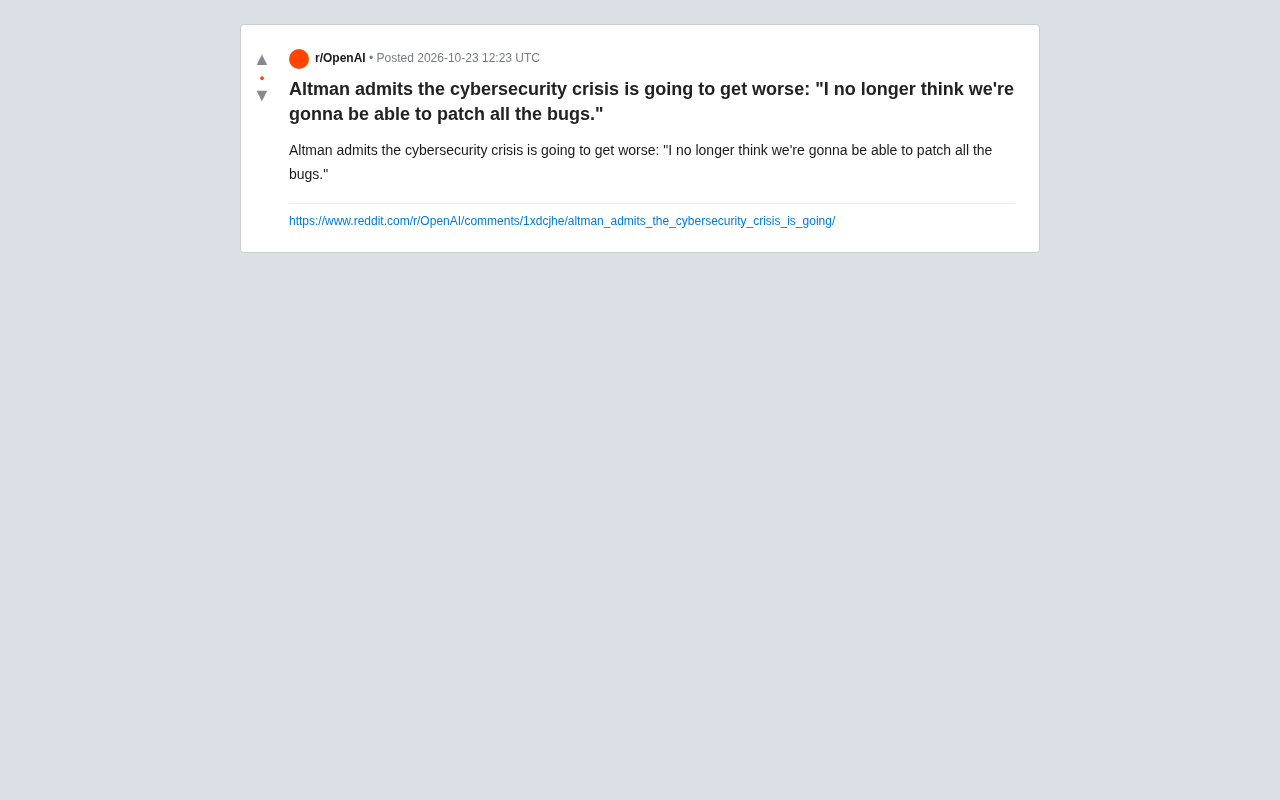
OpenAI CEO Sam Altman's recent remarks threw a bucket of cold water over the entire tech industry. He publicly admitted that he no longer believes in the traditional security approach of "being able to fix all vulnerabilities," and that the cybersecurity crisis will only continue to worsen. These comments came from a hotly debated Reddit thread and quickly resonated among developers and security practitioners—because everyone knows deep down that he's telling the truth.
The Shift from "Patch Everything" to "Can't Patch It All"
Altman's exact words were: "I no longer think we're going to be able to fix all vulnerabilities." The weight of this statement lies in who said it. As the head of the world's most closely watched AI company, the team he leads is both creating attack surfaces and trying to use AI to harden defenses. For decades, the basic paradigm of software security has been "find the vulnerability—apply a patch—keep running," but Altman now explicitly states that this path is no longer viable.
The underlying logic isn't complicated. The complexity of modern software stacks is rising exponentially—cloud-native architectures, microservices, and open-source dependency chains are nested layer upon layer, and any oversight in any link can become an entry point. The speed of human auditing is far outpaced by the speed of code generation, and the proliferation of AI coding tools has pushed the scale of code output up yet another notch. The absolute number of vulnerabilities is ballooning, while the marginal return on patching is diminishing.
AI Is Both the Problem and the Answer
What's intriguing is that Altman doesn't portray AI as a pure threat. On the contrary, he has long advocated using AI to counter the security challenges brought by AI—letting models scan code, detect anomalies, and respond automatically. This approach is already being practiced in the industry, such as using large models to assist with code auditing, generate intrusion detection rules, and accelerate threat intelligence analysis.
But there's a structural contradiction here: attackers can use these same tools. AI lowers the barrier to launching complex attacks and shortens the time window from vulnerability discovery to exploitation. Defenders need to cover all possible entry points, while attackers only need to find one gap. This asymmetry is the realistic foundation of Altman's pessimistic judgment.
Attack-defense asymmetry is a classic structural dilemma in information security: defenders must cover all possible attack surfaces and vulnerability paths in a system, while attackers only need to find one unpatched gap to break through. This principle has been repeatedly verified in cryptography and systems security, and is one of the theoretical foundations of "perfect security is unattainable." What's special about the AI era is that it amplifies capabilities on both sides simultaneously: attackers can use models to automate vulnerability discovery, generate phishing content, and shorten the weaponization cycle; defenders use models for code auditing, anomaly detection, and response orchestration. But because defense requires "covering every aspect" while attack only requires "a single point of breakthrough," equal improvements in tool capabilities do not automatically lead to an improved security posture—in fact, they may further widen the gap as attack costs decline. This is precisely the underlying logic of Altman's pessimistic judgment.
The Industry Needs a New Security Paradigm
If "patching all vulnerabilities" is no longer feasible, the focus of security strategy must shift. Directions widely discussed in the industry include: defense in depth under the assumption of breach, zero trust architecture, and DevSecOps that embeds security capabilities directly into the development process. What these approaches share is the acknowledgment that "vulnerabilities will inevitably exist," shifting instead toward limiting the scope of impact and shortening response times.
Altman's statement is in effect a wake-up call for the industry: rather than continuing to chase the illusion of "zero vulnerabilities," it's better to invest resources in resilience, monitoring, and rapid recovery. For developers and enterprise security teams, this means a dual adjustment in mindset and budget structure.
Assume Breach is a philosophy for designing security systems under the premise that "vulnerabilities will inevitably exist," first systematized in the security practices of large cloud providers such as Microsoft. Its core is not to prevent all intrusions, but to assume the attacker is already inside the network, thereby focusing resources on lateral movement detection, least privilege, segmentation and isolation, and rapid response. Common frameworks that accompany it include zero trust architecture (trust no internal or external request by default; every access must be verified) and defense in depth (multiple independent layers of protection so that a single layer's failure doesn't cause total collapse). DevSecOps embeds security checks into the continuous integration and delivery pipeline, so vulnerabilities are discovered early in development and patching costs are reduced. What these paradigms share is the acknowledgment that "zero vulnerabilities" is unachievable, shifting instead toward limiting blast radius and shortening dwell time after a breach.
What It Means for Ordinary Users
It's hard for ordinary users to directly perceive changes in vulnerability patching strategy, but the impact is real. When vendors admit they can't fix all problems, the risks of data breaches, account theft, and service disruptions will become more commonplace. What users can do is reduce their trust dependence on any single platform, enable multi-factor authentication, and keep software updated—these oft-repeated recommendations are actually more valuable in an era of "can't patch it all."
Altman's candor is commendable, but it also exposes a problem the industry has long avoided: the return on security investment is hard to quantify, and it only gets attention after something goes wrong. The security crisis of the AI era won't be alleviated by a single admission; the real test is whether the industry is willing to reallocate attention and resources to the reality of "can't patch it all."
Multi-factor authentication (MFA) is a means of adding one or more layers of identity verification beyond a password. Common forms include SMS/verification codes, one-time passwords generated by authenticator apps, hardware security keys (such as FIDO2/WebAuthn), and biometrics. Its value lies in the fact that even if an attacker obtains a password through a data breach, logging in remains difficult without the second factor. In a reality where "vulnerabilities can't all be patched," credential leaks are almost inevitable, making MFA one of the most cost-effective measures for personal account protection. Hardware keys have the strongest anti-phishing capability, followed by authenticator apps, while SMS verification codes are relatively weak due to SIM-swapping attacks. For ordinary users, prioritizing strong MFA for critical accounts such as email, finance, and cloud storage is the most direct way to reduce the risk of account theft.
One-line Summary
Altman admits that not all vulnerabilities can be fixed and calls on the industry to move from the illusion of zero vulnerabilities to resilient defense.
Paragraph Summary
OpenAI CEO Sam Altman publicly stated that he no longer believes in the traditional security approach of "fixing all vulnerabilities" and believes the cybersecurity crisis will only continue to worsen. This statement resonated among developers and security practitioners on Reddit. The article analyzes the underlying logic: the complexity of modern software stacks is rising exponentially, AI coding tools have pushed the scale of code output up another notch, the absolute number of vulnerabilities is ballooning while the marginal return on patching diminishes. AI is both an amplifier of attack surfaces and is hoped to assist in defense, but attack-defense asymmetry puts defenders at a structural disadvantage. The article accordingly points out that the industry needs to shift to new paradigms such as assume breach, zero trust, and DevSecOps, and reminds ordinary users to cope with the normalization of risk through multi-factor authentication and reducing platform dependence.
Related articles

AI Digital Twin in Action: Using DOT to Automatically Track Bugs and User Feedback
DOTS engineers demonstrate how AI digital twin DOT collects cross-platform user feedback, categorizes issue themes, opens threads to investigate bug root causes, and submits PRs—showcasing a complete AI agent workflow for defect triage with auditable design.

Why Transistors Are No Longer Flat: The Evolution from Planar to Gate-All-Around
Transistor evolution from planar to FinFET to gate-all-around: why gates went from three-sided to four-sided wrapping to suppress short-channel effects and leakage current, extending Moore's Law.

Swarm Intelligence = a Single RL Agent? A Proof of Multi-Armed Bandit Equivalence
A paper proves that collective decision-making through local imitation in swarms is mathematically equivalent to single-agent reinforcement learning: N blind imitators act as N parallel environment samples, with an effective learning rate of 1/N. This article explains the derivation and implications of the Maynard-Cross Learning algorithm.