AI Gateway vs. MCP Gateway: How to Define the Boundary Between Two Architectural Layers

AI Gateways handle model routing and costs; MCP Gateways handle tool access and authorization — know the difference before you architect.
In multi-Agent systems, AI Gateways and MCP Gateways solve two fundamentally different problems. AI Gateways handle model routing, API key management, and token cost control — governance on the "model side." MCP Gateways control which Agents can access which MCP servers and what they're permitted to do — authorization on the "tool side." Tools on the market offer either bundled or layered approaches, each with trade-offs around operational complexity and single-responsibility design. Log completeness — especially preserving call parameters — is a non-negotiable constraint regardless of architecture. The choice between one or two layers depends on team size, responsibility evolution, and audit requirements.
In the real-world deployment of AI Agents, a seemingly simple question keeps tripping up engineers: when your system has multiple internal MCP servers and multiple Agents, should you use an AI Gateway or an MCP Gateway to manage the calls between them? This isn't just a tool selection question — it's fundamentally about drawing the right architectural boundaries.
Where the Problem Starts: Two Completely Different Concerns
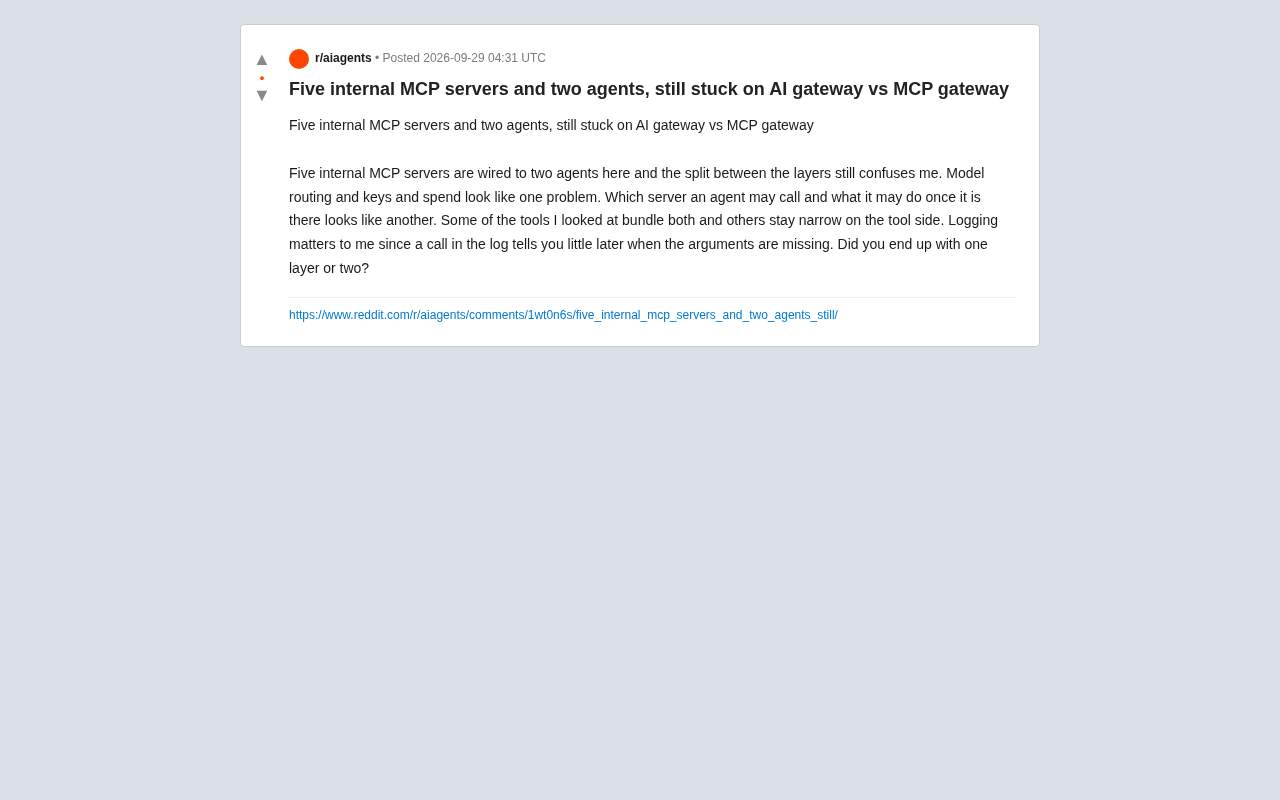
A Reddit user described a genuine dilemma: he connected five internal MCP servers to two Agents, but the division of responsibilities between the two layers consistently left him confused.
He astutely identified the core tension — there are two categories of problems that appear related but are fundamentally different in nature:
- Model routing, key management, and cost control: This is one category of problem, essentially about governance around "which model to call, whose API key to use, and how much was spent."
- Access control and permission boundaries: Which MCP servers an Agent can reach, and what it's allowed to do once it gets there — this is an entirely different category.
Mixing these two categories together is exactly why many people get stuck during architectural design. The former focuses on the economics and scheduling of the "model side"; the latter focuses on the security and authorization of the "tool side."
AI Gateway vs. MCP Gateway: Respective Responsibilities
AI Gateway: A Governance Layer Facing the Model
An AI Gateway handles the cross-cutting concerns related to interactions with large language models. It typically takes care of:
- Model routing: Dispatching requests to different models or providers based on cost, latency, or task type;
- Key and credential management: Centrally hosting API keys to prevent them from being scattered everywhere;
- Cost and quota control: Tracking token consumption, setting budget caps, and preventing runaway spending.
The core value of this layer is making "model consumption" controllable, observable, and switchable.
The concept of an AI Gateway evolved from traditional API gateways applied to LLM scenarios. Typical open-source or commercial implementations include LiteLLM, Portkey, and Kong AI Gateway. These tools abstract away the API differences between providers like OpenAI, Anthropic, and Gemini through a unified proxy layer, so upstream applications don't need to be aware of underlying model switches. In multi-Agent systems, the value of an AI Gateway is especially pronounced: when ten Agents are making model calls simultaneously, centralized key management prevents API key leakage, unified rate limiting and budget control prevents a runaway Agent from exhausting the quota, and cross-provider routing enables dynamic selection of the most cost-effective model per scenario. These governance capabilities are logically orthogonal to permission management at the tool layer.
MCP Gateway: An Authorization Layer Facing the Tools
An MCP Gateway focuses on access governance for Model Context Protocol servers. It answers two key questions:
- Which Agent can access which MCP server (authorization at the connection level);
- What operations the Agent is permitted to perform once inside (permission constraints at the tool level).
In other words, an MCP Gateway is the gatekeeper for tool calls. It doesn't care which model you're using or how much you're spending — it only cares about "whether this call is permitted and where the boundaries are."
MCP (Model Context Protocol) is a standard protocol proposed and open-sourced by Anthropic in late 2024, designed to establish a unified interface specification for interactions between large language models and external tools and data sources. Before MCP, every tool integration required custom adaptation. MCP enables Agents to discover and invoke various services in a standardized way — whether that's a filesystem, a database query, or a third-party API. An MCP server is essentially a process that exposes standardized tool schemas and execution endpoints, with Agents communicating with it via an MCP client. As more and more tool vendors provide official MCP servers, "how to govern Agent access to these servers" has naturally become a core infrastructure concern in production deployments, and MCP gateways have emerged as a result.
Two Orientations in the Market: Bundled vs. Focused
The original poster observed a noteworthy phenomenon: among the tools he researched, some bundle both capabilities together, attempting to solve both model governance and tool authorization with a single gateway, while others remain focused on the tool side, handling only MCP-layer concerns.
Both orientations involve trade-offs:
- Bundled solutions reduce operational complexity — one component handles everything — and are suitable for smaller-scale scenarios where responsibility boundaries are less distinct;
- Focused solutions follow the single-responsibility principle, with clear boundaries that make independent evolution and replacement easier, but require maintaining more components.
For a moderately complex system that already has multiple MCP servers and multiple Agents, this choice directly affects long-term maintainability.
The Underrated Key Issue: Log Usability
The original poster specifically highlighted a pain point that's easy to overlook — log quality. His original words are representative: "A call entry in the logs that's missing parameter information tells you almost nothing when you look back at it later."
This hits right at the weakness of debugging and auditing in Agent systems. In a multi-layer gateway architecture:
- If a log only records "Agent X called MCP Server Y" but drops the specific call parameters, that log entry is essentially useless when an anomaly occurs or a post-mortem is needed;
- Complete observability requires recording the call chain + parameters + results, and this is precisely what can be lost in transit when gateway layering is handled incorrectly.
Regardless of whether you choose a one-layer or two-layer architecture, log completeness should be a hard design constraint — not a feature to be patched in after the fact.
One Layer or Two? No Standard Answer, But a Decision Framework
The original post ultimately posed the question: "Did you end up using one layer or two?" This is an open architectural choice, and the decision criteria can be summarized as follows:
- Whether responsibilities need to evolve independently: If model strategy and tool permissions change at different rates and belong to different owners, layering makes more sense;
- Team size and operational capacity: Smaller teams benefit from bundled solutions to reduce cognitive overhead; larger teams tend to prefer decoupling;
- Security audit requirements: Scenarios with strict audit requirements for tool calls benefit from an independent MCP gateway that provides finer-grained control;
- Observability baseline: Regardless of how many layers you have, ensure parameter-level logs are never lost.
From an architectural principles standpoint, model governance and tool authorization are fundamentally two separate concerns, and the long-term inclination is toward layering. But for early-stage or lightweight systems, the practicality of bundled solutions is equally worth recognizing.
As the MCP ecosystem and Agent applications continue to develop rapidly, the boundary between AI Gateways and MCP Gateways will become an infrastructure decision that more and more teams must confront. Understanding the essential differences between the two matters far more than blindly following the default design of any particular tool.
Related articles

Free Unlimited Claude Code Solution: Agnes AI + CC Switch Setup Guide
No paid subscription needed — pair the free AI platform Agnes AI with the open-source tool CC Switch to provide a backend for Claude Code, enabling unlimited free calls to text, image, and video models. This guide covers the full setup, test results, and usage boundaries.

A Complete Zero-Cost Guide to Getting Started with Claude Code for Beginners in China
A beginner's guide to Claude Code for users in China: two installation methods (command line and IDE plugin), full configuration steps for replacing the official API with the free domestic LongCat model, and a hands-on demo of building a small tool with natural language, plus tips.

When the NSA Gets Involved: The AI Supply Chain Crisis Behind Open-Source CVEs and API Key Hijacking
Multiple open-source projects disclosed severe CVEs in one day, PHP flaws alarmed the FBI, and Railway and OpenCode were breached with API keys stolen. This article breaks down the vulnerability window, AI-accelerated exploitation, and the AI supply chain crisis behind the API key black market, with a developer defense checklist.