AI-Generated LabVIEW in One Click: A Complete Guide to Estimating Pi with Monte Carlo
Estimate Pi by scattering random dots — explained with Monte Carlo math and AI-generated LabVIEW code.
This article uses random point scattering to estimate Pi as a gateway to explaining the Monte Carlo method: points randomly placed in a square yield a circle-hit ratio that, multiplied by 4, approximates π. The Law of Large Numbers ensures convergence as sample size grows, visualized through a real-time adjustable trend chart. The article also details how AI tool VI Generator auto-generates complete LabVIEW code using an event-driven timeout state machine, modular sub-VIs, and a 'full statistics, display only the latest 5,000 points' performance strategy. It concludes by surveying Monte Carlo's broad applications — from financial risk and particle physics to AlphaGo's MCTS — and reflects on how AI-assisted coding shifts human value toward mathematical understanding.
Using random numbers to compute a precise mathematical constant sounds like a contradiction. But when you watch the π estimate on your screen steadily converge toward 3.14159 as more and more random points accumulate, the elegant probabilistic logic behind it becomes clear. This is the Monte Carlo method — a classic approach to solving deterministic problems through random sampling. Drawing from a demonstration featured on Bilibili channel "明镜与点点", this article explains the mathematical principles and shows how the AI tool VI Generator can generate a complete LabVIEW demo program in a single click.
From Random Dots to Pi: The Mathematical Intuition Behind Monte Carlo
The core idea of the Monte Carlo method is to approximate true probability using the statistical frequency of a large number of random events. Applied to estimating π, the construction is elegantly simple.
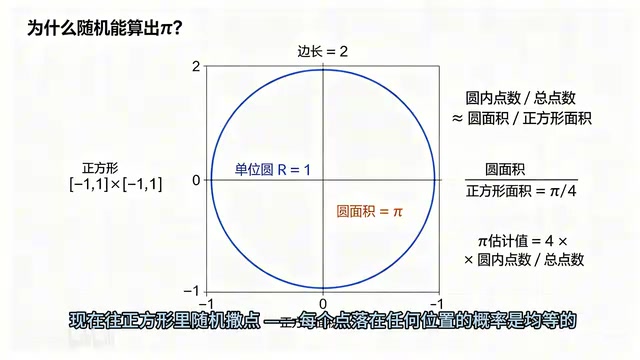
Imagine a square with side length 2, giving it an area of 4. Inscribe a unit circle of radius 1 inside it, with an area of exactly π. Now scatter points randomly inside the square. Since every location has an equal chance of being hit, the probability that any given point falls inside the circle equals the circle's area divided by the square's area — that is, π/4.
Flipping this relationship around: simply track the ratio of points that land inside the circle to the total number of points, then multiply by 4, and you get an estimate of π. The more points you scatter, the closer this ratio converges to the true probability, and the more accurate the estimate becomes. The entire derivation requires no calculus, no complex formulas — just the correspondence between probability and geometric area. This is precisely what makes the Monte Carlo method so intuitively accessible.
The Law of Large Numbers: Why More Points Mean Greater Accuracy
The most compelling part of the demo is watching the estimate converge in real time.
With only a few points, the π estimate fluctuates wildly — it might jump to 3.0 or spike to 3.3. But as points accumulate, the swings in the trend chart visibly narrow, and the estimate gradually stabilizes near 3.14. The underlying principle is the Law of Large Numbers: the larger the sample size, the closer the observed frequency of an event converges to its theoretical probability.
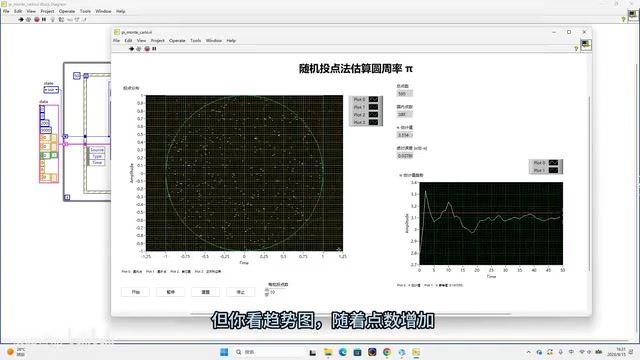
The program also supports interactive adjustment, making it easy to see how sample size affects accuracy. Increasing the points-per-batch from 500 to 2000 noticeably speeds up convergence; dropping it to 100 slows it down. This kind of adjustable, real-time feedback turns an abstract statistical principle into a visible, dynamic process — far more convincing than reciting formulas. A pause function lets you freeze the display to examine any particular moment, while a reset button clears the slate and starts fresh.
Worth noting is that the Monte Carlo method converges relatively slowly. Mathematically, the estimation error is roughly inversely proportional to the square root of the sample size — to reduce the error by a factor of ten, you need a hundredfold increase in sample size. This is known as the "1/√N convergence rate." Deterministic methods like numerical integration can achieve much faster convergence when functions are smooth. However, Monte Carlo's key advantage is dimension independence: when a problem involves a high-dimensional space — say, dozens of interacting variables — deterministic methods suffer exponential growth in computational cost as dimensions increase, while Monte Carlo's error remains governed solely by sample size, regardless of dimensionality. This is why Monte Carlo is virtually irreplaceable in high-dimensional problems like financial derivatives pricing and particle physics simulation.
AI-Generated LabVIEW Code: VI Generator's Engineering Implementation
What makes this demo especially notable is that the entire codebase was automatically generated by the AI tool VI Generator — including the main VI and multiple sub-VIs — and runs directly out of the box.
According to the "明镜与点点" channel, the AI encapsulates functionality into clean modules: batch point generation, plotting, building, and resetting are each isolated into separate sub-VIs with well-defined responsibilities. The main VI uses an event-driven timeout state machine structure, refreshing the display every 50 milliseconds to deliver a smooth, dynamic demonstration.

The engineering details are thoughtfully considered as well. For cumulative statistics, the program retains all points to calculate ratios accurately, but the graphical display only renders the most recent 5,000 points — preventing lag from excessive drawing data during long runs. This "full statistics, incremental display" approach balances precision with performance, a common optimization pattern in real-world engineering. The entire workflow — from concept to running program — is generated in one click, leaving users to focus on understanding the underlying mathematics while handing off the tedious coding to AI.
The event-driven timeout state machine is a common architectural pattern in LabVIEW's graphical programming model. The program waits inside an event structure for user interactions (such as button clicks or parameter adjustments). If no event occurs within the specified timeout period, a "Timeout" case fires automatically to execute periodic tasks — in this example, that means completing one round of point scattering and screen refresh every 50 milliseconds. This architecture simultaneously handles user interaction and keeps the interface continuously updating, avoiding the CPU waste of polling loops. It's a go-to design pattern for real-time LabVIEW demonstrations. Distributing business logic across independent sub-VIs further improves code readability and reusability, and also makes it easier for AI to partition modules along functional boundaries when generating code.
Beyond Pi: The Broader Value of Monte Carlo
Estimating π is just an introductory demonstration of the Monte Carlo method. Its true power shows up in tackling complex problems involving randomness.
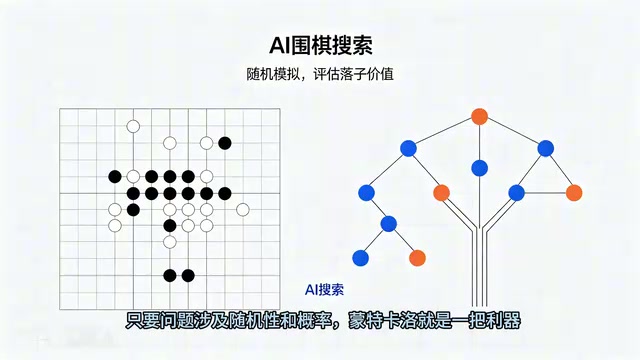
In finance, it's used to assess investment portfolio risk. In physics, it simulates the random trajectories of particle motion. In artificial intelligence, Monte Carlo Tree Search (MCTS) is one of the core algorithms powering Go-playing AI systems. Wherever a problem involves randomness and probability, Monte Carlo is a remarkably versatile tool.
From random point scattering, to estimate convergence, to a complete demo program generated by AI in one click — this case study weaves together mathematical principles, programming implementation, and AI tooling into a single coherent narrative. As more and more of the actual coding gets handed off to AI, human value increasingly shifts back to understanding the essence of the problem and the mathematics behind it. That may be the deepest change that AI-assisted programming is bringing about.
According to the channel's author, more AI-generated LabVIEW case studies will be shared in future installments. Readers who are interested are encouraged to follow along.
Monte Carlo Tree Search (MCTS) was already the dominant technique in Go programs well before AlphaGo. The basic idea: starting from the current board position, randomly simulate a large number of subsequent games through to completion and identify the move with the highest win rate. AlphaGo combined MCTS with deep neural networks — the neural network evaluates board value and narrows the search space, while MCTS performs random rollouts among candidate moves to validate them. Together, they improved search efficiency by several orders of magnitude. This example demonstrates that Monte Carlo is not a legacy technique born of computational limitations, but a foundational algorithmic idea that integrates deeply with modern AI and plays a unique role in navigating vast search spaces.
Related articles

vLLM v0.30.0rc1 Released: Isolates FlashInfer BF16 Autotuning Logic
vLLM v0.30.0rc1 release candidate fixes FlashInfer BF16 autotuning isolation (PR #57285). Learn the technical background and its impact on inference deployment.

Comp AI Raises $34M Series A, Bets on Agentic Security Compliance
Comp AI raises $34M Series A led by Roo Capital and Grand Ventures, betting on "continuously agentic" AI to transform compliance from periodic audits into real-time monitoring.

MIT Technology Review's 35 Innovators Under 35: A Climate Tech Edition Explained
MIT Technology Review's latest 35 Innovators Under 35 list focuses on climate tech, spotlighting nine young global innovators. Here's what the list means and why it matters.