vLLM v0.30.0rc1 Released: Isolates FlashInfer BF16 Autotuning Logic
vLLM v0.30.0rc1 isolates FlashInfer BF16 autotuning logic to improve inference stability.
vLLM has released v0.30.0rc1, focusing on an engineering fix that isolates the supplemental autotuning logic for the FlashInfer backend under BF16 precision (PR #57285), eliminating potential performance regressions caused by coupling with the main execution flow. FlashInfer is vLLM's optional high-performance attention backend, and BF16 is a widely adopted half-precision format for LLM inference. When their autotuning paths share state with general logic, edge cases can trigger hard-to-reproduce issues. Though small in scope, this fix carries real significance for teams requiring stable production inference performance.
vLLM v0.30.0rc1 Highlights
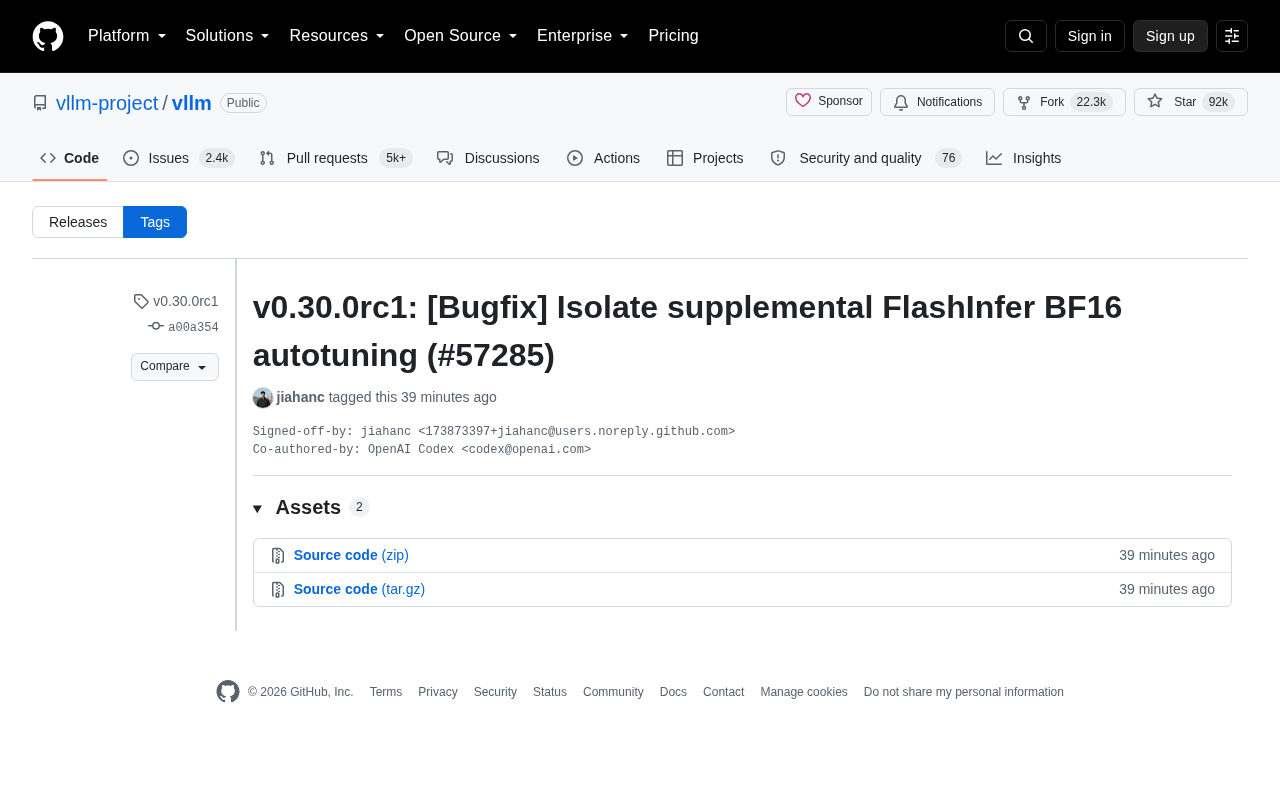
vLLM has released its v0.30.0rc1 release candidate, with a core bugfix targeting inference performance optimization. The fix centers on isolating the supplemental autotuning logic for the FlashInfer backend under BF16 (Brain Floating Point 16) precision, preventing potential interference with other code paths. The change was submitted via PR #57285 by contributor jiahanc, developed in collaboration with OpenAI Codex.
As one of the most active LLM inference frameworks today, vLLM has accumulated over 92k stars and 22.3k forks on GitHub. Every release candidate deserves attention from teams working on inference deployment, as it typically signals the direction of the upcoming stable release.
![rss source: v0.30.0rc1: [Bugfix] Isolate supplemental FlashInfer BF16 autotuning (#57285)](/media/screenshots/source/28070_0.png)
FlashInfer and BF16 Autotuning
Understanding this fix requires familiarity with two key components. FlashInfer is a high-performance attention computation library designed specifically for LLM inference. It provides GPU-optimized kernels that significantly accelerate both the decoding and prefill stages of large model serving. vLLM supports it as an optional backend to improve throughput and reduce latency.
BF16 is a half-precision floating-point format widely used in deep learning. Compared to FP32, it cuts memory usage in half and speeds up computation while preserving a wide dynamic range — making it a popular choice for large model inference.
"Autotuning" refers to the framework's ability to automatically select the optimal kernel configuration or algorithm parameters at runtime, based on hardware characteristics and workload patterns. While this mechanism can yield performance gains, coupling the tuning logic across different precisions or code paths can lead to unexpected behavior. This fix specifically isolates the "supplemental FlashInfer BF16 autotuning" logic to prevent it from affecting the main execution flow.
Technical Implications of the Isolation Fix
The phrase "Isolate supplemental" in the PR title indicates that developers identified extra BF16-related tuning steps that could produce side effects or coupling with other code paths. By separating this logic, the autotuning process becomes more controlled and predictable, reducing the risk of performance regressions or errors in edge cases. While this kind of fix may seem minor on the surface, it is critical for users who demand stable inference performance in production environments.
It's worth noting that FlashInfer's autotuning mechanism typically benchmarks multiple kernel configurations on the first run and caches the optimal setup for subsequent use. This "runtime tuning" is conceptually similar to PyTorch's torch.backends.cudnn.benchmark, but is specifically optimized for attention computation — accounting for sparsity patterns, sequence length distributions, and batch sizes.
BF16 differs from FP16 in its numerical representation (wider exponent bits, narrower mantissa), which can lead to entirely different optimal kernel configuration paths compared to FP16 or FP32 scenarios — necessitating a separate tuning branch. If BF16's supplemental tuning logic shares state or a global cache with the general-purpose path, it can produce hard-to-reproduce performance anomalies in mixed-precision scenarios or under concurrent requests.
Practical Impact for Users
For teams deploying large models with vLLM, RC (release candidate) versions generally offer an early opportunity to validate upcoming features and fixes before they stabilize. Users running models with the FlashInfer backend at BF16 precision should pay attention to whether this autotuning isolation produces any measurable changes in performance.
A reminder: RC versions are pre-release and intended primarily for testing and validation. For production deployments, it is still advisable to wait for the official stable release, or to upgrade only after thorough testing. This version was tagged by jiahanc on September 17, with a signed commit (Signed-off-by), in compliance with vLLM's contribution standards.
To evaluate whether this fix benefits your specific workload, monitor the following metrics: GPU utilization stability, Time To First Token (TTFT), and tokens per second (TPS). If you previously observed random latency spikes or occasional performance degradation under a FlashInfer + BF16 configuration, this isolation fix may address the root cause. When testing, reproduce your production environment's sequence length distribution and concurrency levels for the most representative comparison.
Summary
The v0.30.0rc1 update is modest in scope, but reflects the vLLM community's ongoing attention to the finer details of inference performance. Isolating the FlashInfer BF16 autotuning logic is an engineering refinement in the framework's broader pursuit of high-throughput, low-latency inference. For developers focused on LLM inference infrastructure, this release is worth including in your testing plan to assess its impact on your workloads.
Related articles

Comp AI Raises $34M Series A, Bets on Agentic Security Compliance
Comp AI raises $34M Series A led by Roo Capital and Grand Ventures, betting on "continuously agentic" AI to transform compliance from periodic audits into real-time monitoring.

MIT Technology Review's 35 Innovators Under 35: A Climate Tech Edition Explained
MIT Technology Review's latest 35 Innovators Under 35 list focuses on climate tech, spotlighting nine young global innovators. Here's what the list means and why it matters.

Ollama Cloud Deep Dive: One Subscription to Run DeepSeek, GLM, and More Open-Source Models
Ollama Cloud revamped with transparent per-token pricing and no service fees. One subscription runs DeepSeek, GLM, Kimi, Qwen & 20+ open-source models. Great time-zone perks for China users.