AI Getting More Expensive the More You Use It? Actually, the Cost of Intelligence Has Dropped 20x

AI cost per unit of intelligence has plummeted about 20x; rising bills are just because we're using it for bigger, harder tasks.
The article addresses the contradiction between Sam Altman's prediction that "intelligence will be too cheap to meter" and the reality of soaring API bills. The author points out that per-token prices for top models have indeed risen 5-10x, but focusing only on unit price is the worst cost calculation—you should combine token consumption per task and the cost to reach a specific intelligence level. At the same intelligence level, AI costs have dropped from $0.6 per task to $0.02—about a 20x reduction, far exceeding the promised tenfold. Low-price models like GLM 5.3 Flash outperform GPT-5 in agentic tasks at one-twentieth to one-thirtieth the token cost. The bill explosion is Jevons Paradox in action: the cheaper and better models get, the bigger and harder the tasks people use them for, naturally increasing consumption.
Sam Altman once predicted that intelligence would become so cheap it wouldn't be worth metering. But when you look at this month's API bill, that prediction probably sounds like a bad joke—token prices are rising, bills are soaring, so how can anyone claim it's gotten cheaper?
Theo (t3.gg) tackled this contradiction in a recent video. The conclusion is a bit counterintuitive: AI really is getting dramatically cheaper—it's just that the way you're spending has changed.
Rising Token Prices Are Real, But Focusing Only on Unit Price Is Missing the Point
Let's acknowledge one fact first—the per-token price of top-tier models has indeed gone up. GPT-5 Medium outputs at $10 per million tokens, while subsequent models like Astra jumped to $50 for output, with input rising from $1.25 to $10. Looking at the numbers alone, that's a 5x to 10x increase—the exact opposite of the promise that "costs will drop to one-tenth every year."
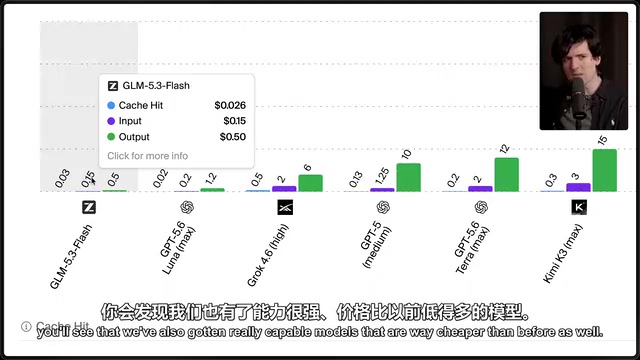
But measuring cost purely by token unit price is one of the worst possible calculations. Theo proposes looking at three dimensions:
- Price per token: how much intelligence you can buy per dollar
- Token consumption per task: how many tokens it takes to complete specific work
- Cost to reach a given intelligence level: how much it costs to get a model to solve problems at a specific capability level
Combining these three dimensions paints a completely different picture. For example, Gemini 3.8 Flash outputs at just $3.75 per million tokens—less than half of GPT-5, which looks like a great deal. But it consumes so many tokens on intelligence index tests that the cost gap for completing the same task shrinks from over 10x to less than 3x. Conversely, 3.5 Flash burns through so many tokens that its total cost actually exceeds models with much higher unit prices.
Jevons Paradox was proposed by British economist William Stanley Jevons in 1865 while studying coal. He observed that when steam engines became more efficient and each unit of coal produced more power, Britain's total coal consumption actually rose rather than fell. The reason: improved efficiency lowered the relative cost of using coal, so coal was applied to scenarios that previously weren't worthwhile, and total demand expanded enough to offset or even exceed the savings from each individual use. This paradox is often used to explain why technological efficiency gains don't necessarily lead to reduced resource consumption. In AI, it means that even if the price per token drops dramatically, as long as AI becomes cheap and good enough, people will stuff it into more, bigger, and more complex tasks—ultimately driving the total bill up. Understanding this concept is the key to understanding the surface-level contradiction of "unit prices falling, bills rising."
The Low-End Is Also Exploding: More Capable, at One-Thirtieth the Price
While high-end models get more expensive, the low end has seen astonishing progress. GLM 5.3 Flash costs $0.15 per million tokens for input and $0.5 for output, with many channels offering another 50% off. That means the cost per token is roughly one-twentieth to one-thirtieth of GPT-5.
Theo's assessment is blunt: he'd rather use GLM 5.3 Flash for everything than be forced to use GPT-5. Because 5.3 Flash has absorbed a year of industry progress—better vision processing, smoother tool calling, and especially in agentic workflows, its performance running continuously for hours far exceeds GPT-5. GPT-5's only advantage is having more knowledge it can call upon without searching, but with search tools attached, 5.3 Flash can pull the gap on knowledge tasks to an order of magnitude.
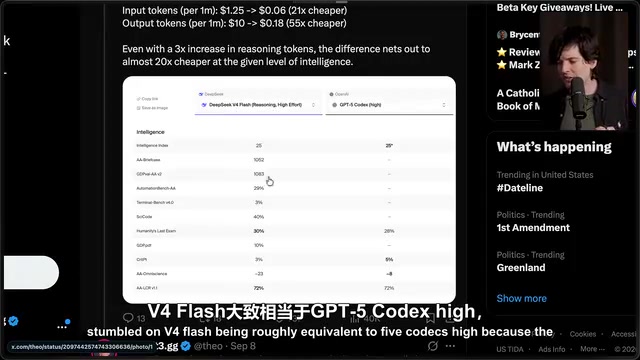
This means: at a given intelligence level, prices have already dropped about 20x, far exceeding the "one-tenth" target.
Agentic Workflow refers to letting AI models do more than just question-and-answer—they autonomously plan, continuously call tools, observe results, and iterate execution like an agent to complete a multi-step long task. For example, when fixing a bug, the model might need to first screenshot and analyze the interface, search the code, modify files, run tests, and then continue adjusting based on error messages. These workflows demand different capabilities from models than single-turn conversations: they need stable tool calling, long-context memory, and reasoning about intermediate states. When the article mentions GLM 5.3 Flash "running continuously for hours," that's precisely the agentic scenario, where lower-priced models—because of smoother tool calling and better vision processing—can actually be more cost-effective than models with higher unit prices but weaker tool capabilities.
Historical Data: Costs Are Falling Off a Cliff at Every Intelligence Level
Artificial Analysis has been tracking this. Take intelligence index scores below 10: it used to cost $0.6 per task, and over about two years it dropped to $0.02. For the 10-20 range, it cost $15 in September 2024, but by February 2025 Grok Mini could achieve higher scores for just a few cents—nearly a 99% price drop in just 4 months.
For the 20-something range, it went from $1.55 to 26 cents to 10 cents, and now just 4.7 cents. The 30-something range dropped from $1.9 to 3 cents. The 40-50 range started at $3.85, then 5.6T achieved higher scores at nearly half the price, GLM 5.3 went further at less than one-third the price, and GLM 5.3 Flash ultimately achieved comparable scores at one-hundredth the price.
Someone in the livestream chat said "each price drop is faster than the last," and Theo agreed with that observation. The axis is on a logarithmic scale—you need to remember that when reading the chart to grasp how dramatic the drop really is.
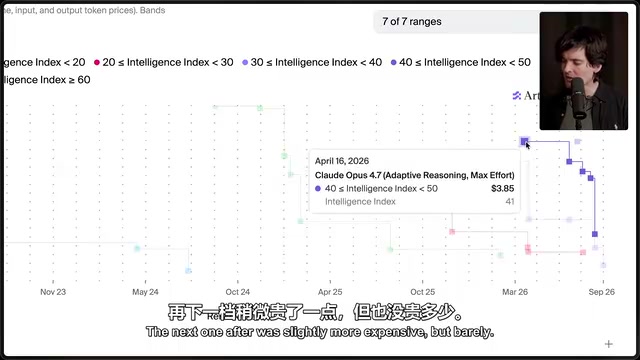
Logarithmic scale is a way of labeling axes where adjacent ticks increase by a fixed multiple rather than a fixed difference. For example, 1, 10, 100, 1000—each step represents multiplying by 10. On a logarithmic chart, a gently rising straight line can correspond to exponential real-world growth, and a visually "halved" decline can represent an order-of-magnitude change. The Artificial Analysis charts mentioned in the article use a logarithmic scale to show cost declines, so readers can't intuitively estimate using the proportions of a normal linear chart. The same visual drop might look like just a few times on a normal scale, but represents tenfold, hundredfold, or even thousandfold differences on a logarithmic scale—which is exactly why the article emphasizes "remember this to understand how dramatic the drop is."
The Truth Behind Soaring Bills: It's Not That It Got More Expensive—You're Using It More
Since costs are falling, why are bills rising? Theo's explanation: Jevons Paradox. When steam power became cheaper and coal more accessible, people actually spent more on these things because they suddenly became cheap and good enough to apply to places that previously couldn't use them.
Theo mentions that his total AI spending in 2025 was about $800-1,000, while in 2026, a single day could consume over $1,000 in tokens. But that doesn't mean he's losing money—he's having models do completely different things. Before, it was having the model auto-complete a function in a codebase; now it's having it look at a bug screenshot, implement the fix in code from start to finish, and run continuously for hours without frequent intervention.
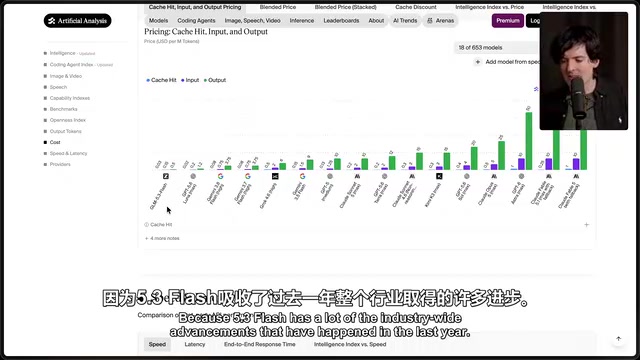
Tokens generated per prompt increasing dramatically is actually a sign of success. Models have become cheaper, better, and more capable, so naturally we use them for bigger and harder tasks. Rising bills and rising productivity are correlated.
Theo also candidly admitted he made a video two years ago titled "AI Won't Keep Improving," and acknowledged he was "spectacularly wrong." He thought development had stalled because old benchmarks could no longer measure new models' capabilities. Now he's certain: progress is far faster than expected, and prices far lower than imaginable.
What Happens Next
Getting Fable-level intelligence at GLM 5.3 Flash prices—Theo said on livestream that "this will absolutely happen." Because the industry is advancing so fast in tool use, long-task management, and search capabilities that small models with good tools can far surpass last year's smartest models.
Altman's "intelligence so cheap it's not worth metering" may not happen the way he implied, but the promise of "intelligence ten times cheaper"—Theo believes that's been far exceeded. The difference is that we can now use AI for bigger, harder things, which is more exciting than simply saving money.
Prices will keep falling. Even if it doesn't seem like it right now, don't be scared by the bill—every dollar you spend is buying capabilities that didn't exist last year.
Intelligence Index is a score used by evaluation organizations like Artificial Analysis to quantify a model's overall capabilities, typically combining multiple benchmark categories like reasoning, math, programming, and knowledge Q&A. It converts different capabilities of different models into a comparable score, making it easy to observe "how much it costs to complete a task at a certain intelligence level." The article uses ranges like 10 points, 20 points, 30 points, and 40-50 points to track cost changes, with the intelligence index on the horizontal axis and cost on the vertical axis. It's worth noting that no single index can fully represent a model's performance in real business scenarios, especially agentic capabilities like tool calling and long-task stability that may not be fully covered—so index scores should be used in combination with actual task testing.
One-line Summary
AI cost per unit of intelligence has plummeted about 20x; rising bills are just because we're using it for bigger, harder tasks.
Paragraph Summary
The article addresses the contradiction between Sam Altman's prediction that "intelligence will be too cheap to meter" and the reality of soaring API bills. The author points out that per-token prices for top models have indeed risen 5-10x, but focusing only on unit price is the worst cost calculation—you should combine token consumption per task and the cost to reach a specific intelligence level. At the same intelligence level, AI costs have dropped from $0.6 per task to $0.02—about a 20x reduction, far exceeding the promised tenfold. Low-price models like GLM 5.3 Flash outperform GPT-5 in agentic tasks at one-twentieth to one-thirtieth the token cost. The bill explosion is Jevons Paradox in action: the cheaper and better models get, the bigger and harder the tasks people use them for, naturally increasing consumption.
Related articles

Cursor AI Programming in Practice: Build a Student Management System from Scratch in 30 Minutes
A Bilibili creator demonstrates Cursor AI programming: generating a student management system in 30 minutes with natural language. Details on Agent mode, Claude selection, prompt techniques, and thresholds.

Top 20 AI Coding Tools Ranking: From Rock-Solid to Lackluster, a Scored Matrix
Bilibili creator releases top 20 AI coding tools ranking, tiered T0–T4 from rock-solid to lackluster, with Claude Code and Codex tied at T0. This article details the scoring dimensions (capability, reliability, robustness, durability, cost, domestic availability) and tool performances to help developers choose the right AI coding assistant.

Vibe Coding Systematic Tutorial: Master AI-Assisted Programming from Zero
A three-month Vibe Coding tutorial from a Bilibili creator covering Codex, ClaudeCode, and Cursor, from core logic to commercial project practice for beginners.