AI Giants in a Price War: Gemini, Grok, and DeepSeek Strike on the Same Day — A Golden Era for Developers Begins

AI giants slash prices and boost performance simultaneously, igniting a developer golden era.
In a single day, Google halved Gemini 3.7 Flash pricing while boosting code benchmarks, xAI's Grok 4.6 topped GDPVAL scores at aggressive API rates with Cursor integration, OpenAI previewed 14x faster inference via Cerebras hardware, and DeepSeek open-sourced its modular agent framework Harness. The convergence signals a competitive shift from raw performance to cost, speed, and ecosystem — unlocking unprecedented value for developers.
The All-Out Price War Among Large Model Providers
The cost and efficiency of calling large models is reaching a critical inflection point for developers. On this single day, nearly all leading players made their moves simultaneously: Google officially released its flagship model Gemini 3.7 Flash with pricing slashed by half compared to the previous generation; xAI launched Grok 4.6, surpassing competitors; OpenAI unveiled a 14x ultra-fast mode; and DeepSeek open-sourced its proprietary agent framework. A three-way battle over performance, pricing, and ecosystem has officially begun.
For developers who rely heavily on large models for code completion and complex workflow orchestration, this round of "more performance at lower cost" competition is undoubtedly a major win. Below, we break down the technical logic and selection value behind each of these key moves.
Google Gemini 3.7 Flash: Performance Leap, Price Halved
Gemini 3.7 Flash, officially released by Google DeepMind, combines high performance with ultra-low latency. Based on benchmark data, this upgrade is substantial:
- Achieved 43.6% on the code benchmark Frontier Code 1.1;
- On the software engineering evaluation DeepSafe, jumped from 49% in the previous generation to 65.3%, an improvement of nearly 16 percentage points;
- Scored 1588 in the web development arena.
It's worth explaining what these two benchmarks measure: Frontier Code 1.1 is an industry-standard comprehensive benchmark for evaluating large models' code generation capabilities, covering multi-language code completion, function-level generation, cross-file dependency understanding, and more. Higher scores indicate greater practical utility in real development scenarios. DeepSafe focuses on full-lifecycle software engineering capabilities, including bug localization, code review, test case generation, and security vulnerability patching — simulating the complex task chains a senior engineer handles daily. The leap from 49% to 65.3% signifies a qualitative improvement in the model's ability to handle complex engineering problems at the real codebase level.
More critically, the pricing strategy is aggressive — the launch price is directly halved compared to 3.6 Flash, and GitHub Copilot now fully supports it, enabling direct calls from VS Code and other IDEs. For developers who heavily depend on code completion and intelligent code review, the combination of performance gains and halved pricing leaves virtually no reason not to switch immediately in Copilot.
The signal is clear: Google is using the "Flash" lightweight yet high-value product line to capture the entry point for developers' high-frequency daily calls. The "Flash" series is essentially built on model distillation and inference optimization — compressing large model knowledge into smaller architectures and applying inference acceleration techniques to dramatically reduce latency and cost with minimal accuracy loss, purpose-built for scenarios involving millions of daily calls.
xAI Grok 4.6: Low Price, High Score, Bound to the Cursor Ecosystem
Hot on Google's heels, Elon Musk's xAI dropped a bombshell — the new flagship model Grok 4.6.

On the GDPVAL benchmark, which measures real-world task performance, Grok 4.6 scored 1753 — the highest score across the board — surpassing GPT-5.6 and competing flagships in one fell swoop. GDPVAL (General-purpose Dynamic Performance Validation) differs from traditional static Q&A tests by requiring models to complete planning, tool invocation, error recovery, and other dynamic tasks across multiple interaction turns, more closely approximating real-world complexity. A score of 1753 means Grok 4.6 demonstrates the strongest comprehensive capability currently available for autonomously executing complex task chains.
The new model's core strength lies in long-horizon agentic tasks — scenarios where the model must autonomously decompose goals, execute across multiple steps, and self-correct at intermediate stages. Examples include the complete software delivery pipeline from requirements analysis and architecture design to implementation and test deployment, or end-to-end tasks like conducting research across multiple data sources, analyzing findings, and writing reports. This capability represents the core bottleneck in AI's evolution from "Q&A tool" to "autonomous executor," and is precisely where AI application deployment most urgently needs breakthroughs.
Pricing is equally aggressive: API pricing is set at $2 per million input tokens and $6 per million output tokens — far below comparable competitors. Grok 4.6 is already integrated with Cursor, Grok Build, and the automated agent GrokBot, with Cursor offering double usage in the first week. Following Musk's integration with the Cursor ecosystem, this combo of "low price + double usage + deep integration" is extremely attractive to developers looking to maximize value.
Notably, the $2 per million input tokens pricing approaches the cost threshold of self-deploying open-source models. Considering the GPU rental, operations, and engineering overhead required to build your own inference cluster, this price means that for small and mid-sized teams, calling the API directly may actually be cheaper than deploying open-source models themselves.
OpenAI's Response: 14x Ultra Fast Mode Solves Latency Pain Points
Facing aggressive moves from competitors, OpenAI played its speed card. The company officially previewed the Ultra Fast service mode in its API, enabling its flagship model GPT-5.6 to achieve up to 14x speed improvement, with output throughput reaching 750 tokens per second.
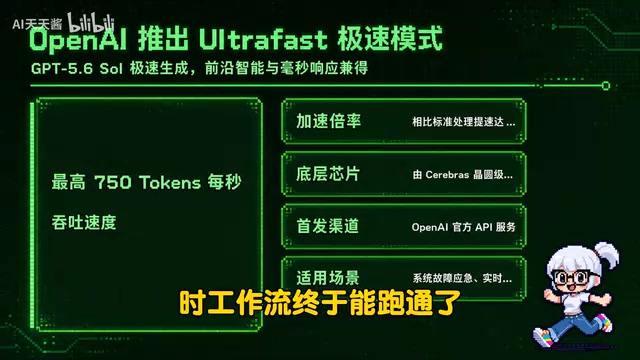
This acceleration is powered by Cerebras, a wafer-scale chip manufacturer. Cerebras' core innovation is manufacturing an entire wafer (approximately 215mm × 215mm) as a single chip, rather than the traditional approach of dicing a wafer into hundreds of small chips and interconnecting them. This Wafer-Scale Engine (WSE) contains trillions of transistors and hundreds of thousands of AI-optimized cores, with on-chip memory reaching tens of gigabytes, fundamentally eliminating inter-chip communication bottlenecks. It's precisely this extreme parallelism and bandwidth advantage that enables ultra-low latency inference for large models, achieving the stunning 750 tokens/second throughput.
This solution specifically addresses the pain point of excessive latency in complex frontier models in production environments, covering demanding scenarios like online incident response, real-time financial risk control, and low-latency customer service. To understand what 750 tokens/second means: this roughly equates to outputting 500-600 Chinese characters per second, generating a thousand-word article in under two seconds. For conversational systems requiring real-time responses or risk control scenarios demanding millisecond-level decisions, this speed approaches the threshold of a "zero-perceived-latency" experience.
The industry logic behind this deserves deeper consideration: when large models are both smart enough and lightning fast, many real-time workflows that previously could only compromise with lightweight small models can finally run on flagship models. This means "speed" is evolving from a marginal optimization factor to a core metric determining application viability. The industry's previous common practice was a cascade architecture using small models for initial screening and large models for refined processing — but when flagship models can also respond in milliseconds, this compromise may be replaced by "one-shot" single-model solutions, dramatically simplifying overall architecture.
DeepSeek Open-Sources Agent Framework Harness: A Modular Foundation for Developers
The open-source community also received a major contribution — DeepSeek officially open-sourced its proprietary agent framework DeepSeek Harness.
This system adopts a fully pluggable, building-block design where models, tools, strategies, and context management are all freely customizable. It includes over 100 official plugins and supports scripting via programmatic tool-calling to orchestrate multi-step complex tasks. Developers can spin up a web interface locally with a single command.
The "pluggable building-block design" technically means the framework decomposes core agent capabilities into independent modules: a reasoning engine (connectable to any LLM), a tool registry (supporting custom APIs, databases, file systems, and other external tools), a strategy layer (defining task decomposition and execution logic such as ReAct, Plan-and-Execute, and other paradigms), and a context manager (handling long-conversation memory and session state persistence). Each layer is decoupled through standard interfaces, allowing developers to replace any single module without affecting the others. This architecture dramatically lowers the customization threshold and enables community-contributed plugins to be quickly integrated.
For enthusiasts looking to build highly customizable personal development agents, this foundation provides an excellent starting point. It also reflects a broader trend: agent frameworks are moving from closed commercial products toward open, modular, composable infrastructure. Compared to earlier frameworks like LangChain and AutoGen, DeepSeek Harness differentiates itself through deep optimization integration with the DeepSeek model family and production-grade deployment stability.
AI Cracks a 30-Year Math Problem: From Auxiliary Tool to Research Powerhouse
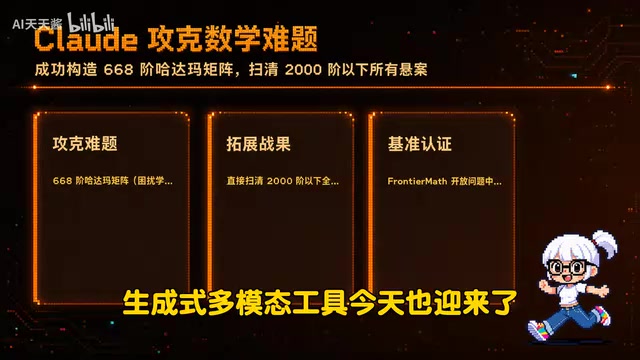
Worth highlighting separately, AI has achieved another breakthrough in pure scientific and mathematical frontier research. A team of mathematicians from Anthropic, working alongside human researchers with Claude, successfully constructed the order-668 Hadamard matrix — a problem that had stumped mathematicians for 30 years — and produced 12 matrix solutions at once, clearing all unresolved matrix orders below 2000.
A Hadamard Matrix is a square matrix whose elements consist only of +1 and -1, satisfying strict orthogonality conditions — the inner product of any two rows must equal zero. It has broad applications in signal processing (Walsh-Hadamard transform), error-correcting codes (Reed-Muller codes), quantum computing (quantum gate design), and statistical experimental design (orthogonal Latin squares). The Hadamard conjecture states that for all orders that are multiples of 4, a corresponding Hadamard matrix exists, but constructing high-order matrices is extremely difficult because the search space explodes exponentially with order — order 668 means finding a solution satisfying constraints within an astronomical search space of approximately 2^(668×668) ≈ 2^446224. AI's success demonstrates its potential to surpass human exhaustive search capabilities in combinatorial search and symbolic constraint satisfaction problems.
This achievement has been marked as "solved by AI" on the top-tier mathematical evaluation benchmark FrontierMath, becoming the 4th case solved among its 50 frontier open problems. This once again proves that large models are transitioning from auxiliary tools to genuine research powerhouses in rigorous mathematical symbolic reasoning and vast search space exploration.
Multimodal and Enterprise Services: Specialized Upgrades
Generative multimodal tools are also undergoing specialized transformation. AI music generation platform SUNO launched Studio 2.0, with the most significant update being the long-requested MIDI support, along with effects plugins, synthesizers, and a conversational AI assistant capable of handling complete mixing workflows.
MIDI (Musical Instrument Digital Interface) has been the universal standard protocol in music production for 40 years. It records not sound itself, but performance instructions such as note pitch, duration, velocity, and controller changes. Supporting MIDI export means SUNO-generated music is no longer an uneditable audio "black box" but structured data that can be modified note by note, rearranged, and re-instrumented. This means SUNO is evolving from a simple text-to-audio tool into a professional digital audio workstation with fine-grained engineering control — generated material can finally be exported to traditional DAWs like Logic Pro and Ableton Live for deep post-processing, truly integrating into professional musicians' creative workflows.

The domestic enterprise services sector is equally active. iFlytek released a full-scenario enterprise agent matrix covering seven core business areas including intelligent management, process IT, supply chain, and R&D manufacturing, positioning AI to move from "single-point Q&A" to "being accountable for business outcomes."
On the technical foundation, the Spark knowledge base has been upgraded to executable Agentic RAG. Unlike traditional RAG, which merely performs passive retrieval and concatenation, Agentic RAG empowers the model with proactive decision-making: the model can assess whether current retrieval results are sufficient, decide whether to perform additional retrieval, switch data sources, invoke external tools for verification, and even proactively backtrack and re-plan retrieval strategies when contradictions are detected. This elevates enterprise knowledge bases from static "dictionary lookup" tools to intelligent systems capable of autonomous reasoning and execution — particularly suitable for complex business scenarios involving multi-system coordination, such as cross-department approval workflows or supply chain anomaly diagnosis.
Additionally, iFlytek launched an integrated hardware-software agent appliance and the Ocean product line supporting over a hundred languages for international expansion, providing enterprises with a mature full-pipeline reference for large model deployment.
Edge Computing: The Next Battleground in Large Model Competition
Finally, there's news from the underlying hardware front. An edge AI chip startup, less than three years old, completed a $130 million Series B round, bringing total funding to over $480 million. Its first edge AI chip and the AgentBox personal agent hub powered by it have entered mass production.
The chip delivers 700 TOPS peak compute, employs a heterogeneous architecture with deep CPU-NPU coordination, and achieves processing speeds of 1,416 tokens per second with long-context caching — directly addressing the high cloud computing costs and privacy concerns of always-on agents.
Two key technical metrics need explanation here: TOPS (Tera Operations Per Second) measures AI chip inference compute power. 700 TOPS means the chip can execute 700 trillion low-precision operations per second (typically INT8 or INT4), sufficient to run models with tens of billions of parameters locally. The heterogeneous architecture with deep CPU-NPU coordination means the general-purpose processor handles logic-intensive tasks like control flow and data scheduling, while the Neural Processing Unit (NPU) focuses on compute-intensive operations like matrix multiplication and activation functions. The two work in tight coordination through unified memory address space and high-speed on-chip interconnects, maximizing hardware utilization and reducing power consumption.
As demand for always-on local agents grows, dedicated edge compute is becoming the next critical battleground for tech giants. A simple cost calculation: if an AI assistant needs to be online 24/7, at current cloud API pricing, inference costs alone could reach hundreds of dollars per month; whereas the amortized cost of an edge chip might be just a few dollars per month, with data never leaving the device — naturally solving privacy compliance issues.
Conclusion: The Developer Golden Era Has Only Just Begun
From Gemini 3.7 Flash's halved pricing to Grok 4.6's low-cost high scores, OpenAI's ultra-fast mode, and DeepSeek's open-source framework, this day's concentrated releases paint a clear industry narrative: performance continues to improve rapidly, but the competitive focus has shifted to cost, speed, and ecosystem integration.
What does this competitive landscape mean for the industry? Historical experience shows that when infrastructure costs drop rapidly, entirely new application categories that were previously economically infeasible tend to emerge — just as the continuous decline in cloud computing costs spawned the SaaS explosion, the sudden drop in large model calling costs will unlock a wave of AI-native applications that were previously too expensive to commercialize. For developers and enterprises, this means lower barriers to entry and a richer selection landscape — the real golden era may have only just begun.
Related articles

Graduate Student Proves Quantum Uncertainty Principle on Fractals: A Breakthrough Bridging Fourier Analysis and Geometry
A graduate student proved the quantum uncertainty principle on fractals, establishing quantitative constraints between function concentration on fractal sets and Fourier transforms, opening new research directions.

NeurIPS Submissions Reveal New Trends in Research Collaboration in the AI Era
Analyzing a Reddit recruitment post to explore NeurIPS Workshop submission strategies, how AI coding tools reshape research productivity, and the opportunities and risks of global collaboration for young researchers.

Lincoln's Great Speeches: Historical Echoes of Leadership and Courage
Deep analysis of the leadership wisdom behind Lincoln's Second Inaugural and Gettysburg Address—from listening skills and bearing immense pressure to the courage to speak truth in moments of victory.