AI Giants Set Record Lobbying Spending: Nvidia, Anthropic, and OpenAI Spend Big Over the Summer

OpenAI, Anthropic, and Nvidia all set record summer lobbying spending as AI giants accelerate their involvement in Washington policymaking.
Federal disclosure filings show that OpenAI, Anthropic, and Nvidia all set new quarterly highs for lobbying spending from July to September, at $1.5 million, $2.1 million, and $2.2 million respectively. Nvidia's high investment stems from its chip business being directly affected by export controls, Anthropic focuses on model safety and liability issues, and OpenAI is positioning early as regulatory frameworks take shape. Although the three companies still lag behind established giants like Meta and Google in absolute dollar terms, their growth rate far exceeds the early stages of those companies, reflecting the AI industry's higher policy sensitivity. The article argues that increased lobbying means AI companies are shifting from passively accepting regulation to actively shaping rules, and that leading companies' influence may further strengthen—but what truly matters is whether this spending can translate into clear, enforceable rules.
Summer Lobbying Season: AI Giants Step Up Their Washington Game
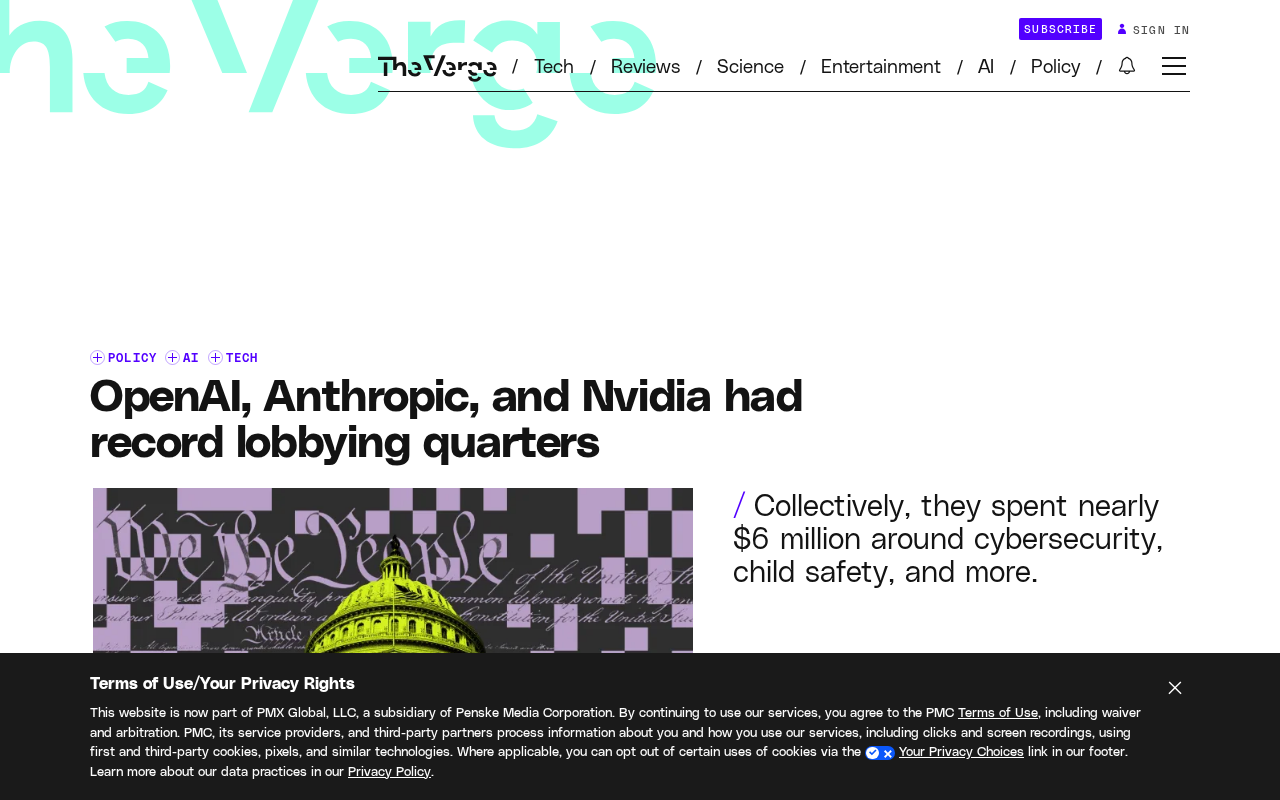
According to federal disclosure filings, OpenAI, Anthropic, and Nvidia all set their own quarterly records for lobbying spending between July and September. Nvidia led with $2.2 million, followed closely by Anthropic at $2.1 million, with OpenAI third at $1.5 million. The data, reported by the rss source article, reveals that AI companies are now engaging in the policymaking process with unprecedented intensity.
Compared with the large tech companies that have spent years cultivating ties in Washington, these three AI firms still lag in absolute terms—but their rate of growth and concentration of spending are worth watching. Summer is typically a congressional recess period, yet the heat around AI legislation has not cooled. From export controls to model safety to copyright and liability attribution, each issue could reshape the industry landscape.
Why AI Companies Suddenly Ramped Up Lobbying
The Regulatory Window Is Narrowing
Regulatory frameworks for generative AI are taking shape across multiple jurisdictions simultaneously. The EU AI Act has entered its implementation phase, and the U.S. Congress is advancing several AI-related legislative drafts. For model developers like OpenAI and Anthropic, engaging early in legislative discussions costs far less than being forced into compliance after the fact.
The EU AI Act is the world's first comprehensive law regulating AI. It officially took effect in 2024 and is being implemented in stages: prohibitive provisions came first, followed by obligations for general-purpose AI (GPAI) models and compliance requirements for high-risk systems. The act divides AI systems into four risk tiers—unacceptable risk, high risk, limited risk, and minimal risk—corresponding respectively to prohibition, strict compliance, transparency obligations, and free use. For model developers, the GPAI provisions are especially critical, requiring technical documentation, summaries of copyright policies, and systemic risk assessments. This means companies with business operations in the EU, such as OpenAI and Anthropic, need to adjust their model training and release processes in advance to meet compliance requirements.
Compute Export Controls Directly Affect Nvidia
It comes as no surprise that Nvidia tops the lobbying spending list. As a leading supplier of AI chips, its business is directly affected by export control policy. The $2.2 million quarterly outlay reflects the chip giant's high sensitivity to the direction of trade policy—every round of adjustments to control rules could mean billions of dollars in changes to market access.
Compute export controls primarily refer to the Export Administration Regulations (EAR) implemented by the U.S. Department of Commerce's Bureau of Industry and Security (BIS), which impose licensing requirements on exports of certain high-performance chips and their manufacturing equipment to countries such as China. Since 2022, the U.S. has updated its rules multiple times, defining controlled scope through metrics such as compute thresholds and interconnect bandwidth, and has successively added several AI accelerator cards to the control list. Rule adjustments affect not only the chips themselves but also upstream segments such as advanced-node foundry and high-bandwidth memory. For Nvidia, each revision of the controls could alter the product mix it can sell to markets and its revenue expectations—a direct driver of its high lobbying spending.
Safety and Liability Issues Require a Corporate Voice
Anthropic's $2.1 million in spending is slightly below Nvidia's, but relative to its own size, the investment ratio is considerable. Model safety, alignment research, and liability exemptions are core concerns for Anthropic, and actively participating in rulemaking helps translate its own technical approach into industry standards.
Model alignment is a core concept in the AI safety field, referring to the technical research direction of making model behavior consistent with human intent and values, typically including methods such as reinforcement learning from human feedback and Constitutional AI. The related issue of liability exemption concerns how responsibility should be allocated among model developers, deployers, and users when model outputs cause harm. Currently, the U.S. has no unified AI liability legislation; some proposals favor providing defenses or safe harbors for companies that comply with specific safety standards. For a company like Anthropic, which differentiates itself through safety research, pushing for rules that link safety practices to liability allocation can both reduce its own legal risk and turn its technical approach into an industry-wide standard.
The Gap With Established Tech Giants Is Narrowing
The original article notes that compared with large tech companies that have long been established in Washington, these three AI firms are still in a catch-up phase in lobbying spending. But it's worth noting that companies like Meta and Google took more than a decade to build mature government relations teams, whereas AI companies have pushed spending to historic highs in just a few quarters. That acceleration is itself a signal: the AI industry is far more policy-sensitive than the internet software industry that preceded it.
In terms of spending structure, the three companies' combined total (about $5.8 million) still falls short of a single established giant's quarterly lobbying budget. But considering that their products are penetrating regulated sectors such as education, healthcare, and finance, future lobbying investment is likely to keep climbing.
Federal lobbying disclosure is conducted under the U.S. Lobbying Disclosure Act (LDA). Registered lobbyists must file quarterly reports with Congress disclosing clients, issue areas lobbied, specific bills or agencies involved, and the amount spent on lobbying during the quarter. These data are made public by the Senate and House of Representatives and serve as an important public information source for studying corporate-government interactions. It should be noted that "lobbying spending" in disclosure terms typically covers only external lobbying activities and some internal lobbying costs; it does not include political contributions or indirect spending through industry organizations. Therefore, when making cross-company comparisons, it can only serve as a reference indicator, not a complete picture of a company's policy investment.
Potential Impact on the Competitive Landscape
Increased lobbying spending means AI companies are shifting from passively accepting regulation to actively shaping the rules. This shift has two implications:
- Leading companies gain more say: Companies that can afford high lobbying spending have more opportunity to leave their mark on legislative drafts, while smaller firms may be forced to adapt to rules shaped with input from giants.
- Policy uncertainty is reduced: Proactive corporate communication helps regulators more accurately understand technological boundaries and reduces over-regulation caused by information asymmetry.
According to data disclosed in the rss source article, all three companies marked July through September as their peak lobbying quarters. This synchronicity suggests that the entire industry's perception of policy risk rose sharply within the same time window. For those following AI governance, lobbying disclosure data provides a window into the rhythm of industry-government interaction.
Conclusion: Industry Maturity Behind the Lobbying Data
Record lobbying spending is not necessarily a negative signal. It reflects that AI companies are learning how to operate in a regulated environment, and it shows that policymakers are willing to listen to voices from the technological frontier. What truly deserves continued attention is whether this spending can translate into clearer, more enforceable rules—rather than becoming a tool for leading companies to entrench their advantages.
Related articles

LLaMA-Factory in Practice: A Complete No-Code Guide to Fine-Tuning Large Models
An introduction to LLaMA-Factory, the open-source fine-tuning tool: its 60.1K-star background, supported models and algorithms, local vs. cloud deployment, and CUDA setup steps.

Zeng Ming's Deep Retrospective: Why OpenAI May Not Be the Ultimate Winner — and Why the Corporate System Will Disappear
Zeng Ming's deep retrospective on the AI endgame: model companies are just infrastructure, OpenAI and Anthropic won't be the final winners; the next battle is the Agent entry point standard; the corporate system will disappear as AI restructures collaboration, and only mission-driven companies can survive the cycle.

OpenHands v1.28.0: OpenCode and PI Added as Built-in Agents, API Keys Requestable In-Conversation
OpenHands ships 5 releases in 21 days: v1.27.0 adds OpenCode and PI as built-in agents, v1.28.0 enables in-chat key requests. ACP integration, credential reuse, model list changes, and upgrade advice.