AI Is Making Law Firms More Efficient — Now Clients Want Their Discount

AI cuts legal busywork, forcing firms to rethink how they price their services.
AI is fundamentally undermining the billable-hours model that has defined legal services for decades. Tasks once requiring hours of associate work now take minutes, prompting corporate clients — who increasingly deploy legal tech themselves — to demand discounts or shift to fixed-fee and outcome-based arrangements. Law firms face not just pricing pressure but a structural overhaul of their business model, with fixed fees, value-based pricing, and AI-enhanced services emerging as possible paths forward. The deeper question is whether legal value lies in hours spent or outcomes delivered — and the answer will reshape firm staffing, pricing logic, and legal education alike.
AI Disrupts the Billing Logic of the Legal Industry
Artificial intelligence is rapidly penetrating legal services — from contract review and legal research to document drafting, tasks that once took junior associates hours can now be completed in minutes. Greater efficiency sounds like a win, but it raises a sharp business question: when law firms dramatically reduce their working hours with the help of AI, what happens to the billable-hours model that has sat at the core of legal pricing for decades?
This is precisely the tension the New York Times reported on — firms are getting more efficient, and clients are starting to ask: "So where's my discount?"
The Internal Contradiction of the Billable-Hours Model
The legal industry's traditional profit logic is built on billable hours. The more time a lawyer spends, the higher the invoice. This model sits awkwardly in the AI era: technology makes the same tasks take less time, so if firms continue billing for actual hours worked, revenue naturally falls; but if they maintain their original rates, clients will question why they're paying human-labor prices for work a machine can finish in minutes.
In other words, AI has quietly transformed efficiency gains into a distribution problem — should the productivity dividend go to the firm or to the client? Corporate legal and procurement departments clearly believe that if technology lowers costs, prices should follow.
The billable-hours system traces its origins to the American Bar Association's promotion of the model in the 1950s, designed to give lawyer labor a quantifiable, auditable pricing basis — replacing the vague flat-fee conventions that came before. Over the following decades it became the profit engine of large firms: top partners bill over $1,000 per hour, and total billable hours per firm are a core metric for evaluating attorney performance. Yet the system's incentives were always distorted — it rewards time spent rather than efficiency, and clients bear the information disadvantage of having no real way to verify actual hours worked. AI has simply forced a long-simmering contradiction onto the negotiating table, making it impossible to ignore any longer.
Clients Are Gaining Negotiating Leverage
Historically, pricing power in legal services rested more with firms, thanks to high professional barriers and severe information asymmetry. The spread of AI tools is eroding that asymmetry: a growing number of large corporate clients are deploying legal tech themselves, and they know exactly which tasks can be automated and how far costs can be compressed.
When clients walk in with the knowledge that "AI can do this," the balance of power at the negotiating table shifts noticeably in their favor. Demanding discounts, or pushing for fixed fees and outcome-based billing, becomes a natural ask. For firms that depend on high-margin billable work, this is a structural stress test.
Law Firms Face a Pricing Overhaul
Confronted with this trend, firms may be forced to redesign their business models. Several directions are worth watching:
- Fixed fees: For predictable, highly standardized work, price by project rather than by hour, internalizing part of the efficiency gain as profit.
- Value-based pricing: Anchor fees to the outcomes delivered and the value created for clients — not time invested — breaking free from the billable-hours logic at its root.
- AI-enhanced services: Package AI capabilities as a differentiated offering, emphasizing faster turnaround and more comprehensive risk analysis, competing on quality rather than hours.
At its core, AI is forcing firms to answer a question they have long avoided: what are clients actually paying for — the time a lawyer spends sitting in an office, or the legal outcome they ultimately deliver?
Value-based pricing faces a practical obstacle in the legal industry: how do you objectively measure "the value of a legal outcome"? In litigation, whether a case is won depends on variables outside the lawyer's control — judicial discretion, opposing counsel's strategy — making it hard to isolate the attorney's contribution. For this reason, some firms are exploring hybrid models: charging a fixed fee for baseline services, then adding a success fee if specific outcomes are achieved (a merger closes successfully, a litigation award exceeds a target figure). This structure partially aligns the firm's interests with the client's, and goes some way toward resolving the operational difficulty of pure value-based pricing.
The Deeper Implications for the Industry
The debate over discounts looks on the surface like a pricing dispute, but at a deeper level it is a renegotiation of how legal services are defined and valued. As repetitive, formulaic work is automated, the value of human lawyers will concentrate in judgment, strategy, negotiation, and client relationships — areas where machines struggle to compete.
For the industry as a whole, short-term pain is unavoidable: the path for training junior associates, the staffing structures of firms, and even the direction of legal education may all shift as a result. But in the long run, breaking free from the constraint of measuring value in time could push legal services toward a more transparent, outcome-oriented future. When clients ask "where's my discount," they're not just asking about price — they're asking the entire industry to prove its worth all over again in an AI-driven world.
The position of junior associates (associates) deserves special attention. Traditional firm talent development relies heavily on "volume building quality": young lawyers accumulate experience and advance by doing large amounts of repetitive work — reviewing contracts clause by clause, searching case databases, drafting memos. These are precisely the tasks AI is replacing first. This means that over the next few years, firms may scale back junior hiring, while those who remain will be pushed to take on high-complexity work far earlier — expected to operate at the level of strategy and judgment without having put in the foundational "grunt work." Whether law schools' career development models need to adapt to this gap in advance has become an increasingly urgent topic of discussion within the profession.
Related articles

M&M's Spent Millions Replacing Artificial Blue Dye — Why Is It So Hard?
Mars spent millions trying to replace artificial blue dye in M&M's with spirulina, but thick material clogs pipes and residue risks mold, forcing a full production-line rebuild. Here's the engineering behind the reformulation.

Teammate Wanted for Meta Global AI Developer Hackathon: Computer Vision & Medical AI
A Reddit developer seeks teammates for the Meta Global AI Developer Hackathon, focusing on computer vision and medical AI. This article analyzes the track logic, skills-complementarity needs, and topic selection strategy behind this teaming signal.
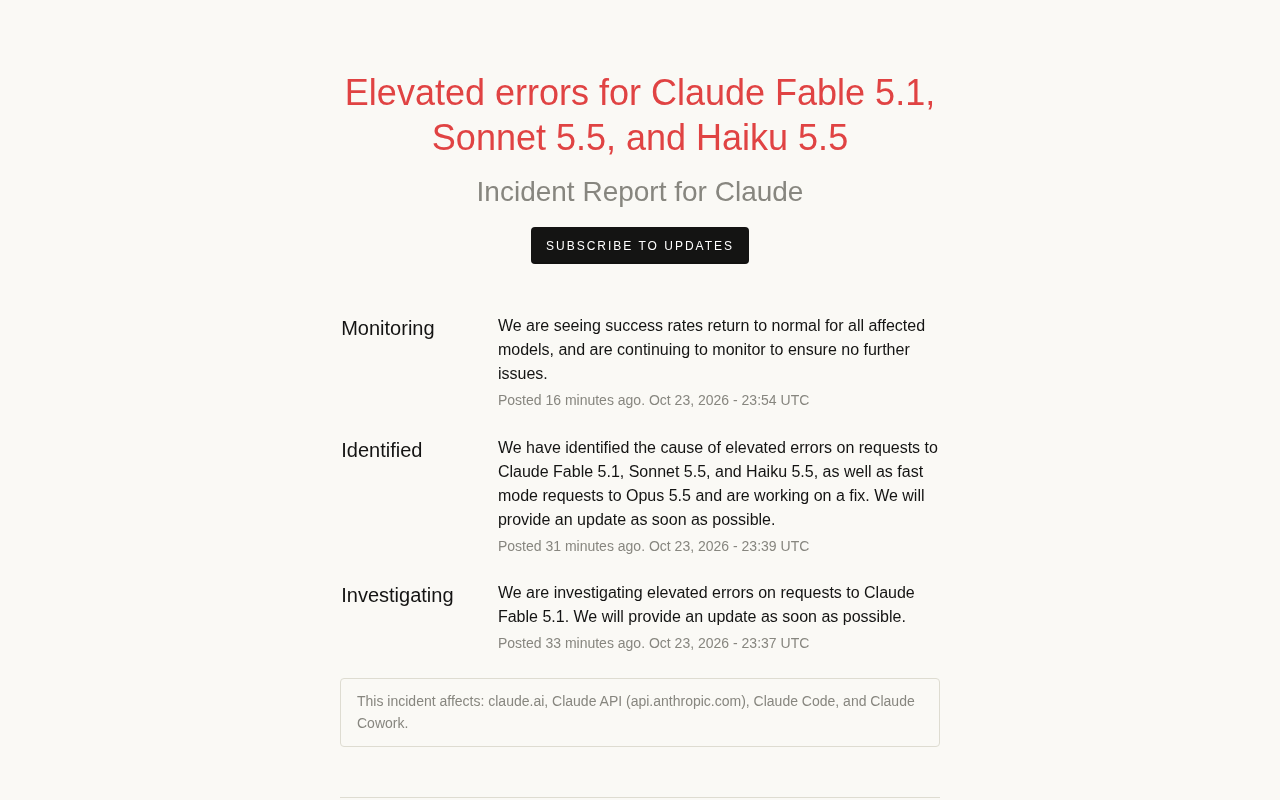
Multiple Claude Models Hit by Errors: A Postmortem of Fable 5.1, Sonnet 5.5, and Haiku 5.5
Claude Fable 5.1, Sonnet 5.5, Haiku 5.5, and Opus 5.5 fast mode saw elevated errors; Anthropic identified and resolved the issue in 17 minutes. This postmortem covers the timeline, the technical reasons for the multi-model cascading failure, and practical lessons for retry and degradation strategies.