AI Is Mass Decompiling Games: Technological Progress and Copyright Concerns Go Hand in Hand

AI is mass decompiling games, boosting preservation and porting while threatening the entire software copyright system.
AI is being used to mass decompile games, greatly lowering the reverse-engineering barrier and driving old game ports to new hardware and browser-based WebAssembly play, ushering in a golden age for game preservation. But the same technology means any software could be decompiled and used freely, posing a fundamental challenge to traditional software licensing and copyright protection. Legal and ethical frameworks lag badly, and the software industry may be forced toward new business models such as servitization. Independent developers, as both creators and consumers, are torn between preservation value and livelihood threats. The article fully captures the tension between technological optimism and commercial reality.
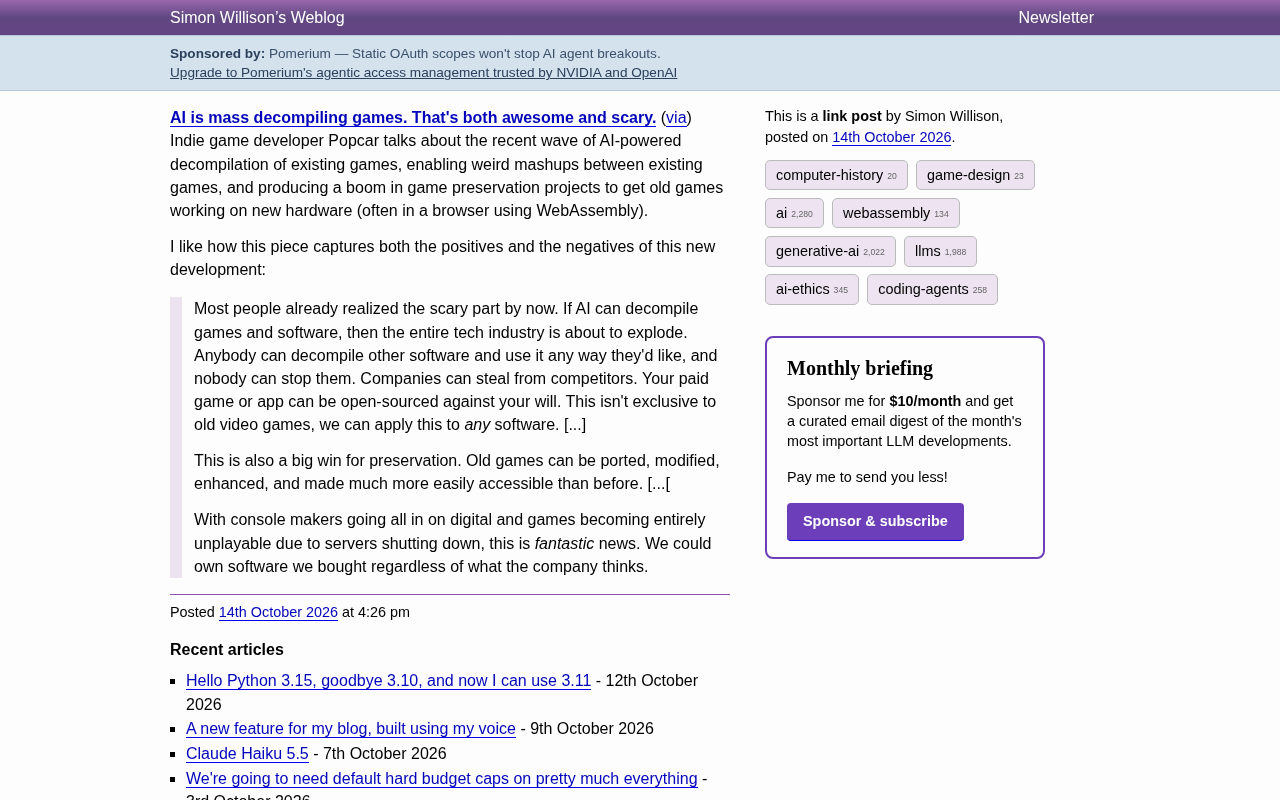
Independent game developer Popcar has raised a quiet industry shift in his blog: AI is being used to mass decompile existing games. This trend has not only spawned bizarre mashups between games, but also driven a surge in preservation projects that port old games to new hardware—especially running in browsers via WebAssembly. When recommending the article, Simon Willison precisely captured its core tension—both awesome and scary.
The Optimistic Side: A Spring for Game Preservation and Accessibility
The most immediate benefit of AI decompilation is the efficiency revolution it brings to game preservation. Traditionally, porting an old game to a new platform requires reverse-engineering teams to spend months or even years manually disassembling, understanding the underlying logic, and rewriting code. AI can complete this process at a fraction of the manual cost and far faster than humans.
In the article, Popcar points out that old games can be more easily ported, modified, enhanced, and made more accessible than ever before. For digital-only games that became completely unplayable due to server shutdowns, this is almost the only path to redemption. Players may finally be able to truly "own" the software they purchased, free from the whims of publishers.
WebAssembly plays a key role in this process. It allows decompiled game code to run directly in the browser without installing any plugins or emulators. This means that as long as there is an internet connection and a browser, anyone can access these games. For game history preservation, this is an unprecedented low barrier to entry.
What is decompilation? Decompilation is the process of converting compiled machine code or bytecode back into source code in a higher-level language that is closer to human-readable form. Traditional decompilation tools (such as IDA Pro and Ghidra) rely on rule matching and manual analysis, requiring reverse engineers to understand assembly instructions section by section, which is extremely time-consuming and has a very high barrier to entry. The involvement of AI models (especially large language models) has changed this situation: models can be pretrained on massive amounts of code, learning the correspondence between code structure and semantics, thereby inferring variable names, function boundaries, and control flow without source code, and generating output far more readable than traditional tools. This capability essentially comes from AI's statistical understanding of code "intent" rather than mechanical translation instruction by instruction, so it can still produce usable results when faced with obfuscated and optimized binaries.
WebAssembly (Wasm) is a low-level bytecode format for browsers, originally standardized by the W3C, with the goal of allowing programs compiled from languages such as C/C++ and Rust to run on web pages at near-native speed. Unlike JavaScript, Wasm provides a memory model and execution semantics closer to hardware, making it very suitable for carrying code decompiled and ported from game consoles or PCs. Developers only need to recompile the decompiled logic into a Wasm module, then add a layer of JavaScript glue code to handle input and output, and old games can run directly in a browser tab without users installing emulators or plugins. This makes game preservation no longer dependent on specific hardware or operating systems, and also greatly lowers the barrier for ordinary users to access classic games.
The Disturbing Other Side: Any Software Can Be Decompiled
Popcar does not avoid the severity of the problem. He clearly states: if AI can decompile games and software, then the entire tech industry will face an explosive impact. Anyone can decompile someone else's software and use it however they want, and no one can stop them.
This capability is not limited to old video games. Popcar emphasizes that we can apply this technology to any software. Companies can steal code from competitors; games or apps you paid for may be open-sourced against your will. Traditional software licensing models and legal protections appear pale and powerless in the face of AI-driven mass decompilation.
This constitutes a fundamental contradiction: the technological force driving game preservation is also dismantling the copyright system on which the software industry depends for survival. The value of Popcar's observation lies precisely in the fact that he sees both sides at once, rather than simply choosing a side.
Who Is Driving All of This?
Judging from the heated discussion on Hacker News, this topic has attracted widespread attention in the tech community. Combined with Simon Willison's tagging system (coding-agents, llms, generative-ai, ai-ethics), it is clear that AI decompilation is not an isolated phenomenon, but a concrete manifestation of the rapid evolution of generative AI and coding agent capabilities.
When coding agents can understand, reorganize, and generate code, the barrier to decompilation is completely lowered. Work that once required professional reverse-engineering skills may now require only the right prompts to an AI model. This democratization of capability both gives independent developers and preservationists unprecedented power and makes the legal departments of large software companies sit on pins and needles.
Coding agents refer to AI systems that can autonomously plan, invoke tools, and execute multi-step coding tasks. They can not only complete a single line of code, but also read an entire codebase, run tests, fix errors, and generate new modules. In decompilation scenarios, coding agents can automatically complete the entire pipeline of "identifying binary formats—analyzing control flow—inferring data structures—generating compilable source code—iteratively fixing compilation errors." This end-to-end automation compresses work that previously required weeks of collaboration by a reverse-engineering team into just a few hours, and as model context windows expand and reasoning capabilities improve, their ability to handle complex commercial software is still rapidly increasing. This is precisely the technical foundation that has turned AI decompilation from isolated hobbyist experiments into an industry-level trend.
The Gray Area of Law and Ethics
At present, the legal framework surrounding AI decompilation is almost blank. Traditional copyright law protects forms of expression rather than functional logic, but there is no consistent judicial practice across countries regarding the extent to which decompiled code constitutes infringement. When AI completes decompilation in an instant and generates large numbers of derivative works, enforcement costs will become unbearable.
Popcar's article implies a cruel reality: technological capability has already run ahead of law and ethics. Game companies can choose to sue individual decompilation projects, but they cannot stop AI-driven mass operations. This may force the software industry to seek new business models—for example, relying more on services rather than products, and focusing more on continuous updates rather than one-time sales.
The Dual Identity Dilemma of Players and Developers
For players, AI decompilation seems like good news: old games are revived, digital games gain permanent playability, and entirely new experiences can even be created based on existing games. But for developers—especially independent developers—they are both creators and consumers, facing a split identity.
Today you cheer for the preservation of old games; tomorrow your paid app may be decompiled and distributed for free. Popcar's identity as an independent developer makes his observations more convincing: he understands both the value of preservation and the threat it poses to creators' livelihoods. This kind of honesty is rare in technical discussions.
Conclusion: An Irreversible Technological Wave
AI mass decompiling games is only the beginning. As model capabilities continue to improve, every corner of the software industry may be affected. The reason Popcar's article is worth reading is that it refuses to provide simple answers, instead presenting in full the tug-of-war between technological optimism and commercial reality. The golden age of game preservation and the twilight of software copyright may be two sides of the same coin.
One-line Summary
AI is mass decompiling games, driving preservation and porting while also threatening the entire software copyright system.
Paragraph Summary
AI is being used to mass decompile games, greatly lowering the barrier to reverse engineering, driving the porting of old games to new hardware and running in browsers via WebAssembly, ushering in a golden age for game preservation. But the same technology also means that any software can be decompiled and used freely, and traditional software licensing and copyright protection face fundamental challenges. Legal and ethical frameworks lag far behind, and the software industry may be forced to shift toward new business models such as servitization. Independent developers, as both creators and consumers, are torn between the value of preservation and threats to their livelihoods. The article fully presents the tension between technological optimism and commercial reality.
Related articles

Free Unlimited Claude Code Solution: Agnes AI + CC Switch Setup Guide
No paid subscription needed — pair the free AI platform Agnes AI with the open-source tool CC Switch to provide a backend for Claude Code, enabling unlimited free calls to text, image, and video models. This guide covers the full setup, test results, and usage boundaries.

A Complete Zero-Cost Guide to Getting Started with Claude Code for Beginners in China
A beginner's guide to Claude Code for users in China: two installation methods (command line and IDE plugin), full configuration steps for replacing the official API with the free domestic LongCat model, and a hands-on demo of building a small tool with natural language, plus tips.

When the NSA Gets Involved: The AI Supply Chain Crisis Behind Open-Source CVEs and API Key Hijacking
Multiple open-source projects disclosed severe CVEs in one day, PHP flaws alarmed the FBI, and Railway and OpenCode were breached with API keys stolen. This article breaks down the vulnerability window, AI-accelerated exploitation, and the AI supply chain crisis behind the API key black market, with a developer defense checklist.