AI Large Model Learning Roadmap: A Complete Five-Stage Guide from Zero to Independent Deployment

A five-stage roadmap guiding developers from Python basics to fine-tuning and deploying AI large models.
This article breaks down a structured five-stage AI large model learning roadmap (L0–L4), covering Python fundamentals, prompt engineering, RAG pipeline construction, Agent development, and model fine-tuning with private deployment. It helps developers at any level find the right entry point and build practical skills in a logical, progressive order.
In an era where AI large model technology is sweeping across every industry, more and more developers and tech enthusiasts want to systematically master large model capabilities. Yet faced with an overwhelming number of tutorials and a fragmented tech stack, many people don't know where to begin. This article breaks down a widely recognized zero-to-hero learning roadmap, mapping out the complete path from beginner to advanced practitioner — helping you set a clear direction and avoid common pitfalls.
The Overall Framework of the AI Large Model Learning Roadmap
This learning roadmap divides AI large model study into five stages — L0 through L4 — forming a progressive growth curve that moves from shallow to deep. The core logic is: first build a solid programming and conceptual foundation, then gradually move into engineering practice and agent development, ultimately reaching model fine-tuning and private deployment.
The value of this layered design lies in preventing beginners from getting lost in complex frameworks right from the start. For many self-taught learners, the most common mistake is skipping the fundamentals and jumping straight into advanced projects — ending up knowing what to do but not why it works. Clear stage definitions allow everyone to find the right entry point based on their current level.
L0: Python Programming Fundamentals
For those with a weak programming foundation, learning should start at the L0 stage, with the core task being a systematic mastery of Python. Python has become the de facto standard in the AI field thanks to its clean syntax and rich ecosystem — from NumPy and Pandas for scientific computing, to PyTorch and TensorFlow for deep learning, to LangChain for large model application development, virtually the entire AI tech stack is built around Python. Variables, functions, object-oriented programming, common data structures, and the use of mainstream libraries like NumPy and Pandas form the foundation for all subsequent learning.
If you already have some programming experience, you can quickly skip this stage and move directly into building an overall understanding of large models.
Prompt Engineering and RAG Pipelines: L1 to L2
The L1 stage focuses on building an overall understanding of AI large models, with the most critical skill being Prompt Engineering. Prompt engineering is a systematic methodology for constructing and optimizing input instructions to maximize the output quality of large language models. Since the release of GPT-3, researchers have found that model output quality is highly dependent on how inputs are phrased — the same question, worded differently, can produce vastly different results. This gave rise to a range of established techniques such as Chain-of-Thought prompting, Few-shot Prompting, and Role Prompting. The core value of mastering prompt engineering lies in the fact that it's a low-code method of unlocking model capabilities. Regardless of how the underlying models evolve, the ability to precisely express your intent remains the central interface between humans and AI — and runs throughout the entire learning journey.
At the L2 stage, the focus shifts to mastering the full pipeline of RAG (Retrieval-Augmented Generation). RAG was first proposed by the Meta AI research team in 2020, with the core idea of combining information retrieval systems with generative language models to address two fundamental weaknesses of large models: the training cutoff (knowledge recency) and hallucination. A typical RAG pipeline consists of three core components: document chunking and embedding (vectorization), vector database storage and semantic retrieval, and injecting retrieved results into a prompt for the LLM to generate a response. RAG has become the go-to choice for enterprise deployment because it allows private knowledge to be injected without retraining the model, deployment costs are far lower than full fine-tuning, and the knowledge base can be dynamically updated — dramatically lowering the barrier and risk of applying large models in business contexts.
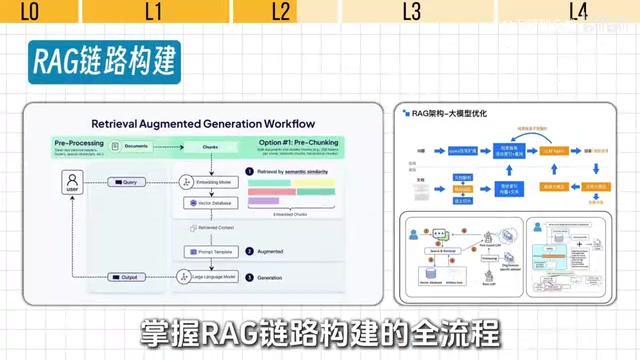
On the tooling side, it's recommended to learn the two mainstream frameworks: LangChain and LlamaIndex. LangChain was released by Harrison Chase in October 2022 and quickly became the most downloaded open-source framework in the LLM application development space. Its core abstractions are "Chains" and "Agents," making it well-suited for orchestrating complex call pipelines and workflows. LlamaIndex (formerly GPT Index) focuses on solving the core challenge of "how to make LLMs efficiently understand your data," with deeper optimization in document parsing, multi-level indexing, and hybrid retrieval strategies. The distinction between the two is clear: LangChain is more of a general-purpose LLM application orchestration framework, while LlamaIndex is a specialized data indexing and query engine. In real-world engineering, the two are often used together — LlamaIndex handles the data layer while LangChain orchestrates the application logic layer — enabling you to quickly build a complete RAG application. This is the critical leap from theory to engineering practice.
L3: Core Capabilities in Agent Development
The L3 stage centers on Agent development, which is currently the hottest and most imaginative technical direction. In the era of large models, an Agent is redefined as: using an LLM as the "brain," combined with Tool Use, Memory systems, and Planning capabilities, enabling the model to autonomously decompose goals, execute tasks in a loop, and adjust strategies based on feedback. The learning path progresses from single-agent systems to multi-agent collaboration. Multi-agent frameworks (such as Microsoft's AutoGen and CrewAI) introduce mechanisms for "role division" and "collaborative communication," allowing multiple specialized agents to work together on complex tasks — an architectural philosophy closely analogous to microservices design in software engineering. Key topics include Agent core architecture design, framework selection, and task orchestration.
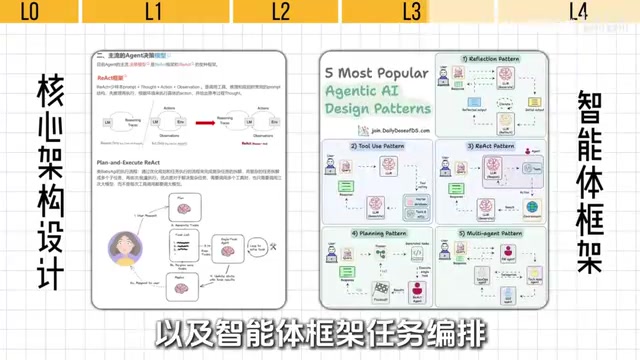
This stage places particular emphasis on enterprise-level project practice. The core challenges of Agent technology — accuracy of task planning, reliability of tool calls, and error accumulation over multi-turn loops — cannot be mastered simply by watching tutorials. Real-world project training is essential to truly understand the practical difficulties of task decomposition, tool invocation, and state management. The progression from single-agent to multi-agent systems is fundamentally an upgrade in capability: from solving individual tasks to orchestrating complex collaborative systems.
L4: Model Fine-Tuning and Private Deployment
As the most advanced stage of the learning roadmap, L4 covers reinforcement learning, model fine-tuning, and private deployment, with the goal of building vertical large models tailored to specific industries — customizing a general-purpose large model using industry-specific data and requirements.

Fine-tuning is the technique of performing secondary training on a pre-trained large model using domain-specific data. Full fine-tuning is prohibitively expensive, so parameter-efficient fine-tuning methods (PEFT) have become the mainstream approach. Among these, LoRA (Low-Rank Adaptation) is the most widely used technique today — by injecting low-rank matrices alongside the original weight matrices, it achieves performance comparable to full fine-tuning using less than 1% of the parameters, dramatically lowering the barrier to developing vertical models. On the private deployment side, mature inference frameworks like Ollama, vLLM, and LMDeploy have made it possible to deploy open-source large models on local GPU servers and even consumer-grade graphics cards. For data-sensitive industries such as finance, healthcare, and law — where data cannot leave the organization — private deployment is not just a technical choice but a compliance requirement. This is the fundamental reason why L4-level capabilities command extremely high commercial value in the enterprise market. Learners who reach this stage have acquired the practical ability to independently build industry-grade large model solutions.
How to Make the Most of This AI Large Model Learning Roadmap
Overall, the L0-to-L4 roadmap is logically clear and progressively structured, covering a complete tech stack from foundational programming to advanced deployment. Its greatest value lies not in the depth of any single topic, but in providing beginners with a clear learning map — one that shows where you are, and where to go next.
That said, it's important to have realistic expectations about "fast-track" learning claims. AI large models are an extremely knowledge-dense field, and true mastery depends on long-term hands-on practice. Use this roadmap as a structural reference, and allow sufficient time for practical work at each stage — especially L2's RAG pipeline and L3's Agent development, which are currently the two most industry-relevant and practically valuable areas.
For newcomers looking to enter the field, rather than feeling overwhelmed by the sheer volume of content, set clear stage-by-stage goals and start steadily from L0 or L1. Build your own knowledge system piece by piece.
Key Takeaways
Related articles

The Truth Behind Codex 'Build a Website in 5 Minutes': AI Isn't Creating Sites—It's Helping You Copy Them
Exposing the truth behind viral Codex 5-minute website videos: creators aren't building original sites with AI—they're copying shared prompts or scraping others' work. Learn AI coding tools' real limits.

Getting Started with AI Agent Development: A Complete Guide from Concept to Practice
A comprehensive guide to AI Agent architecture and development, covering automated marketing, intelligent customer service, and investment analysis scenarios with single and multi-agent collaboration.

The Truth Behind Codex 'Build a Website in 5 Minutes': AI Isn't Creating Sites — It's Helping You Copy Them
Exposing the truth behind viral Codex 5-minute website videos: creators aren't building original sites with AI — they're copying shared prompts or scraping others' work.