AI Leaders Call for a Slowdown — But Trump Says the Industry Is Overreacting
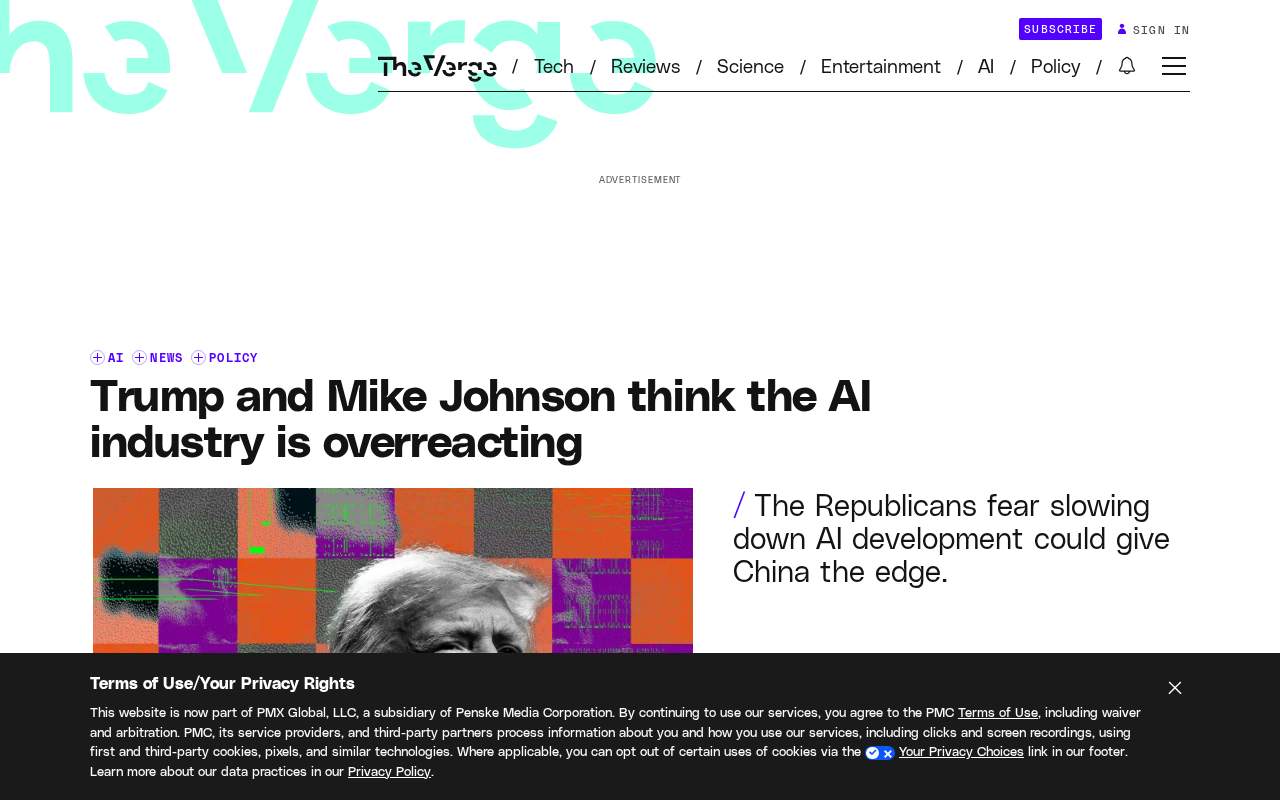
AI CEOs unite to call for slowing frontier development, but Trump's Washington says the industry is overreacting.
Anthropic CEO Dario Amodei published an open letter calling for the AI industry to voluntarily "pace the frontier" and slow the race to build more powerful models. The proposal earned rare public endorsement from OpenAI's Sam Altman, xAI's Elon Musk, and Google DeepMind's Demis Hassabis — a remarkable moment of alignment among fierce competitors. Yet the U.S. political establishment, including President Trump and House Speaker Johnson, dismissed the concern as overreaction, fearing that slowing down would cede ground to China. The article argues this exposes a deeper structural problem: without external enforcement mechanisms, voluntary industry slowdowns are inherently unstable — and the government that should provide those mechanisms is instead standing in the way.
An Open Letter Ignites the AI Regulation Debate
Anthropic CEO Dario Amodei published a heartfelt open letter with a single core message: it's time to "pace the frontier" — to deliberately slow down the race to build ever-more-powerful AI models. Rather than dwelling on abstract safety anxieties, the letter is a direct call for the industry to voluntarily pump the brakes in its pursuit of stronger models.
What makes this noteworthy is the rare public response it received from the industry's top players. OpenAI's Sam Altman and Tesla/xAI's Elon Musk both voiced support on X, while Google DeepMind's Demis Hassabis offered cautious endorsement of Amodei's proposal. The fact that fierce competitors — companies locked in an arms race with one another — could find some common ground around "slowing down" is itself a signal worth noting.
Washington Pushes Back: The Industry Is Overreacting
The political response from Washington stands in sharp contrast to the industry's cautious posture. According to reports, President Donald Trump and House Speaker Mike Johnson aren't buying it — they believe the AI industry is simply "overreacting."
This divide stems from two fundamentally different frameworks. For tech leaders like Amodei, the rapid leap in frontier model capabilities is itself a source of risk, and voluntarily slowing down is a form of preventive responsibility. For the political forces represented by Trump and Johnson, slowing AI development means ceding ground in the global technology race — especially against China — which is a trade-off they find unacceptable.
Why This Divide Deserves Attention
The typical script goes like this: tech companies chase growth, and regulators push for restraint. This time, the roles are almost entirely reversed — it's the industry leaders calling for the brakes, while the politicians are the ones stepping on the gas.
This role reversal reveals a deeper reality. When the people who best understand the actual trajectory of the technology start raising alarms, and policymakers dismiss those concerns as "overreacting," it signals a serious information and perception gap. Technical experts see the slope of the capability curve; political decision-makers see a grand narrative of national competitiveness and economic growth.
Consensus and Disagreement Coexist
Based on public information, the leading AI labs have reached a rare point of convergence on the idea that "some form of restraint is needed." But what "restraint" actually means — whether it's self-regulation, an industry agreement, or legislatively mandated limits — remains unanswered. The lukewarm response from the government side makes any form of enforceable slowdown a distant prospect in the near term.
Is Slowing Down Even Feasible?
Even if all the major labs verbally agreed to "pace the frontier," implementation faces structural obstacles. AI development is a classic multi-player game: as long as one party chooses to accelerate, everyone else who holds back ends up at a competitive disadvantage. Without external constraints — whether from regulation or international agreements — a slowdown driven purely by corporate self-discipline is hard to sustain.
And right now, the very government that should be playing the role of external constraint is standing firmly on the side of "no need to panic." This means that even if the industry wants to slow down, there's no mechanism to coordinate all parties and prevent defectors from reaping the rewards.
The real value of this debate may not lie in its conclusions, but in the question it finally puts on the table: when the pace of technological advancement outstrips society's ability to absorb it and regulation's ability to keep up, who has the authority — and what tools do they have — to hit pause? Until the industry and the government each provide an answer, the frontier model race will clearly not stop.
Related articles

Codex vs. Claude Code: A Beginner's Guide to AI Coding Agents
Codex vs. Claude Code: which AI coding agent should you use? This guide compares both tools and walks beginners through GPT account setup, virtual number platforms, US App Store switching, and subscription cost-saving tips.

Pi-chat in Practice: Connecting External Tools to AI Agents via MCP Protocol
Learn how to integrate external tools into AI Agents using MCP protocol with Pi framework. Covers pi-mcp-adapter setup, .mcp.json config, Extension Factory initialization, and a live 12306 train ticket query demo.

AI Large Model Engineering Careers Decoded: Algorithm Research vs. Engineering Deployment — Which Path Is Right for You?
AI large model jobs split into algorithm research and engineering deployment. Learn the skill requirements, core competencies like RAG and Multi-Agent, and why Harness architecture is the 2026 interview differentiator.