AI Penetration Testing Learning Roadmap: Four Stages from Beginner to Security Expert

A four-stage roadmap for mastering AI-powered penetration testing, from basics to building intelligent security Agents.
This article outlines a four-stage learning path for AI penetration testing: starting with AI fundamentals and security ethics, progressing to hands-on AI-assisted vulnerability discovery, advancing to enterprise-level automated security integration, and culminating in intelligent Agent development. The core philosophy is human-AI collaboration—letting AI handle repetitive tasks while humans focus on strategy and analysis.
As AI Agents become capable of automatically discovering vulnerabilities, the role of cybersecurity professionals is being redefined. The traditional penetration testing model—relying on manual command execution and repetitive tool usage—is gradually giving way to a "human-AI collaboration" paradigm. Based on an AI penetration testing learning roadmap shared by a Bilibili creator, this article outlines a complete growth path from beginner to expert, helping professionals looking to enter the AI security field establish a clear plan.
Why AI + Cybersecurity Is a Direction Worth Pursuing
The cybersecurity field has long faced a core contradiction: the attack surface keeps expanding while security talent remains severely scarce. Many aspects of penetration testing—information gathering, asset mapping, vulnerability verification, report generation—are essentially repetitive, labor-intensive tasks. This is precisely the type of work that large language models and intelligent agents excel at taking over.
With the maturation of code agent tools like Claude Code and Codex, AI can now understand vulnerability principles, write scanning scripts, and orchestrate tool-calling chains. The future of security testing is no longer about manually typing commands and staring at scanner output—it's about letting AI handle the repetitive labor while humans focus on higher-value vulnerability analysis, attack strategy design, and security policy formulation.
This shift means that professionals with combined "AI + security" capabilities will become the core of their teams. The entire learning roadmap is divided into four progressive stages, which we'll break down one by one.
Stage 1: AI Penetration Testing Fundamentals
The core goal of the introductory stage is to understand what AI can do for penetration testing and establish proper security awareness boundaries—not to dive headfirst into complex underlying algorithms.
First, you need to understand the foundational concepts of AI and intelligent agents, including Tokens, Context, Agent operating mechanisms, and how to use common tools like Codex and Claude Code. This step is the foundation for understanding all subsequent hands-on work.

Second, you must establish proper cybersecurity ethics awareness. The definition of white-hat hackers, professional ethics, and the legal authorization boundaries of security testing are absolute red lines that cannot be ignored. Any penetration testing must be conducted with legitimate authorization; otherwise, it violates the law.
Finally, master the standard penetration testing workflow: Information Gathering → Threat Modeling → Vulnerability Exploitation → Post-Exploitation → Report Generation. Within this framework, understand AI's core application points—rapidly mapping target assets during information gathering, assisting in understanding principles during vulnerability analysis, and supporting vulnerability verification and report generation. This stage focuses only on practical, immediately applicable AI security fundamentals without touching complex algorithms.
Stage 2: AI-Assisted Web Vulnerability Discovery in Practice
The second stage enters hands-on practice, with the goal of actually incorporating AI into vulnerability discovery work, achieving automated asset collection and intelligent vulnerability analysis.
The first step in practice is setting up an AI penetration testing lab environment. This includes AI assistant installation and configuration, selecting appropriate large language models, workspace setup, and access permission management. A stable, controllable environment is the prerequisite for all subsequent operations.
Next comes AI-assisted asset collection and attack surface mapping. With AI, you can quickly write asset collection tools, perform web fingerprinting, analyze scan results, and even discover potential security issues through source code analysis.

Most critically, learn to combine AI capabilities with hands-on tools like Kali Linux. By chaining AI's tool-calling capabilities with vulnerability analysis abilities, you can complete a relatively comprehensive automated penetration testing workflow. This step represents the qualitative leap from "knowing what AI can do" to "actually getting AI to do the work for me."
Stage 3: Enterprise-Level AI Automated Penetration Integration
The third stage targets enterprise scenarios, with the goal of integrating AI capabilities into existing security testing frameworks to build a personal penetration testing platform with AI capabilities.
The technical complexity increases significantly at this stage, covering four main directions:
Secondary Encapsulation of AI-Assisted Penetration Frameworks
Connect AI to existing security tool chains to achieve automated information gathering and vulnerability scanning, allowing the entire process to run without frequent human intervention.
AI-Assisted Exploitation and Post-Exploitation Operations
Leverage AI to assist in generating attack payloads and designing strategies to bypass defense mechanisms—this places higher demands on AI's reasoning capabilities and security knowledge base.
AI-Automated Security Report Generation
AI can automatically organize penetration testing data and output standardized security reports, dramatically reducing the time spent manually writing documentation.

AI in CI/CD Security Pipelines
Embed automated security detection during enterprise code commits, shifting security left into the development phase to form a "security closed loop." This is a typical implementation scenario combining DevSecOps philosophy with AI.
Stage 4: Advanced Growth to Become an AI Security Expert
The final stage is career advancement, with the goal of becoming your team's AI security testing expert, capable of handling complex system penetration and developing custom security tools.
Real-World Vulnerability Discovery Platform Practice
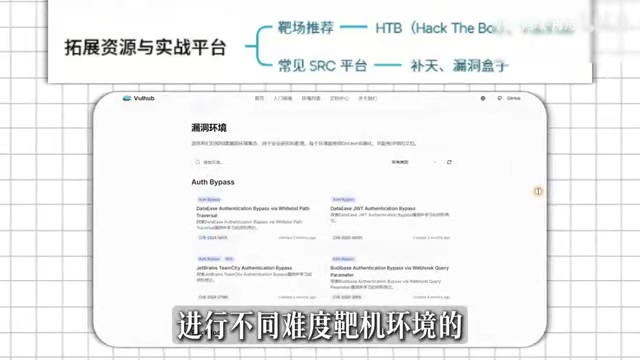
Gain in-depth familiarity with SRC (Security Response Center) platforms like Butian and Vulbox, accumulating experience in vulnerability discovery workflows and submission processes in real enterprise environments. This is the real battlefield for validating AI penetration testing capabilities.
Security Lab Penetration Exercises
Use platforms like HackTheBox to conduct vulnerability analysis and penetration exercises in attack environments of varying difficulty, systematically improving practical skills.
Intelligent Penetration Testing Agent Development
This is the most cutting-edge part—building multi-Agent collaborative systems where multiple intelligent agents cooperate to execute automated penetration testing and automatically explore attack paths. This touches the technical ceiling of AI security.
Adversarial Security Strategy Formulation
At this point, the focus of work should completely shift from "repetitively running tools" to vulnerability analysis, attack strategy design, and security policy formulation, returning to the essential value of security work.
Human-AI Collaboration: The Core Philosophy of AI Penetration Testing
This four-stage roadmap clearly outlines the growth curve for security professionals in the AI era: from understanding AI fundamentals, to using AI to assist in vulnerability discovery, to enterprise-level integration, and finally growing into a security expert capable of developing intelligent Agents.
The core philosophy throughout is—delegate repetitive work to AI, and reserve your energy for thinking. The essence of security confrontation is the battle of minds between attackers and defenders, and AI amplifies the leverage effect of human thinking. For newcomers hoping to enter the field, this roadmap not only provides a technical map but, more importantly, points to where future security talent's value lies: not as command executors, but as strategy designers.
Related articles

Apple HomeView Hands-On Review: Is the $300 Smart Home Hub Worth It?
Apple HomeView hands-on: a $300 smart home hub with facial recognition for quick account switching, but no App Store or voice recognition. Is the wall-mounted version worth it? Should you buy the first generation?

Meta Muse Wonder Launch: What It Means for Meta's Return to the Frontier AI Race
Meta releases Muse Wonder and WonderFull, benchmarks reach the frontier, community feedback is polarized. An in-depth look at Meta's return to the frontier AI race, its personal agent strategy, and Zuckerberg's different path.

Apple Home Smart Home Lineup Leaked: LG and Schneider Team Up, UWB Door Lock on Board
Apple Home ecosystem gains new LG and Schneider devices: UWB smart lock with proximity unlock, 2.5K dual-camera doorbell, privacy indoor camera, and AirPods-like seamless pairing.