AI-Powered Vulnerability Discovery in Practice: A Complete Guide to LLM Security Applications

A comprehensive guide to using LLMs for automated vulnerability discovery and security offense-defense applications.
This article provides a systematic analysis of LLM applications in cybersecurity, covering six major directions including AI code auditing, automated vulnerability discovery, CTF Agents, model jailbreaking, and AI self-security. It includes practical guidance on tool selection, API platform recommendations, learning paths from beginner to practitioner, and essential compliance guidelines for ethical security research.
Introduction: The Deep Convergence of AI and Cybersecurity
Since ChatGPT burst onto the scene, the capability boundaries of large language models have been continuously redefined. While AI has been shining in code generation and content creation, a more challenging question has emerged: Can AI truly discover security vulnerabilities automatically?
This is not just a technical question for security practitioners—it represents a paradigm shift facing the entire cybersecurity industry. The core technical foundation of Large Language Models (LLMs) is the Transformer architecture, which achieves efficient modeling of long text sequences through the Self-Attention mechanism. Since ChatGPT's release in late 2022, models like GPT-4, Claude, and DeepSeekAd have demonstrated near-human-expert capabilities in code comprehension and logical reasoning. This breakthrough has rapidly moved AI cybersecurity applications from theoretical discussion into engineering deployment, marking the industry's paradigm shift from "rule-driven" to "intelligence-driven."
This article is based on a practical AI+security sharing session by Wu Yang (学海无涯), a cybersecurity instructor on Bilibili, systematically covering the current state of LLM applications in security offense and defense, practical pathways, and learning methods.
According to the speaker, he has been in R&D since graduating in 2012, transitioned to cybersecurity in 2016, and has worked across penetration tool development, malware analysis, security system development, and more. In recent years, he has focused on AI and security convergence research. This compound background lends both engineering perspective and practical experience to the analysis.

Six Major Application Directions for LLM Security Offense and Defense
Full Coverage from Basic Capabilities to Practical Scenarios
LLM empowerment of the security domain isn't a single-dimensional improvement—it covers multiple stages of the entire offense-defense chain. According to the course plan, LLM security practice encompasses the following core directions:
- AI Code Auditing: Using LLMs to automatically analyze source code and identify potential security flaws and logic vulnerabilities
- AI Automated Vulnerability Discovery: Leveraging specialized Agent tools to achieve semi-automated or fully automated vulnerability detection
- CTF Agent: Having AI participate in Capture The Flag competitions to validate its reasoning and attack capabilities
- Model Jailbreaking: Researching the security boundaries and protection mechanisms of LLMs themselves
- AI Self-Security: Exploring risks introduced by LLMs as a new attack surface
These directions form a complete knowledge framework—encompassing both using AI for security (offense and defense) and securing AI itself (model protection). This bidirectional perspective is the core framework of current AI security research.
AI Code Auditing: LLMs' Natural Advantage Battlefield
Code auditing became the first security scenario where LLMs achieved practical deployment because the task's nature aligns perfectly with LLM capabilities. Code itself is structured text, and vulnerabilities often manifest as specific patterns and logic flaws. LLMs' powerful contextual understanding and pattern recognition capabilities are precisely suited to capture these issues hidden deep within code.
Traditional static analysis tools (such as Fortify, SonarQube, Checkmarx) perform detection based on Abstract Syntax Tree (AST) parsing and predefined vulnerability rule databases. Their limitation is that they can only find vulnerabilities matching known patterns, and are often powerless against complex business logic vulnerabilities (such as permission bypasses, race conditions). LLMs' semantic-level understanding capability means they can comprehend code "intent" like a human auditor—for example, judging whether an input validation truly covers all edge cases, or whether an authentication flow has a timing logic flaw. This capability stems from pre-training on massive code corpora (including public GitHub repositories, CVE security vulnerability databases, etc.), enabling them not only to recognize known vulnerability patterns but also to infer potential risk points from code context. This means that for novel, complex logic vulnerabilities, AI can provide insights that traditional tools struggle to cover.
Agents: The Core Engine of Automated Offense and Defense
Among these application directions, Agents are the key technology for achieving automated offense and defense. The core idea of an Agent is to give LLMs the autonomous capability of "planning-executing-reflecting." In security scenarios, a typical Agent workflow might be: receive target system information → autonomously plan attack paths → invoke security tools (such as Nmap, Burp Suite, etc.) to perform reconnaissance → analyze returned results → adjust strategy and continue deeper. Representative frameworks include LangChain, AutoGPT, CrewAI, etc. Compared to simple Prompt calls, Agents can handle multi-step, dynamic decision-making complex security tasks—precisely the core capability needed for automated vulnerability discovery.
CTF Competitions: The Litmus Test for AI Reasoning Capabilities
CTF (Capture The Flag) is the most important skills competition format in cybersecurity, with challenges spanning Web security, reverse engineering, cryptography, binary exploitation (Pwn), miscellaneous (Misc), and more. CTF challenges typically have clear objectives (capturing the Flag) and well-defined difficulty levels, making them ideal benchmarks for measuring AI security reasoning capabilities. Since 2024, multiple research teams (such as NYU's Cybench, UIUC's research) have demonstrated that LLMs can reach beginner-to-intermediate player levels on Web and cryptography CTF challenges, but significant gaps remain on Pwn and reverse engineering challenges requiring complex multi-step reasoning. Having AI participate in CTF problem-solving not only validates the model's actual attack capabilities but also provides valuable feedback data for improving Agent strategies.
Model Jailbreaking and AI Self-Security: New Attack Surfaces
Model jailbreaking refers to bypassing an LLM's safety alignment mechanism through carefully crafted prompts to make it output prohibited content (such as malicious code, attack tutorials, etc.). Common jailbreak techniques include role-playing attacks, multi-turn conversation manipulation, encoding obfuscation, and more. AI self-security is a broader concept encompassing threat vectors such as Prompt Injection, Data Poisoning, Model Extraction, and adversarial sample attacks. As LLMs are widely integrated into enterprise systems, these attack surfaces are becoming core concerns for next-generation cybersecurity, and OWASP has published a dedicated LLM Application Security Top 10 list. Researching these attack and defense mechanisms is both necessary work for securing AI systems and an important pathway for understanding AI capability boundaries.
Tool Selection and Technology Stack Setup Guide
Three Essential Tool Categories
During the AI security practice preparation phase, the speaker emphasized three categories of tools that must be mastered:
- AI Programming Tools: Such as Cursor, Cloud Code, etc., for daily AI-assisted development and code analysis
- General-Purpose Agents: AI frameworks with autonomous planning and execution capabilities, forming the core of automated offense and defense
- AI Vulnerability Discovery Tools: Automated vulnerability detection tools specifically designed for security scenarios
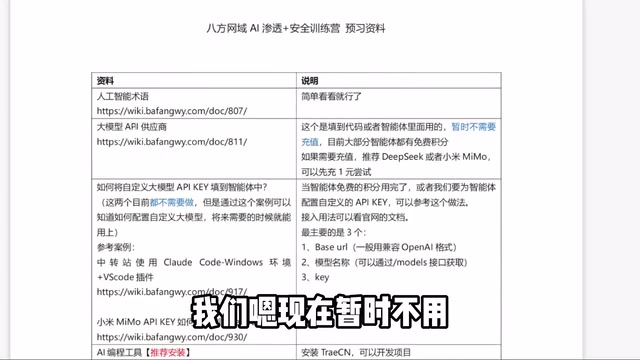
You might not have noticed, but tool selection isn't a one-way binding. The speaker specifically pointed out: regardless of which LLM platform you use, once you master the core methodology, switching tools or models can achieve the same goals. This perspective deserves attention from beginners—don't fall into tool worship; instead, understand the underlying principles and methods.
Cost-Effective Choices for LLM API Platforms
Regarding LLM API selection, the speaker mentioned several key considerations. DeepSeek was strongly recommended for its excellent cost-effectiveness and solid reasoning performance, while alternatives such as Xiaomi API and free models were also mentioned.
DeepSeek is a leading Chinese LLM company whose DeepSeek-V3 and DeepSeek-R1 models excel in reasoning capabilities, with API pricing far below international competitors like OpenAI (approximately one-tenth the price of GPT-4). This extreme cost-effectiveness makes large-scale AI security experiments affordable even for individual researchers and small teams.
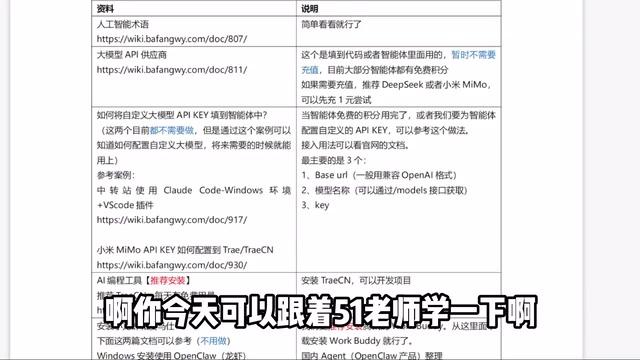
A common misconception needs clarification here: DeepSeek's API interface is completely different from its web version or desktop client. In security practice, we primarily call the API interface, integrating LLM capabilities into the toolchain programmatically rather than using the chat interface directly.

API calls typically use RESTful interfaces or OpenAI SDK-compatible methods, allowing developers to embed model capabilities into automation pipelines using languages like Python. In the security toolchain, a typical integration pattern is: security scanner discovers suspicious code snippets → sends them to the LLM via API for semantic analysis → model returns vulnerability assessment and exploitation suggestions → system automatically generates security reports. This pipeline approach makes security auditing of large-scale codebases possible, truly achieving scalable security detection.
AI Security Learning Path and Compliance Guidelines
Progressive Path from Zero to Practice
A complete AI security learning journey typically consists of two progressive stages:
Stage One: Building LLM Foundational Capabilities
Understand LLM development history, core capability boundaries, and API calling methods. This is the foundation for all subsequent practice—only by truly understanding what models can and cannot do can you design effective security application solutions. Specifically, learners need to understand basic concepts such as Transformer architecture principles, Tokenization mechanisms, context window limitations, and how temperature parameters affect output, while mastering at least one programming language (Python recommended) for API calls and data processing.
Stage Two: Practical Deployment in Security Scenarios
Apply LLM capabilities to specific security scenarios, including code auditing, vulnerability discovery, CTF problem-solving, etc. This stage emphasizes hands-on practice, building offense-defense experience through real projects. It's recommended to start with reproducing known vulnerabilities in open-source projects, gradually transitioning to auditing unknown code, while participating in CTF competitions and enterprise SRC programs to validate learning outcomes.
The speaker mentioned that over years of teaching, he has helped thousands of zero-foundation students enter the security industry, demonstrating this path's viability for newcomers. The key is to build a solid foundation and progress step by step, rather than blindly chasing the latest tools.
Technology for Good: The Inviolable Legal Bottom Line
While demonstrating powerful security techniques, the speaker repeatedly emphasized the importance of compliance: China's cybersecurity-related laws are quite comprehensive—never use learned techniques for illegal activities, or face the consequences.
China's cybersecurity legal framework is primarily built on three pillars: the Cybersecurity Law (2017), the Data Security Law (2021), and the Personal Information Protection Law (2021), complemented by Criminal Law Articles 285 (crime of illegally intruding into computer information systems) and 286 (crime of destroying computer information systems), forming a comprehensive legal protection network. Conducting penetration testing or vulnerability scanning on others' systems without authorization may constitute illegal activity. Compliant security research should be conducted within authorized scope, such as participating in enterprise SRC (Security Response Center) bug bounty programs, or practicing in purpose-built lab environments (such as Vulhub, DVWA, HackTheBox, etc.).
This reminder is far from empty words. As AI dramatically lowers the technical threshold for vulnerability discovery, the risk of security capability misuse rises in parallel. When AI can automatically discover vulnerabilities, the destructive potential of malicious use increases exponentially. AI lowers the attack threshold, but legal liability is not diminished because "AI did it." Therefore, all AI security learning must be built upon the dual constraints of ethics and law.
Conclusion: Future Outlook for AI Security Offense and Defense
Returning to the original question—can AI truly discover vulnerabilities automatically? The answer is yes, but requires a nuanced perspective.
Current LLMs can already provide substantial assistance in code auditing, vulnerability discovery, and CTF problem-solving, significantly improving security work efficiency. However, they primarily serve as a capability amplifier rather than a complete replacement for human security experts. The true value lies in human-machine collaboration—letting AI handle scalable, pattern-based detection work while humans focus on complex decision-making and creative offense-defense strategies.
From an industry trend perspective, AI security offense and defense is entering a new phase: on the attack side, AI Agents can autonomously complete the entire attack chain from information gathering to vulnerability exploitation; on the defense side, AI-driven Security Operations Centers (SOC) can achieve 24/7 intelligent threat detection and response. This situation where both sides leverage AI to enhance capabilities will push the entire cybersecurity industry into a new era of "AI versus AI."
For learners hoping to enter the AI security field, mastering LLM fundamentals, understanding API integration methods, establishing correct tool selection thinking, and adhering to compliance guidelines is the essential path to practice. In an era of rapid technological evolution, the accumulation of methodology matters far more than the iteration of any single tool.
Key Takeaways
Related articles

Chain of Thought Isn't Just for AI: How Humans Can Use CoT to Improve Thinking Quality
Chain of Thought isn't just a prompt trick for large models. Starting from a Hacker News discussion, this article analyzes why CoT works for human thinking too, breaks down actionable ways to transfer it, and highlights the key differences between human CoT and machine CoT.
Cloudflare Teams Up with OpenAI: Closi…
Cloudflare Teams Up with OpenAI: Closing the Loop from Vulnerability Discovery to Defense with AI
Cloudflare uses OpenAI Daybreak to investigate security vulnerabilities and generate reviewable remediation plans, while developers use Codex to boost coding efficiency and quality.

Orca Multi-Agent Orchestration in Practice: A Guide to Parallel Collaboration with Claude and Codex
Orca is Stable AI's free open-source agent workbench supporting 34 agents like Claude Code and Codex in parallel. Learn its Git worktree isolation, multi-model orchestration, and mobile management.