AI Predicts the World Cup: 6 Models Backed France, Claude Alone Picked Spain — and Got It Right

6 AI models echoed betting odds and picked France; Claude alone picked Spain — and Spain won.
A community experiment asked 8 major AI models to predict the World Cup winner. Six models converged on France, essentially restating betting market consensus. Only Claude picked Spain. After Spain eliminated France 2–0, the experiment sparked debate about AI herd behavior, the limits of LLM-based prediction, and what it means for a model to exercise genuine independent judgment.
A Real-World Test of AI Prediction
A fascinating community experiment recently sparked widespread discussion: someone asked 8 mainstream AI models the same question — who will win the 2026 World Cup? The lineup was impressive, covering today's most prominent models from both East and West: Claude, ChatGPT, Gemini, DeepSeekAd, Qwen, Kimi, MiniMax, and GLM.
The results were dramatic. Six of the eight models converged on the same answer: France. The original poster described this level of agreement as "almost boring." Reality, however, had other plans — in the semifinal, Spain beat France 2–0, eliminating the tournament favorite.
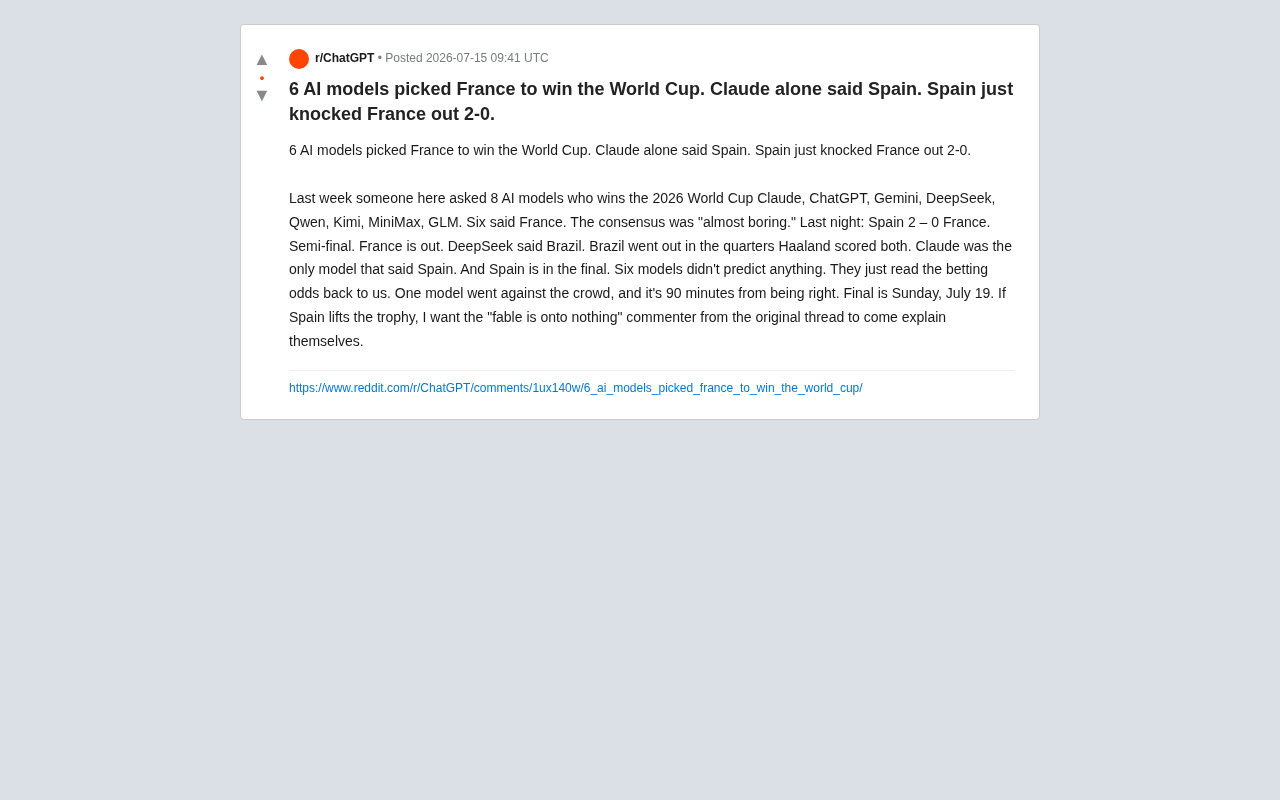
What makes this even more intriguing: Claude was the only model that bucked the trend and picked Spain. Spain has since advanced to the final, just 90 minutes away from lifting the trophy.
AI Prediction: Reading the Odds, or Reading the Game?
The most thought-provoking aspect of this experiment isn't who got it right — it's what the results reveal about a fundamental limitation of large language models when applied to prediction tasks.
The original poster cut right to the heart of it: those six models that picked France "didn't predict anything — they just read the betting odds back to us." It's a sharp observation.
To be fair, betting markets are themselves a form of efficient prediction market. The judgments of countless professional analysts, scouts, and data scientists are aggregated through money into odds, creating a kind of crystallized collective intelligence. Research shows that betting odds outperform most individual expert predictions over the long run. When an AI model restates the odds, it's essentially citing an already market-tested information aggregate — not offering any incremental insight. It's a "correct but useless" answer.
The Technical Roots of Herd Behavior
The way large language models are trained predisposes them to give the "most likely" or "most mainstream" answer. LLMs are pretrained on massive text corpora to learn language patterns and world knowledge, with a core training objective of maximizing next-token prediction probability — a process that is fundamentally statistical averaging. On top of that, RLHF (Reinforcement Learning from Human Feedback) further steers models toward outputs that human evaluators consider "good" — and human evaluators tend to favor answers that align with mainstream consensus. Together, these two mechanisms cause LLMs to naturally gravitate toward conclusions that match the high-frequency consensus in their training data, a phenomenon sometimes called the "median answer" effect.
When asked about a sporting event, a model pulls from its training data — team strength, historical results, public expectations, market odds — and outputs the statistically highest-probability option. France, as a traditional powerhouse with low odds and high expectations, became the "safe choice" for most models. This isn't prediction; it's a restatement of existing consensus. What models are doing is closer to probability-weighted information aggregation than independent reasoning.
DeepSeek's Different Kind of Miss
Worth noting: DeepSeek picked Brazil, who were eliminated in the quarterfinals. This case illustrates that deviating from the consensus doesn't automatically imply sharper insight — sometimes it's just a different kind of error.
A genuinely valuable "contrarian" call requires a deeper understanding of the underlying information, not a random departure from the mainstream.
Why Was Claude Different?
Of course, we should stay rational: was Claude's pick of Spain a genuine insight, or just luck? With an extremely small sample size — one match, one prediction — we can't draw any statistically reliable conclusions.
How an AI system behaves under uncertainty involves a fundamental engineering trade-off: the tension between calibration and independence. A well-calibrated model should, in most cases, reflect the true probability distribution — meaning it should align with market consensus. A model with independent judgment, on the other hand, needs to identify scenarios where the market has mispriced the outcome. This closely parallels the active versus passive investing debate in finance — active judgment can theoretically beat the market, but it requires an informational or analytical edge, otherwise it's just noise. Whether Claude's contrarian pick falls into the "insight" or "luck" category remains an open question.
One Correct Prediction ≠ Superior Capability
From a scientific standpoint, a model getting a single underdog pick right doesn't prove its reasoning is better than its peers. In machine learning, evaluating model performance on a single test case is a classic statistical trap known as small sample bias. A model making random guesses still has a 50% chance of getting a binary prediction right.
To genuinely assess how models compare on prediction tasks, you'd need thousands of predictions across multiple seasons, sports, and market conditions, evaluated through metrics like precision and calibration curves, before reaching any statistically significant conclusions. The outcome of a single match reflects luck and randomness far more than model capability.
But It Does Raise a Good Question
Even so, this case is still illuminating. It prompts us to ask: how should a good AI model behave when faced with uncertainty?
Should it faithfully reflect mainstream consensus (the "safer" choice in most situations), or should it exercise independent judgment when warranted (occasionally capturing signals the market has missed, but at the cost of higher error risk)? This touches on a deep design trade-off in AI systems.
What This Experiment Actually Teaches Us
Beyond the entertainment value of sports prediction, this community experiment offers a few practical lessons for how we understand and use AI tools.
First, be wary of AI's tendency to "echo consensus." When you ask an AI a predictive or evaluative question, recognize that its answer is likely a weighted average of public opinion and existing data — not genuine independent analysis. RLHF training reinforces this tendency: models are optimized to output answers humans consider "good," not answers that are most insightful. This matters especially in situations where independent thinking is what you actually need.
Second, don't judge a model's capability by a single outcome. Whether it's Claude getting this one right or six other models getting it wrong, neither is sufficient basis for evaluating model quality. Assessing AI capability requires large-scale, repeatable testing — not individual case outcomes.
Third, AI is not well-suited to predicting inherently random events. Who wins the World Cup depends heavily on in-the-moment performance, luck, and contingency — outcomes that no model (or human, for that matter) can reliably predict. Expecting AI to give you a confident answer on this kind of question reflects a misunderstanding of what it can do.
Closing Thoughts
Whether Spain ultimately lifts the trophy is a question the final will answer. But regardless of the outcome, this small AI prediction experiment has already proven more valuable than the match itself — it offers a vivid, concrete reminder to think critically about AI outputs.
When every model gives you the same answer, so "boring it's almost sleep-inducing," that's precisely the moment to ask: why? True intelligence sometimes lies not in giving the right answer, but in knowing when to question the consensus.
Key Takeaways
Related articles

GitHub Daily · October 23: Agent Runtimes and Skill Libraries Surge on the Same Day
NVIDIA open-sources OpenShell, a Rust security runtime for autonomous agents; Claude-Red turns security methodology into SKILL.md skills; VoxCPM2 drops the tokenizer.

Build an AI Super Employee System at Zero Cost: A Full Breakdown of Automated Agent Workflows
A deep breakdown of the AI super employee system demoed on Bilibili: agent orchestration, digital human voiceovers, map and enterprise lead generation, 24/7 customer service, and legal modules. We analyze the business logic and compliance risks behind zero-cost signup to help entrepreneurs judge the real ROI of this AI digital employee system.

The Essential Difference Between Chatbots and AI Agents: Crossing from Conversation to Execution
What's the difference between a chatbot and an AI agent? Based on the MCP series on the Learn Tech channel, this article uses examples like booking flights and summarizing notes to explain: a chatbot only gives answers, while an agent actually completes tasks through a think-act-observe loop. It breaks down the four core components—model, tools, memory, and goal—as well as MCP's role as a bridge, and discusses agents' applicable boundaries and permission risks.