AI Product Manager Portfolio: A Practical Guide to Landing a ChatBI Project with Vibe Coding

Land ChatBI in nine steps with Vibe Coding and turn AI programming into a standout resume project.
The article introduces a hands-on Vibe Coding ChatBI project shared by a Bilibili creator, aimed at helping AI product managers build a practical portfolio that can go on their resume and withstand deep interview scrutiny. ChatBI lets users generate data charts and analytical conclusions through natural language, covering most enterprise data analysis scenarios and offering both business depth and AI implementation value. The article emphasizes that Vibe Coding is not casual conversation with AI, but a nine-step process—requirement breakdown, competitive research, PRD writing, test case generation, SDD specification writing, Harness implementation, data integration, local deployment testing, and evaluation rubric creation—with SDD specification-driven development at its core. Finally, it offers three resume-writing principles: align with the company's positioning, show career progression, and build a capability system.
In the competitive job market for AI product managers, a hands-on project that can go on your resume and withstand deep interview scrutiny is often more convincing than broad theoretical talk. This Vibe Coding ChatBI project shared by a Bilibili creator attempts to answer a key question: how do you build an enterprise-grade data analytics product from zero to one using AI-assisted programming, and turn it into a highlight on your resume?
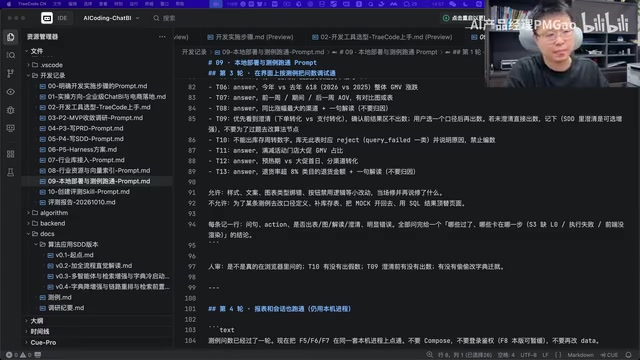
Why ChatBI Is a High-Quality Portfolio Project for AI Product Managers
ChatBI's core capability is letting users generate data charts and analytical conclusions directly through natural language. In enterprise settings, business dashboards, operational metric monitoring, and post-launch model performance evaluation all rely on data analysis. When metrics show abnormal fluctuations, AI can help pinpoint causes and offer recommendations.
According to the creator, once such a product is deployed, it can cover most data analysis scenarios within an enterprise, giving it sufficient business depth. For job seekers, it demonstrates both an understanding of data products and hands-on AI implementation capability, making it a portfolio topic with high value.
Nine-Step Breakdown: Vibe Coding Isn't Letting AI Write Whatever It Wants
The creator repeatedly emphasizes a misconception: many people think that having used Codex, GPT-8.0, or Claude Code means they've mastered Vibe Coding. He has encountered quite a few students with Vibe Coding experience who, upon closer conversation, turn out to have flawed logic—they are simply conversing with AI from an ordinary user's perspective, lacking rules and specifications.
The correct approach is to first break the project down into steps, then refine them gradually. The path the creator lays out includes nine stages: requirement breakdown, competitive research, PRD writing, test case generation, SDD specification writing, Harness implementation, data integration, local deployment testing, and evaluation rubric creation.
SDD: Specification-Driven Development Is the Key
SDD stands for Specification Driven Development, and it is the core of Vibe Coding. The SDD in this project covers three layers—frontend, backend, and algorithm—with the goal of constraining AI so it doesn't write or output arbitrarily during subsequent development.
The creator specifically notes that algorithm SDD often requires multiple rounds of interaction to write clearly; he himself iterated through several versions. What this tests is the product manager's core capability: proposing requirements, judging results, and deciding how to revise next.
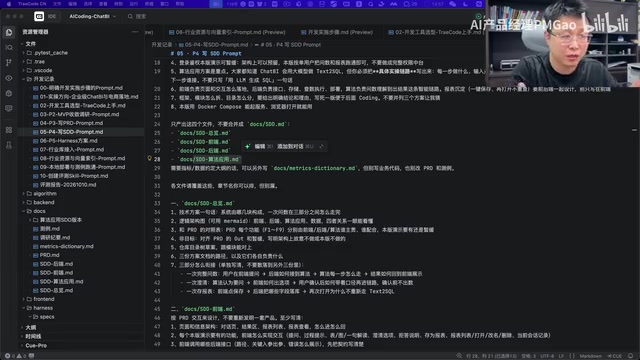
Specification Driven Development comes from the specification-driven development philosophy in software engineering. Its core is to write "what to do, to what standard, and how to determine completion" into an executable specification document in advance, then have the implementer (here, the AI) produce strictly according to the specification. In traditional development, this corresponds to interface contracts, acceptance criteria, and test-first practices; in AI programming scenarios, the role of SDD is amplified further—because large models have randomness and hallucinations, and without constraints they tend to improvise and drift from requirements. Frontend SDD typically constrains component structure, interaction states, and interface contracts; backend SDD constrains data models, API signatures, and exception handling; algorithm SDD constrains input/output formats, evaluation criteria, and boundary conditions. The more precise the SDD, the less rework the AI does, and the stronger the product manager's control over results.
Requirements Documents and Test Cases Produced in Sync
After defining the scope of the first version's features, have AI assist in writing the PRD and test cases. The creator recommends keeping these documents in the actual project files, so that during interviews you can clearly explain how the requirements came about and why certain trade-offs were made. Test cases are then used to verify system performance later, forming an evaluation report that records the expected result, actual result, and failure reason for each case.
Harness and Data Integration: Making AI Work Reliably
After the project goes live, you also need AI to keep working continuously, reliably, and efficiently according to agreed conventions. This involves implementing the Harness—including project rules, task specifications, and reusable skills—essentially assigning work to AI and setting checkpoints.
The data integration phase uses e-commerce data as an example, requiring handling of databases, metric definitions, and knowledge retrieval. For instance, how the return rate metric is calculated and which fields are needed must have clear criteria. The creator demonstrates corresponding solutions for integrating industry knowledge and resources.
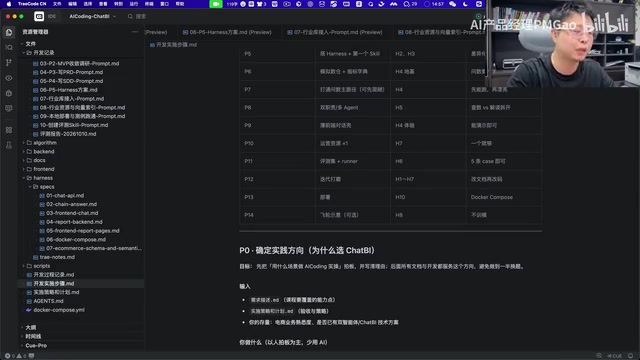
In the context of AI engineering, the term Harness borrows the meaning of "harness, restraint device," referring to a runtime framework and control mechanism built around the model to keep it working reliably within established tracks. It typically includes three layers: project rules (global constraints such as code style, directory structure, prohibited items), task specifications (the inputs, steps, and acceptance criteria for each task), and reusable skills (encapsulating high-frequency operations into fixed capabilities the AI can call). With a Harness, AI no longer improvises from scratch each time but executes tasks within a checkable, reproducible process, allowing the product manager to set checkpoints at key nodes and catch deviations in time. The difference from simply writing prompts is that the Harness is engineered and accumulative, and can be continuously strengthened as the project iterates.
Data integration for ChatBI is not just about connecting to a database; more critically, it involves two layers: "metric definitions" and "knowledge retrieval." Metric definitions refer to the precise definition and calculation logic of each business metric—for example, return rate requires clarifying whether the numerator is the number of returned orders or the returned amount, whether the denominator excludes canceled orders, and whether the statistical period is based on payment time or refund time. These definitions must be solidified into metadata the AI can query; otherwise, natural-language questions will yield answers with inconsistent definitions. Knowledge retrieval means that before generating SQL or conclusions, the system first recalls relevant table structures, field meanings, business terminology, and historical Q&A to help the model understand "what this metric means at your company." Only by combining the two can ChatBI deliver trustworthy, explainable analysis results on real enterprise data.
From Practice to Resume: Three Writing Principles
After completing the project, how to write it on your resume also matters. The creator maintains a resume database of about 430,000 characters, with material from students he has mentored who received three or more offers, validated by the market.
He proposes three principles for resume writing:
- Align with the company's positioning: If you have an e-commerce background, write it in an e-commerce context; if you have an education background, write it in an education context.
- Show career progression: Write from graduation to the present, demonstrating a growth path from an ordinary product manager to data-driven, and then to AI implementation.
- Build a capability system: Use multiple projects to reflect capabilities across different dimensions such as YPQ, Skill, and RJ, so the resume as a whole covers the AI product manager capability model.
The value of this method is that it elevates Vibe Coding from "knowing how to use tools" to "being able to land enterprise-grade projects," making the portfolio a genuine talking point in interviews.
One-line Summary
Land ChatBI in nine steps with Vibe Coding and turn AI programming into a standout resume project.
Paragraph Summary
The article introduces a hands-on Vibe Coding ChatBI project shared by a Bilibili creator, aimed at helping AI product managers build a practical portfolio that can go on their resume and withstand deep interview scrutiny. ChatBI lets users generate data charts and analytical conclusions through natural language, covering most enterprise data analysis scenarios and offering both business depth and AI implementation value. The article emphasizes that Vibe Coding is not casual conversation with AI, but a nine-step process: requirement breakdown, competitive research, PRD writing, test case generation, SDD specification writing, Harness implementation, data integration, local deployment testing, and evaluation rubric creation—with SDD specification-driven development at its core. Finally, it offers three resume-writing principles: align with the company's positioning, show career progression, and build a capability system.
Related articles

Gemini 4 Neon Review: Benchmark Scores Rival Carbon, API Pricing and Quota Breakdown
Google Gemini 4 Neon is now live, benchmark scores closely tracking Carbon, API pricing 3/15 at twice Hydrogen's rate. This article compiles Bilibili creator testing: Neon can replace 90% of Carbon scenarios, AntiGravity quota consumption is only one-third of Carbon, plus subscription channel restrictions and 2API ban risks.

Gemini 4 Helium Coming Soon? Signals of Google Loosening Subscription Restrictions
Google team member hints releases will continue; community speculates Gemini 4 Helium (Flash Lite) may be next. Subscription ban controversy gets a response as product lead says "Soon," suggesting restrictions may be lifted. This article covers Gemini developments, OpenAI Coding Agent and risk management, Doubao real-time audio-video API, and compute business dynamics.

AI-Assisted React Development in Practice: Optimizing a Video App and Handling Errors
A 14-year veteran developer demonstrates AI-assisted React video app optimization: compressing video from 80MB to 5MB (~94%) via ImageKit, plus reliable error handling and retry mechanisms. Includes planning, code understanding, and verification methods for working with AI.