AI Programming 101: How Ordinary People Can Actually Make the Most of AI Coding Tools

How ordinary people can collaborate with AI as a tool — not wait for AI to do everything for them.
This article outlines the core framework of a structured AI programming course for everyday learners. It clears up a common misconception — AI programming isn't about generating whole projects from a single prompt — and breaks down three levels of AI coding, focusing on using existing AI tools. It traces the evolution from code completion to AI agents, presents a four-step learning path (mindset, knowledge, workflow skills, and building an AI workflow), and explains why Python and TypeScript/JavaScript are the recommended languages. The piece closes with a conviction: AI gives ordinary people the leverage to turn ideas into real products.
First, Let's Clarify: What Do We Actually Mean by "AI Programming"?
When people hear "AI programming," many immediately think: "AI writes all the code automatically — just describe what you want and it builds the whole project." The flood of overhyped videos online makes it easy to fall into this trap. In the opening of his AI programming course on Bilibili, the creator deliberately spends considerable time correcting this misconception: a real AI programming course isn't about letting AI do everything for you — it's about teaching everyday developers how to use AI as an effective tool.
To understand where this course fits in, you need to see how large model capabilities are structured. The large models trained by various companies represent the "brain" of AI, from which a range of applications are derived — text generation, video synthesis, image and music generation, and coding. Within the coding branch, there are three distinct levels.
The Three Levels of AI Programming
The first level is building AI for programming — developing and training large models themselves, or deploying them locally. This is foundational R&D with an extremely high barrier to entry.
The second level is using AI-powered coding tools — that is, using AI coding assistants (such as various AI Code tools) to build projects, write code, and execute automated tasks. The creator is explicit that this course focuses entirely on this level: teaching everyday people how to get real results from existing AI coding tools and programming-focused large models.
The third level sits somewhere in between: within large tech companies, the AI coding assistants themselves need engineers to develop and maintain them — which can also be categorized as "building AI for programming."
The course's positioning is crystal clear: no model training, no deep-diving into underlying principles. The focus is on the most practical question for ordinary people — how to actually get value out of AI coding tools.
From Code Completion to AI Agents: The Evolution of AI Programming Capabilities
AI coding assistants have gone through a clear evolution. In the beginning, they could only do code completion — offering suggestions as you typed, which was already quite useful. Then came AI Agents, and the scope of what's possible expanded dramatically.
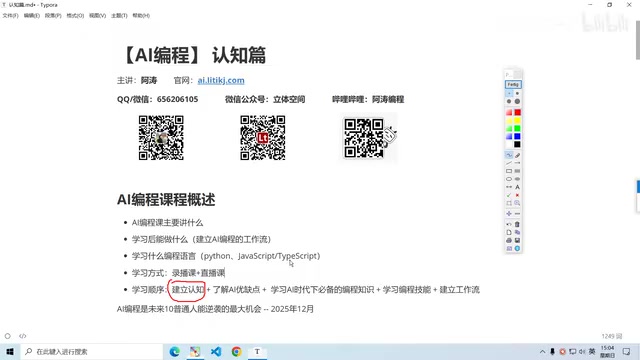
Today's agents can take control of your editor, terminal, and even your browser — effectively taking over your entire computer. When code throws an error, the agent doesn't just complete the next line; it reads the error output, rewrites the code, reruns it, and autonomously handles a whole sequence of programming tasks. This shift from "assistant" to "agent" is the key leap in the value AI programming delivers.
That said, the creator repeatedly stresses the importance of accurate mental models: there are hundreds of large models in the world, each with different strengths — some excel at coding, others at video, others at conversation. Dismissing all models because one particular model got a simple question wrong is a classic overgeneralization that will cause you to miss real opportunities.
The core mechanism of an AI Agent lies in the "perceive–plan–act" loop: it reads the current environment (error messages, file contents, browser pages), uses tools to take action (run commands, modify files, click elements), and then decides what to do next based on the results. The fundamental difference from traditional code completion is that completion is a single-step prediction, while an agent makes multiple rounds of autonomous decisions. Leading AI coding agents today (such as Cursor's Agent mode, GitHub Copilot Workspace, and Devin) are typically built on Function Calling / Tool Use capabilities, which allow large models to invoke predefined external interfaces. Understanding this mechanism helps you set task granularity more appropriately — the more specific the task and the clearer the feedback signal, the higher the agent's success rate. Vague, open-ended task descriptions, by contrast, often send agents into endless trial-and-error loops.
Learning Path: From Building the Right Mindset to Building Your Workflow
AI programming covers an enormous amount of ground. A quick search turns up overwhelming amounts of information, and beginners can easily lose their bearings. The creator lays out a reasonably complete learning path, with the core goal of helping someone starting from zero eventually build their own AI workflow.
Step 1: Establish the Right Mental Model
This step is described as non-negotiable. Understand AI's strengths and limitations from a developer's perspective — what it can do, what it can't, and why it's neither all-powerful nor fully automatic. Without this foundation, unmet expectations will cause you to write off AI entirely.
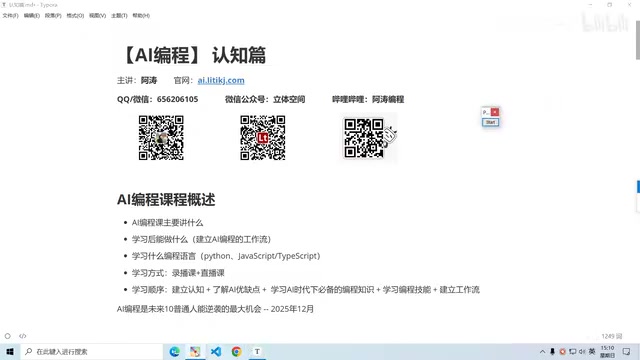
Step 2: Learn the Programming Knowledge You Actually Need in the AI Era
The key shift here: you no longer need to memorize syntax and documentation by rote. The creator uses a vivid analogy — if something itches, you used to have to "scratch your whole body" (learn everything). In the AI era, you just need to know where it itches. Skim through syntax and docs once; when you need them, have AI pull them up for you.
Step 3: Develop Programming "Skills," Not Just "Knowledge"
The creator draws an important distinction between skills and knowledge. Many people have studied programming but still can't use AI tools effectively — because they have knowledge (what HTML is, how syntax works) but don't understand the order in which things get done. Real skill means knowing "what to do first, what to do second." Someone who understands the workflow, paired with AI tools, will build a website far more easily than someone who can recite syntax from memory but doesn't know where to start.
What the creator calls "the order of doing things" maps to a more formal concept in software development: the development workflow — which typically includes requirements breakdown, technology selection, project scaffolding, module-by-module implementation, debugging and testing, and deployment. Even when relying entirely on AI to generate code, the developer still needs to play the role of "director" — knowing which phase you're in, what to ask AI at each stage, and how to verify whether the output is correct. This is precisely why complete beginners often get stuck when using AI coding tools: it's not that AI can't write the code — it's that they can't tell whether what AI produced is actually right, and they don't know which step to debug when something goes wrong. Developing a sense of workflow is the prerequisite for converting AI's capabilities into real productivity.
Step 4: Master AI Coding Tools and Build Your Workflow
With the right mindset, knowledge, and skills in place, picking up specific AI coding tools becomes much smoother. The ultimate goal is to establish an AI workflow: treat AI like a well-trained programmer, assign it tasks every day, and have it do the heavy lifting. The course also covers how to choose between free and paid options — simple applications don't need the most powerful models, and domestic Chinese models are improving rapidly.
Why Python and TypeScript, and Why They're Worth Learning
The course's chosen languages are Python and TypeScript/JavaScript. The reason is straightforward: these two languages have the largest volume of training data, meaning AI support for them is most mature and most reliable. Together, they cover frontend, backend, and mini-program development for most use cases.
The course is primarily pre-recorded, with live Q&A sessions as a supplement — recordings build the complete knowledge framework, while live sessions address the specific sticking points people hit during learning and actual use.
The creator holds a firm conviction about the value of AI programming: he originally said it was "probably the biggest opportunity for ordinary people to break through in the next decade" — but after spending more time with these tools, he dropped the word "probably." His reasoning: ordinary people without connections, resources, or backing can only use a specialized skill, amplified by AI, to quickly turn ideas and products into reality. If you haven't learned AI and your competitors already have, you'll find it very hard to compete.
Generative AI has only existed since late 2022 — barely three years — yet its progress has been staggering. Mastering AI programming before it becomes fully mainstream may be exactly the window of opportunity to catch this wave. For ordinary people, the core message of this course isn't "what AI can do for you" — it's "how you should collaborate with AI to become someone who truly knows how to use the tool."
There's also a technical reason why Python and TypeScript/JavaScript perform best in AI-assisted coding contexts: the quality of a large model's code generation is positively correlated with the volume of that language's code in its training data. According to statistics from GitHub, Stack Overflow, and similar platforms, these two languages have consistently ranked among the most active for years — meaning models have seen the most examples, cover the widest range of scenarios, and are least likely to make elementary mistakes. TypeScript's static type system, compared to plain JavaScript, makes AI-generated code easier to validate with tooling and easier for humans to review, reducing latency bugs that only surface at runtime. Python, with its clean syntax and vast third-party ecosystem (data processing, network requests, automation scripts, and more), remains the go-to choice for rapidly validating ideas. Together, the two languages cover the typical project needs of most independent developers and small teams.
Related articles

Free Unlimited Claude Code Solution: Agnes AI + CC Switch Setup Guide
No paid subscription needed — pair the free AI platform Agnes AI with the open-source tool CC Switch to provide a backend for Claude Code, enabling unlimited free calls to text, image, and video models. This guide covers the full setup, test results, and usage boundaries.

A Complete Zero-Cost Guide to Getting Started with Claude Code for Beginners in China
A beginner's guide to Claude Code for users in China: two installation methods (command line and IDE plugin), full configuration steps for replacing the official API with the free domestic LongCat model, and a hands-on demo of building a small tool with natural language, plus tips.

When the NSA Gets Involved: The AI Supply Chain Crisis Behind Open-Source CVEs and API Key Hijacking
Multiple open-source projects disclosed severe CVEs in one day, PHP flaws alarmed the FBI, and Railway and OpenCode were breached with API keys stolen. This article breaks down the vulnerability window, AI-accelerated exploitation, and the AI supply chain crisis behind the API key black market, with a developer defense checklist.