AI Reaches Half of All Jobs, Yet 'Who Is Hiring?' Posts Hit 12-Year Low
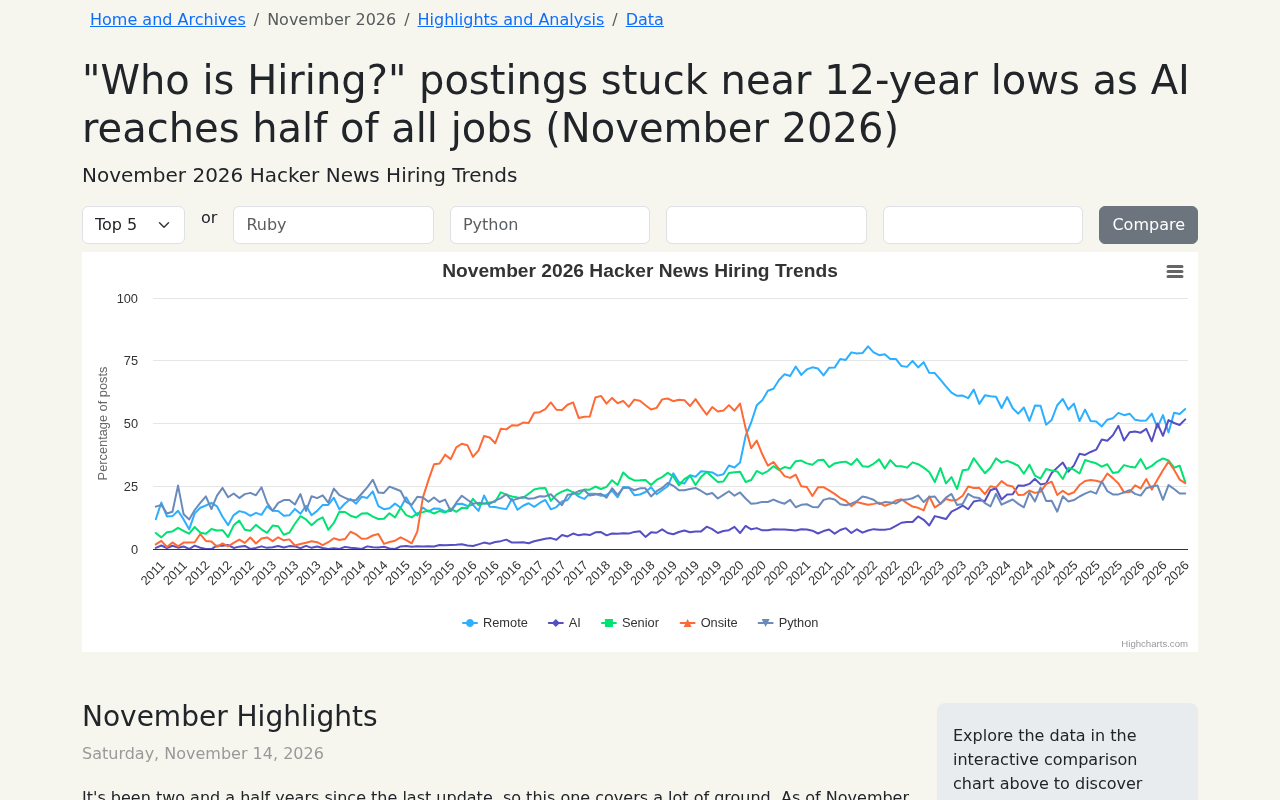
AI covers half of all jobs while HN hiring posts hit a 12-year low—reflecting a shift in hiring form, not just job loss.
Starting from a Hacker News post, the article contrasts two seemingly contradictory data points: AI has permeated half of all jobs, yet 'Who is Hiring?' postings are stuck near a 12-year low. The author argues the slump is driven by community structure, channel migration, and funding cycles, not AI replacement alone. What AI truly changes is the form of hiring: higher matching thresholds, compressed junior roles, and AI collaboration as a default. The two signals describe different facets of the labor market.
A Hacker News post juxtaposes two seemingly contradictory data points: AI has already permeated half of all jobs, while the number of "Who is Hiring?" postings has stalled near a 12-year low. The post itself only has 30 points and 3 comments—not particularly hot—but the tension it points to is worth unpacking. If AI really has entered so many work scenarios, why is the hiring signal contracting instead?
Two numbers side by side—where's the contradiction?
Let's break down the two claims in the title.
"AI reaches half of all jobs" describes AI's coverage: under the statistical scope, about half of all positions have intersected with AI tools—whether writing code, doing customer service, processing documents, or assisting analysis. This ratio comes from the analysis cited in the original post; the specific methodology isn't elaborated in the source material, but the direction is clear—AI is no longer an experiment in a small circle but has entered mainstream workflows.
"Who is Hiring? postings stuck near 12-year lows" describes something else: the monthly hiring thread that Hacker News regularly publishes has seen its job count stuck at a low level, near where it was twelve years ago.
One is expanding, the other contracting. If you only read the title, it's easy to conclude that "AI stole the jobs," but that inference skips too many intermediate steps.
"Who is Hiring?" is a recurring thread automatically posted by the community at the start of each month on Hacker News. The rule is that each company may post only one top-level comment per job, typically including the company name, location, whether remote, and a link to the position. Because the posting cost is low and the format uniform, it has long been regarded as a grassroots thermometer for tech industry hiring sentiment. But it is not a rigorous labor market statistic: the sample covers only Hacker News readers, predominantly North American tech companies and early-stage startup teams, and cannot represent traditional industries or non-technical roles. Therefore, its numerical changes are better interpreted as a proxy for "public recruiting willingness within the tech community" rather than total job openings across the economy.
Low hiring posts don't necessarily mean jobs have vanished
"Who is Hiring?" is a peculiar sample of the Hacker News community, and its numerical changes are affected by at least several layers of factors.
The first layer is the community's own structure. The posters in this thread are tech companies and startup teams, and hiring volume is highly correlated with the funding cycle of tech entrepreneurship. When the funding environment tightens and startups shrink headcount, the number of posts reflects it before overall employment data does.
The second layer is the migration of hiring channels. Over the past decade, the center of gravity for tech job recruiting has shifted from forum posts to LinkedIn, internal referrals, and headhunter channels. The absolute decline in public forum posts is partly a result of channel diversion, not a proportional evaporation of total jobs.
The third layer is the structural change brought by AI. The subtext of the original post is: when AI can take on some junior work, the team's urgency to add headcount decreases, and hiring shifts from "adding bodies" to "improving efficiency." This effect is real, but it overlaps with channel migration and funding cycles, making it hard to attribute to a single cause.
Conflating the three factors leads to oversimplified conclusions. The original title is gripping precisely because it compresses complex structural changes into a single parallel phrase.
Phrases like "12-year low" involve statistical scope issues. If post counts are tallied monthly, the low may be affected by seasonal fluctuations (e.g., year-end holidays, summer vacations); if only a single month is examined, outliers may be amplified. Moreover, Hacker News's post ranking algorithm and moderation rules have been adjusted over the years, which affects the visibility of hiring posts and willingness to participate. The original post does not disclose whether its data is seasonally adjusted or whether duplicate posts were removed, so caution about scope is warranted when citing the "12-year low."
AI covering half of all jobs changes the form of hiring
Rather than asking "is AI eliminating jobs," what's more worth watching is that hiring demand itself is deforming.
When AI tools enter half of all jobs, employers' expectations of candidates shift. The productivity gap between someone who can skillfully leverage AI to get work done and someone who can only do the same work manually will be amplified. In job posts, the requirement to "use AI" goes from a bonus to a default—meaning the number of positions may not have changed, but the matching threshold has.
On the other side is differentiation within roles. Under the same job title, the work content may already be completely different from a few years ago—junior positions compressed, and demands for judgment, architectural ability, and cross-domain collaboration raised. The number of hiring posts is a stock indicator; it cannot reflect this qualitative change.
This also explains why "AI covers half of all jobs" and "hiring posts hit a low" can both hold true: the former speaks to the permeation of work methods, the latter to the contraction of new headcount—two different facets of the labor market.
"AI covers half of all jobs" and "AI replaces half of all jobs" are two easily confused concepts. Coverage usually means that at least some tasks in a role use AI tools—for example, programmers using code completion, customer service using conversation summaries, analysts using AI to help draft reports; it does not mean the number of people employed in those roles has halved. Replacement rate measures the proportion of a role as a whole that is automated away. There can be a large gap between the two: a role can be highly AI-enabled yet still require humans for judgment, review, and cross-department coordination. Understanding this distinction is key to avoiding misreading coverage as unemployment.
Practical implications for job seekers and teams
For job seekers, the reference value of public forum hiring posts is declining, but that doesn't mean opportunities have vanished. Channels are migrating, signals are dispersing—treating "Who Is Hiring?" as the sole bellwether will underestimate the market's true activity. A more pragmatic approach is to observe the job structure across multiple channels simultaneously, especially positions that explicitly require AI collaboration skills.
For recruiting teams, the low post count is itself a signal: in an environment where the candidate pool is shrinking, a generic job description makes it hard to attract anyone. Recruiters who can clearly articulate "what role this position plays in the AI workflow" will be more easily seen.
The original post has only 3 comments; the community did not form a consensual discussion. This also reminds us that a single Hacker News post provides first-hand observation, not a conclusion. Treating it as a starting point for discussion is more appropriate than treating it as a basis for judgment.
The declining reference value of public forum hiring posts is underpinned by the overall fragmentation of hiring channels. Job seekers used to rely on a few centralized posting channels; today job information is scattered across LinkedIn, company websites, referral systems, vertical communities, and headhunter networks, naturally reducing the visibility of any single source. For job seekers, a more effective strategy is to build multi-channel information sources and pay attention to the specific wording of "AI collaboration ability" in job descriptions; for recruiters, channel fragmentation means they need to choose publishing platforms more precisely and highlight the unique value of the role in the AI workflow in descriptions, rather than piling on generic requirements.
An indicator that needs continuous observation
The number of "Who Is Hiring?" posts is a limited but sensitive indicator; it captures marginal changes in tech industry hiring sentiment. When this indicator stays at a low for a long time while AI's job penetration rate continues to rise, the combination is worth tracking.
The real question isn't "does AI make hiring posts fewer," but what hiring itself will become once AI is the default configuration for half of all jobs. The answer won't appear in a post title, but this title at least puts the question on the table.
One-line Summary
AI covers half of all jobs while HN hiring posts hit a 12-year low—reflecting a change in the form of hiring, not simply job disappearance.
Paragraph Summary
Starting from a Hacker News post, the article contrasts two seemingly contradictory data points: "AI has permeated half of all jobs" and "Who is Hiring?" postings stuck near a 12-year low. The author points out that the slump in hiring posts is affected by multiple factors—community structure, hiring channel migration, and funding cycles—and cannot be attributed solely to AI replacement. What AI truly changes is the form of hiring: the matching threshold rises, junior positions are compressed, and AI collaboration skills become a default requirement. Thus, the two signals describe different facets of the labor market. For job seekers, the reference value of a single forum thread is declining, and they need to observe job structures across multiple channels; for recruiting teams, clearly explaining a role's place in the AI workflow is more important.
Related articles
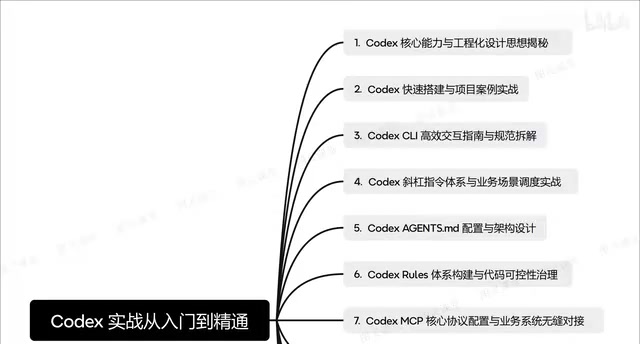
Codex in Practice: From Installation and Configuration to Multi-Agent Collaboration
Based on a Bilibili Codex course overview, this guide maps the full path of AI coding assistants from installation and agents.md context design to CLI commands, MCP integration, and multi-agent collaboration.
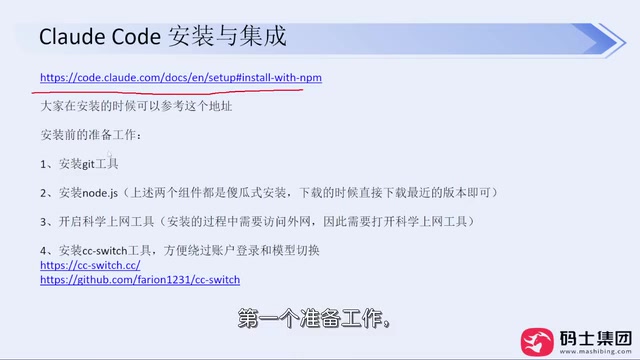
Claude Code Installation and Model Switching Guide for Users in China
How can developers in China install Claude Code reliably? This article compiles a Bilibili creator's hands-on solution: install via NPM, skip official login, use CC Switch to configure API Keys and freely switch between DeepSeek, Kimi, and other models to avoid account bans.
AI Supply Chain Security: What Canary Tokens Reveal
Starting from a Hacker News discussion, this article analyzes the role of canary tokens in AI supply chain security: how they detect abnormal access to model weights, training data, and credentials, as well as coverage blind spots and cost constraints during implementation.