AI Reverse Engineering in Practice: DeepSeek + Skill Automatically Cracks WeChat Login Encryption Logic

DeepSeek with reverse engineering Skills and MCP tools automatically traces and confirms the WeChat login password field uses MD5.
The article presents an AI-driven reverse engineering workflow demonstrated by a Bilibili creator: using DeepSeek with reverse engineering Skills and MCP tools to automatically open the target page, capture packets, and trace the call chain, ultimately confirming that the WeChat Open Platform login password field uses MD5, UTF-8 encoding, and outputs a 32-character lowercase hexadecimal string. Compared with manual breakpoints and call stack analysis, this workflow automates repetitive setup and verification. The article also notes the demo is relatively simple and reliability drops with custom obfuscation or server-side logic, so such techniques should be limited to authorized security testing and research.
Just Talk, and AI Does All the Heavy Lifting on Encryption Logic
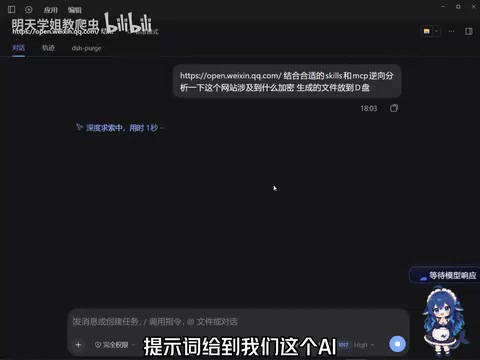
Reverse engineering has long been considered a high-barrier field, requiring familiarity with assembly, debuggers, and call chain analysis. But the workflow demonstrated by a Bilibili creator turns "just talking" into a new way of operating: using DeepSeekAd together with reverse engineering Skills and MCP tools to automatically open the target page, trace the real environment, and complete encryption logic analysis—all without writing a single line of code.
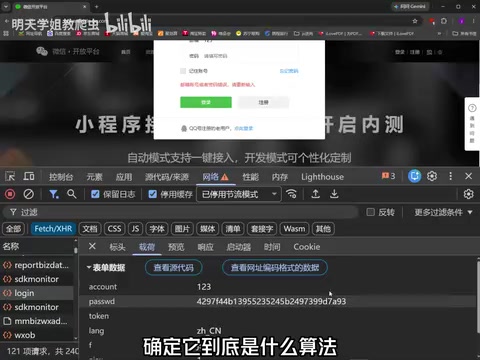
The target of this hands-on exercise is the password field in the WeChat Open Platform login flow. After entering a username and password and clicking login, packet capture triggers a Robin data packet, in which the tag value is the entered username, while the password value is clearly not the plaintext password—it has been processed, with a fixed length of 32 characters. Based on this, the creator initially judged it to be MD5, but emphasized that length alone cannot fully determine the algorithm and that the call chain still needs to be traced for verification.
Reverse engineering refers to the process of analyzing compiled programs or deployed systems to reconstruct their design, logic, or data formats. Traditionally, it requires mastery of assembly language, debuggers (such as OllyDbg and x64dbg), network packet capture tools (such as Charles and Fiddler), and call stack analysis skills. Typical applications include malware analysis, software compatibility development, and security vulnerability research. The AI-assisted reverse engineering shown in this article delegates the repetitive environment setup and tracing steps to automation tools.
Traditional Approach vs. AI-Driven Reverse Engineering Workflow
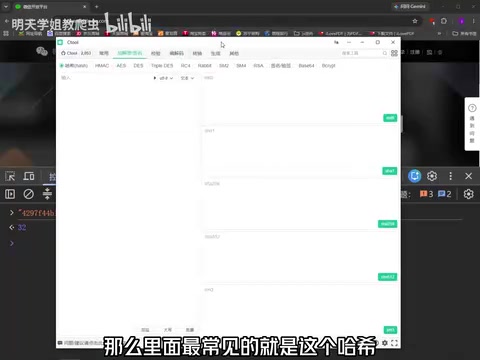
In the traditional approach, analysts must repeatedly observe data length in the console, manually set breakpoints, and work through the call stack layer by layer to clarify the entry point and parameters of the encryption function. The creator also acknowledges that if one were guessing manually, the most common use of a fixed 32-character length is in signature scenarios, and among algorithms matching the "fixed 32 characters" characteristic, MD5 is the most likely suspect.
But a guess is not a conclusion. The value of this AI workflow lies in connecting "open page—capture packets—trace—confirm" into an automated chain: humans only need to provide prompts, while AI handles scheduling skills and tools to complete verification.
How Skill + MCP Divide the Work
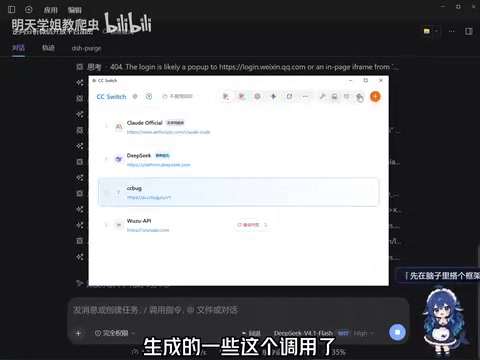
From the demonstration, after receiving the prompt, DeepSeek loaded a reverse engineering skill named reverse and also mounted the corresponding MCP tools. The MCP tools are responsible for automatically opening the target page so that analysis takes place in a real browser environment rather than through static guessing detached from context.
The essence of this combination is "capability plugin-ization": Skills provide analysis patterns in the reverse engineering domain, while MCP provides the hands and feet for interacting with the external environment. Only when the two are combined can the model move from "chatting" to "operating."
MCP (Model Context Protocol) is an open protocol proposed by Anthropic, designed to let large language models connect to external tools and data sources in a standardized way. In this case, the MCP tools act as a bridge between the model and the real browser environment: the model calls tool APIs through the protocol to automatically open pages, execute scripts, capture network requests, and more. Unlike a simple "plugin," MCP defines a unified communication format, enabling different models and tools to be plug-and-play and reducing integration costs.
Final Confirmation: MD5, UTF-8, 32-Character Lowercase Hexadecimal
After completing the analysis chain, the AI concluded that password uses the MD5 algorithm, the input is processed as UTF-8 encoding, and the output is a 32-character lowercase hexadecimal string. This matches the creator's initial guess, but the key difference is that the conclusion comes from call chain tracing rather than length inference.
For learners, the lesson from this case is not that "MD5 is easy to guess," but that AI can take over repetitive environment setup and verification actions, allowing people to focus on judgment and questioning.
MD5 (Message-Digest Algorithm 5) is a widely used hash function that maps input of any length to a fixed-length 128-bit (16-byte) digest, usually represented as a 32-character hexadecimal string. Because of its fast computation and fixed output length, MD5 is often used for data integrity checks and password storage (although it is no longer recommended for security-sensitive scenarios). In web frontends, MD5 is often used to irreversibly process fields such as passwords before transmission. It is important to note that MD5 itself is only a hash, not encryption, and the original text cannot be restored by decryption.
Tooling Barriers and Applicable Boundaries
The creator mentioned that some of the Skills and MCP tools used come from open source and some were organized independently, and that the toolkit can be obtained by leaving a comment in the comments section. It is important to view this soberly: the demonstration scenario is relatively simple, and once the encryption logic involves custom obfuscation, polymorphic transformations, or server-side participation, the reliability of automated analysis will drop significantly. AI reverse engineering is better suited as an efficiency amplifier than as a replacement for understanding underlying principles.
In addition, such techniques should be used only for legally authorized security testing and learning research, and should avoid touching real user data or unauthorized systems.
One-line Summary
DeepSeek combined with reverse engineering Skills and MCP tools automatically traces and confirms that the WeChat login password field uses the MD5 algorithm.
Paragraph Summary
The article introduces an AI-driven reverse engineering workflow demonstrated by a Bilibili creator: using the DeepSeek model to load reverse engineering Skills and MCP tools, automatically open the target page, capture packets, and trace the call chain, ultimately confirming that the password field in WeChat Open Platform login uses the MD5 algorithm, UTF-8 encoding, and outputs a 32-character lowercase hexadecimal string. Compared with the traditional approach of manually setting breakpoints and analyzing the call stack, this workflow automates repetitive environment setup and verification actions, with humans only needing to provide prompts. The article also points out that the demonstration scenario is relatively simple, and reliability will decrease when facing encryption logic involving custom obfuscation or server-side participation; such techniques should be limited to legally authorized security testing and learning research.
Related articles

9 AI Subscription Plans Compared: The Real Cost Per 100M Tokens Revealed
Bilibili creator tests 9 AI subscription plans from Volcano, Alibaba, Tencent, Baidu, Zhipu, Xiaomi, MiniMax and more, converting them all to real cost per 100M tokens, breaking down fixed-quota vs. three-tier coefficient billing and how caching, time-of-day discounts, and window limits affect actual quota.

Vibe Coding for Beginners: Expressing Intent Instead of Handwriting Code
What is Vibe Coding? A 137-episode Bilibili course defines it: the core is expressing intent, not writing code. This article analyzes Vibe Coding's productivity logic, target audience, and entry expectations to help beginners decide if it's worth learning.

LangChain Beginner's Guide: An Agent Development Roadmap from LangGraph to Deep Agents
Clarify the encapsulation relationship among LangChain, LangGraph, and Deep Agents, and master the learning path and selection logic for agent development frameworks—suitable for beginners in large model development.