AI Reverse-Engineers Monitor Firmware in 16 Minutes, Lowering the Bar for Vulnerability Research

AI completes a week-long monitor firmware reverse engineering task in 16 minutes, exposing the flaw of distributing firmware keys and the commoditization crisis of reverse engineering.
A vulnerability researcher used AI to complete the full reverse engineering pipeline of Dell monitor firmware in 16 minutes: from binwalk image extraction and entropy analysis to confirm encryption, to locating the key block via Ghidra MCP, writing a decryption script, and cross-validating with MD5 comparison, statistical entropy analysis, and reset vector identification. The researcher admits that what truly convinced him was not AI's speed but its ability to self-verify. The experiment also exposed a structural flaw in the firmware encryption scheme — keys distributed to users alongside the firmware update package render static encryption meaningless. The article warns that reverse engineering is shifting from a scarce craft to a commoditized capability, the peripheral firmware attack surface will be significantly amplified, and vendors' key management and hardware root of trust urgently need rebuilding.
A low-level vulnerability researcher shared on Bilibili an experiment that left him "a little scared": using AI to complete a monitor firmware reverse-engineering task in 16 minutes that would previously have taken a week. This wasn't a demo — it went through the entire pipeline from firmware extraction, encryption analysis, and key localization to decryption verification. When reverse engineering shifts from a "craft" to a "commoditized capability," the foundations of the security industry begin to shift.
From a Week to 16 Minutes: A Complete Firmware Hunt
The researcher's goal was clear: hack into his own Dell 34-inch monitor. Peripheral firmware handles HDMI commands, video signals, and wireless functionality, harboring an entire attack surface ripe for exploitation. The standard attack path is to download the firmware update EXE from Dell's official website, use binwalk for recursive extraction, locate the actual firmware image, and then hunt for vulnerabilities within it.
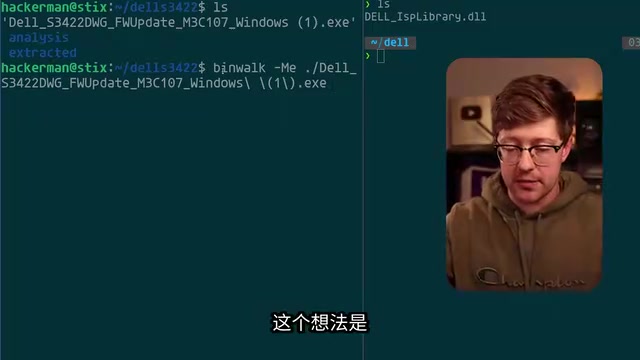
In the past, every step of this path relied on manual trial and error. The researcher would need to open the ISP library (DellISPLibrary.dll) in Ghidra, examine the EncryptDecryptMethod virtual function table function by function, and identify where the encryption key was hidden among nine functions with different purposes. He admitted that reverse engineering "isn't free" — it requires substantial time iterating on hypotheses, brute-force testing, and gradually reducing noise in one's mental model.
This time, he gave the AI a single sentence: the image might be encrypted, help me find the firmware and identify the HDMI command parser. The AI completed all the work in 16 minutes, leaving a complete record on the timeline.
binwalk is an open-source firmware analysis and extraction tool commonly used in the early stages of embedded device reverse engineering. It performs signature scanning on binary files to identify nested file systems, compressed archives, kernel images, and other known formats, and supports recursive extraction — peeling apart a firmware update package layer by layer down to the innermost image. Another common feature of binwalk is entropy analysis: it calculates Shannon entropy of data in blocks, and if the entropy of an entire segment approaches 1 (such as the 0.96 mentioned in the article), it indicates that the byte distribution is highly random, typically meaning the data is encrypted or compressed. This is precisely the basis on which the researcher determined that the firmware image was encrypted.
How AI Disassembles Encrypted Firmware: The Key Is "Self-Verification"
Firmware encryption is the first wall in reverse engineering research. The researcher used binwalk for entropy analysis and found that the entropy of all edges was 0.96 — the data bits were sufficiently random, making it almost certain the image was encrypted. Without the key, the traditional path was nearly impassable.
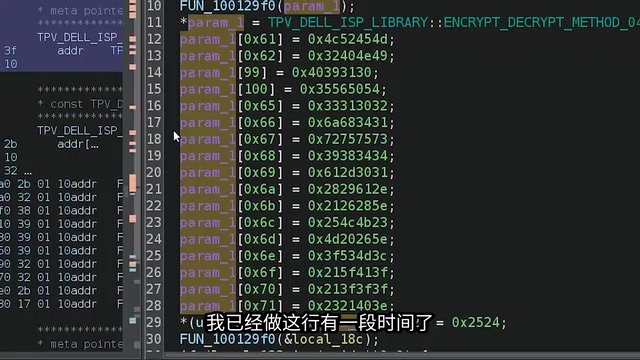
The AI's breakthrough was that it didn't stop at "guessing the key." It invoked Ghidra MCP to lift the binary into pseudo-C code, identified that the constructor 10012A60 created a key block, and that another function used that key block to perform decryption operations. The AI then wrote a decryption script in Python in under a minute, and 40 seconds later completed the first successful decryption and confirmed success.
What truly surprised the researcher was the verification phase. The AI didn't stop at "it looks right after decryption" — it located the MD5 value at offset ECD in the image, zeroed out the MAC field according to the DLL specification, recalculated, and found the results matched; it also performed statistical entropy analysis on the binary, confirming that the byte density of 0x00 and 0xFF matched firmware flashing expectations; it further identified that the short jump encoding was consistent with the MSTAR 8051 microcontroller and found a valid reset vector at the correct offset.
"I was very skeptical about how we could be so certain," the researcher said, but the AI completed this entire cross-validation suite within 45 seconds.
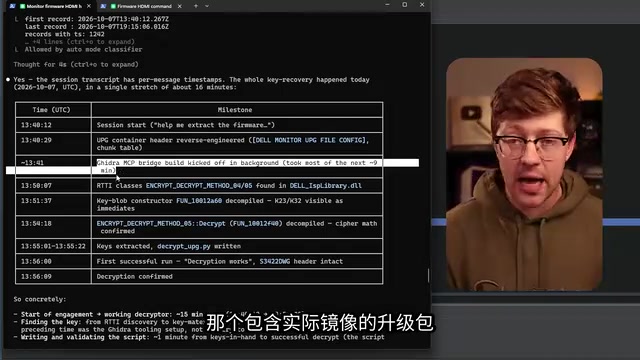
Ghidra is an open-source reverse engineering framework from the National Security Agency (NSA), supporting multi-architecture disassembly and decompilation that can lift binary machine code into readable pseudo-C code. It is the primary open-source alternative to IDA Pro. Ghidra MCP is an interface layer built on the Model Context Protocol (MCP) that provides Ghidra with a structured way for AI models to invoke Ghidra's disassembly, decompilation, function listing, cross-referencing, and other capabilities. MCP is an open protocol proposed by Anthropic for securely and standardly connecting large models to external tools and data sources. With this bridge, AI is no longer just "reading code" but can actively drive reverse engineering tools to complete function localization and semantic analysis — this is the key infrastructure that enabled this experiment to be completed in minutes.
The Real Flaw Isn't AI — It's the Design
The core problem exposed by this experiment isn't that AI is too powerful, but that the firmware encryption scheme itself has a structural flaw: the encryption key is distributed to users directly alongside the firmware. The researcher pointed out that the correct approach should be to have users flash static encryption, with the key burned into the motherboard MCU's ROM where it cannot be extracted, and decryption performed on the motherboard side. Under the current scheme, anyone with sufficient skill can complete the same reverse engineering in a few days — AI merely compressed that time to minutes.
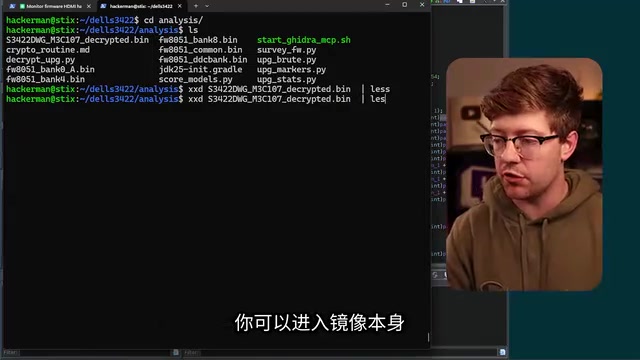
This also explains why the researcher, who calls himself an "AI skeptic," changed his view. He compared AI's significance for vulnerability research to what the calculator did for mathematics: not replacing human judgment, but automating hypothesis generation and rapid verification, freeing researchers from tedious iteration. He ran this experiment using GLM 5.3 and noted that models from OpenAI, Anthropic, and open-source models like Kimi perform equally well on similar tasks.
Root of Trust (RoT) is the trusted foundation for system boot and key operations, typically consisting of immutable code固化 in chip ROM and one-time burned keys. The correct approach proposed in the article — burning the key into the motherboard MCU's ROM and performing decryption on the motherboard side — precisely places the root of trust where attackers cannot read it: even if the firmware is taken in its entirety, it cannot be decrypted away from the motherboard. Conversely, if the key is distributed alongside the firmware update package, the root of trust is effectively public, and static encryption becomes meaningless. This also shows that the core of firmware security lies not in the strength of the encryption algorithm, but in key lifecycle management and the physical isolation of the trust anchor.
After the Barrier Disappears: A New Equation for the Security Industry
The most alarming signal from this experiment is that the ability to "deobfuscate and take apart poorly designed things" has been commoditized. The researcher repeatedly emphasized: anyone can do this. When the entry ticket for reverse engineering shifts from "years of experience" to "one prompt plus 16 minutes," the attack surface of peripheral firmware will be amplified as never before.
For vendors, this means "hidden inside an EXE" is no longer a security strategy — key management and hardware root of trust must be taken seriously. For security practitioners, AI is not a replacement but a lever — it amplifies the value of judgment and also makes it easier for those with insufficient judgment to create chaos. The researcher's own summary carries a hint of unease: there will be more vulnerabilities, anyone can do reverse engineering, anyone can find vulnerabilities.
When tools are no longer scarce, what becomes scarce is knowing what to look for — and being able to judge whether the results are correct.
Attack Surface refers to the set of all entry points in a system that an attacker can reach and exploit. Peripheral firmware is dangerous because it often runs at a lower trust level than the operating system and directly receives external input through interfaces such as HDMI and USB, yet rarely undergoes security auditing at the same level as the host. When the reverse engineering barrier drops from "years of experience" to "one prompt," peripheral firmware that was previously overlooked due to high analysis costs will be extensively mined, and the attack surface is effectively amplified. For defenders, this means threat models must incorporate peripheral firmware rather than assuming it is a trusted black box.
Related articles

The Other Side of the Agricultural Revolution: How Disease Helped Farmers Defeat Hunter-Gatherers
Historian Kyle Harper explains how agricultural societies defeated hunter-gatherers: not only through population growth from superior energy extraction per unit of land, but also through pathogens bred by settled life that caused extra mortality during expansion—a dual replacement mechanism.

Why Is AI-Generated Language So Hard to Understand?
Why is AI-generated language fluent yet hard to understand? Based on a Hacker News discussion, this article analyzes the cognitive load of AI text from three angles—imbalanced semantic density, lack of common ground, and side effects of alignment training—and offers practical advice for getting along with AI language.

Progressive Disclosure Makes Agents 2.3x Faster: A New Approach to Context Engineering
A Hacker News discussion proposes using progressive disclosure to optimize AI agent context, achieving a 2.3x speedup. This article analyzes the three performance costs of context bloat and introduces practical approaches such as layered tool catalogs, on-demand retrieval, and history compression, along with implementation considerations.