AI's Three Giants Are Valued at More Than 25 Years of Total Tech Exits — New Era or Bubble?

Three companies — OpenAI, Anthropic, and SpaceX — may be valued more than all U.S. VC exits since 2000 combined.
Anthropic, OpenAI, and SpaceX are approaching a combined valuation that rivals the total exit value of every U.S. venture-backed company since the dot-com era. This analysis explores what's driving these historic valuations, whether they reflect genuine technological transformation or dangerous speculation, and what extreme capital concentration means for the broader tech ecosystem.
The AI Capital Frenzy: Three Companies Rewriting History
When we talk about value creation in the tech industry, we typically look back at the wealth accumulated through countless IPOs and M&A deals over the past two-plus decades. But that picture is now being turned on its head. According to the latest data, the capital wave about to be unleashed by Anthropic, OpenAI, and SpaceX could exceed the combined exit value of every U.S. venture-backed company since 2000.
That's a staggering claim. It means that just three companies — two focused on artificial intelligence and one on space — could match, in sheer scale of value creation, the combined returns generated by thousands of tech companies through IPOs and acquisitions over the past quarter century.
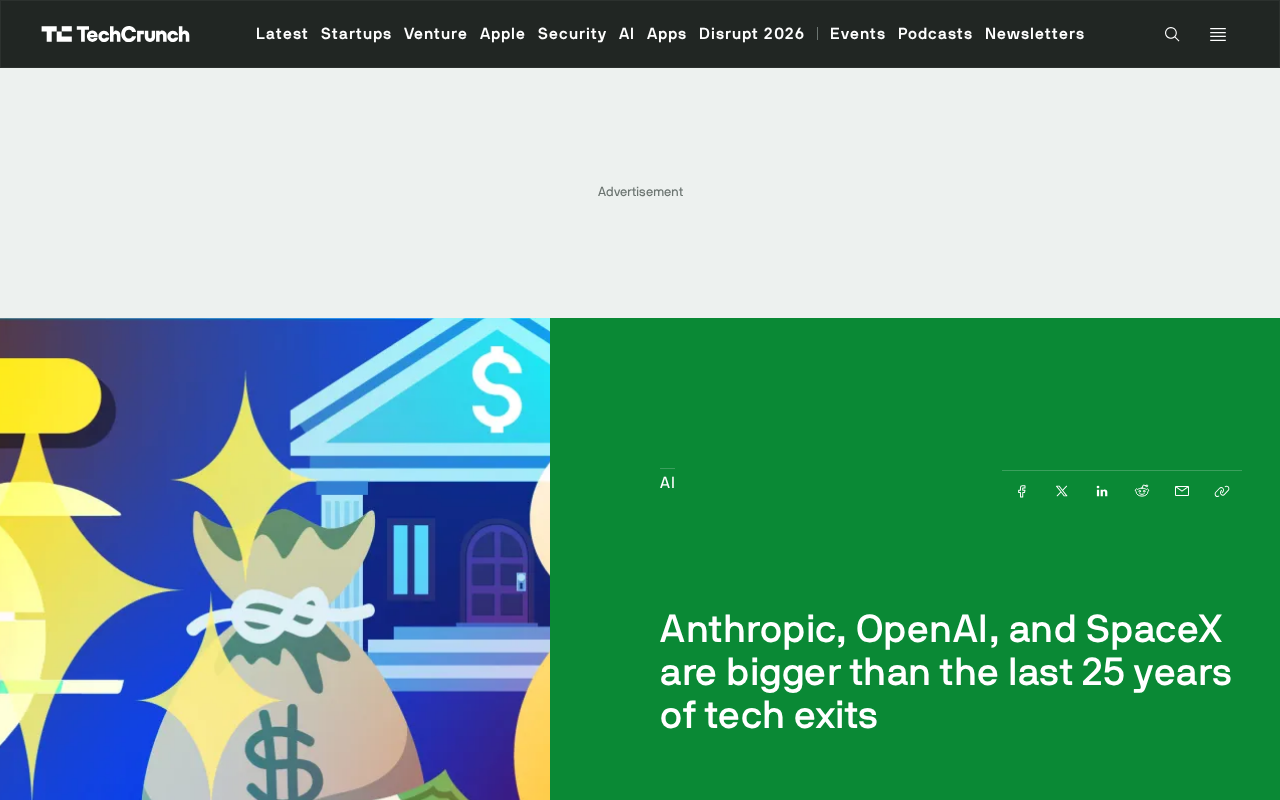
The Era-Defining Shift Behind the Numbers
Historical Exit Scale: The Benchmark for This Disruption
To appreciate the weight of this claim, you first need a frame of reference. Venture capital exits primarily happen through two channels: IPOs (Initial Public Offerings) and M&A (mergers and acquisitions). An IPO involves a company selling shares to the public and listing on a stock exchange — the primary path for VCs to achieve liquidity. M&A involves acquisition by a larger company, often in a company's earlier growth stages or during market consolidation.
Over the 25 years since the dot-com bubble of 2000, U.S. venture-backed companies have generated cumulative exit value estimated in the tens of trillions of dollars — including landmark cases such as Google (2004 IPO, ~$23B market cap), Facebook (2012 IPO, ~$104B market cap), and Uber (2019 IPO, ~$82B market cap). Summing these exits creates a baseline for measuring the value created across an entire venture era.
Since the dot-com bust, Silicon Valley and the broader U.S. VC ecosystem have given rise to countless high-profile companies — Google, Facebook (Meta), Uber, Airbnb, and more. These companies generated enormous wealth for investors and founders through IPOs or acquisitions by tech giants. Adding up those exits already produces an astronomical figure. And now, the AI trio is challenging that cumulative total. This reflects not just a dramatic inflation of individual company valuations, but also the near-euphoric optimism capital markets have toward the next generation of technology platforms. When three companies' combined valuations approach or exceed that benchmark, the symbolism goes far beyond the numbers — it signals that AI and aerospace are concentrating value at a level that rivals the entire innovation ecosystem's output over the past quarter century.
The Valuation Logic of the Three Giants: Why Markets Are Willing to Pay This Price
As the pioneer of the generative AI wave, OpenAI's valuation has surged on the explosive growth of products like ChatGPT. Generative AI refers to AI systems that can automatically produce text, images, code, audio, and other content from input prompts, built on the Transformer architecture introduced by Google in 2017 — which fundamentally reshaped the paradigm of natural language processing. The release of ChatGPT in November 2022 was the inflection point: it surpassed one million users in just five days, hit 100 million monthly active users within two months, and became the fastest-growing consumer application in human history — sending a powerful signal to capital markets that AI was crossing from the lab into large-scale commercial deployment.
Anthropic, with its Claude model family and deep commitment to AI safety, has emerged as another pole of capital attraction. Anthropic was founded in 2021 by former OpenAI VP of Research Dario Amodei and his sister Daniela Amodei, placing AI safety at the core of its research agenda. The company introduced the "Constitutional AI" methodology, which uses a set of preset value principles to constrain model behavior, reducing reliance on human annotation while lowering the probability of harmful outputs. It has since attracted strategic investments from Google and Amazon — with Amazon committing up to $4 billion — representing not just financial backing but a strategic move by cloud giants to stake their position in the era of AI infrastructure.
SpaceX, though it operates in aerospace, follows an equally compelling value logic. Its reusable rocket technology allows the Falcon 9's first stage to autonomously return and land for reuse, compressing the cost of putting payload into orbit from tens of thousands of dollars per kilogram under traditional aerospace models to under $3,000. Meanwhile, the Starlink satellite internet constellation has deployed over 5,000 satellites and surpassed 3 million subscribers, generating steady recurring revenue and building a space infrastructure moat with powerful network effects. Together, these capabilities elevate SpaceX beyond the traditional "rocket company" frame into a platform-type enterprise with both infrastructure characteristics and high-growth expectations — unlocking trillion-dollar potential in its own right.
What these three companies share is this: they are not simply improving existing businesses. They are creating entirely new technology paradigms. When capital markets price them, they are fundamentally paying for "platform-level transformation" — betting on the potential to reshape entire industrial orders, not on current profit figures.
Bubble or New Era? Two Competing Perspectives
The Optimist's View: Current Valuations May Still Underestimate the Upside
Supporters argue that AI and commercial space represent humanity's next technological singularity. The central bet is on Artificial General Intelligence (AGI) — an AI system capable of matching or surpassing human-level cognitive performance across any task, fundamentally different from today's "narrow AI" that excels only in specific domains. OpenAI explicitly lists "ensuring AGI benefits all of humanity" as its core mission and has predicted AGI could arrive within the next few years. If AGI is truly achieved, or if the space economy truly matures, current valuations may not be high at all — they may severely underestimate future returns. From this logic, the trio surpassing 25 years of exits is simply a rational projection of enormous future value.
The Skeptic's Concerns: History's Lessons Cannot Be Ignored
Yet history offers a clear warning. The roots of the dot-com bubble in 2000 lay in exactly this kind of excessive optimism about new technology. The defining features of that bubble were: unclear revenue models, profitability far in the future, and valuations based entirely on narrative rather than financial data. The Nasdaq fell roughly 78% within two years of its March 2000 peak, wiping out trillions in market cap. Today's AI companies share some similarities with that era but also differ in important ways: similarities include valuations far exceeding current earnings and business models still being explored; differences include OpenAI already having real and rapidly growing revenue (reportedly over $3 billion annualized in 2024), with enterprise customers showing significantly stronger willingness to pay than during the dot-com era.
When valuation growth far outpaces actual earnings capacity, bubble risk begins to accumulate. OpenAI and Anthropic remain in a high-investment, high-burn phase, and the long-term sustainability of their business models has yet to be proven. The fact that the combined valuations of three companies approach the entire industry's 25-year exit total is itself a warning signal — such extreme concentration of value may indicate that market sentiment has overheated rather than reflecting pure rational pricing. The AGI thesis itself is also deeply contested: some researchers believe that continued scaling of large language models will naturally give rise to AGI capabilities; others argue the current approach faces insurmountable architectural bottlenecks. This uncertainty sits at the very core of valuation risk.
Far-Reaching Implications for the Tech Ecosystem
Extreme Capital Concentration: The "Winner-Takes-All" Dynamic Intensifies
When enormous capital and public attention concentrate in a handful of companies, the entire tech ecosystem risks a further intensification of winner-takes-all dynamics. Financing space for small and medium-sized startups will shrink, while talent and resources continue gravitating toward the top players.
This concentration has its positive dimension — it enables the sustained investment required for frontier R&D at massive scale. But it also carries risks — potentially compressing the diversity of innovation and seeding a new wave of technology monopolies. Notably, the scaling dynamics of AI model training (the compounding gains from "compute, data, and parameters" working together) naturally favor head concentration, much like the network effects of the internet era — further reinforcing the structural logic of winner-takes-all.
A Historic Moment for the IPO Market
For capital markets, the potential IPOs of these three companies are the most closely watched events in recent memory. Their public listings will not only redefine the valuation framework for tech stocks — they could become the definitive barometer of the entire AI industry's maturity.
The central question every investor is asking is simple: can these companies convert their stunning paper valuations into real revenue growth and sustained profitability? Or will they ultimately become a footnote in the next bubble's collapse?
Conclusion
The fact that three AI and aerospace giants are valued at more than the cumulative tech exits of the past 25 years is the most symbolically charged capital narrative of our time. It simultaneously embodies the genuine value creation driven by technological revolution and the latent risks of an overheated market. The tension between the real value technology creates and the sentiment premium markets assign to it always takes time to resolve — that is the historical wisdom bequeathed by the dot-com bubble, and an indispensable reference point for understanding the current AI capital frenzy.
Whatever the ultimate outcome, one thing is certain: we are at a historical inflection point where technology and capital are deeply intertwined. The fate of these three companies will, in significant ways, shape the trajectory of the tech industry over the next decade. For investors, founders, and observers alike, maintaining a judgment that is both optimistic and clear-eyed will be the key to understanding and navigating this transformation.
Key Takeaways
Related articles

Frontend to AI Agent Development: A Frontline Architect Explains Career Paths and Opportunities
A frontline AI architect explains the industry changes and practical paths for frontend developers transitioning to AI Agent development: why pure frontend jobs are disappearing, why Agent + full-stack has become mainstream in hiring, and three transformation routes—Agent development engineer, FDE, and remote contracting—along with corresponding learning strategies.

How to Choose an AI Agent Development Course: Five Pitfall-Avoidance Guidelines
A mechanical-engineering career changer's two-year pitfall-tested checklist for screening AI Agent development courses: complete delivery pipeline, resume-worthy projects, real development perspective, update frequency, and coaching feedback—with concrete judgment methods and pitfall-avoidance tips.

Coze AI Agent Building for Beginners: A Zero-Code AI Agent Development Guide
Coze, ByteDance's one-stop AI application development platform, supports zero-code drag-and-drop AI agent building. This article outlines Coze's core concepts, three advantages, differences between the domestic and international versions, and the distinction between agents and apps, helping beginners quickly get started with AI Agent development.