AI SDK Ecosystem Patch Release: typesafe-ai 3.0.28 Dependency Upgrade Analysis
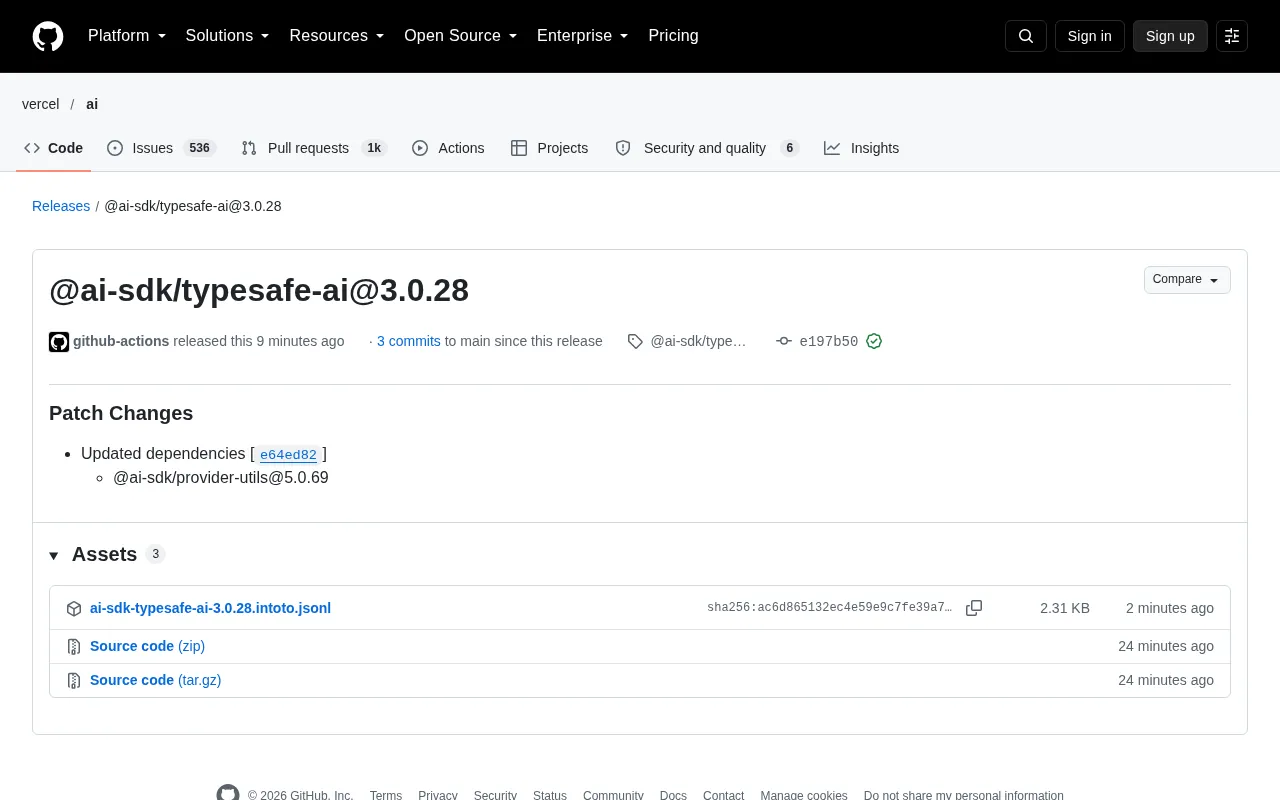
@ai-sdk/typesafe-ai releases 3.0.28 patch, upgrading only the underlying provider-utils dependency.
@ai-sdk/typesafe-ai has released patch version 3.0.28, automatically published by github-actions with a verified signature. The only change is upgrading @ai-sdk/provider-utils to 5.0.69. This is a typical dependency-synchronization patch with no API changes or new features. Since provider-utils sits at the bottom of the AI SDK call chain and carries the shared logic of the provider adapter layer, its patch-level updates generally contain only bug fixes, but running type checks and integration tests in CI is still recommended. Projects using loose dependency ranges such as ^3.0.0 will automatically receive this version. Such releases reflect the AI SDK ecosystem's layered decoupling and changesets-driven small-step iteration cadence, and developers need to consult release notes to judge whether an upgrade is necessary.
The AI SDK ecosystem has always moved fast, with new patch releases landing on GitHub every day. This time the spotlight is on @ai-sdk/typesafe-ai@3.0.28 — a patch version automatically published by the github-actions bot, with a single commit whose only change is updating the dependency @ai-sdk/provider-utils to 5.0.69.
What Kind of Release Is This
Judging from the GitHub Release page, this follows the standard patch changes release flow: the version number increments along the 3.0.x line to 3.0.28, the commit is signed with GitHub's verified signature with GPG key ID B5690EEEBB952194, indicating the release went through the official automation pipeline with no signs of unusual manual intervention.
The only change listed in the release note is upgrading @ai-sdk/provider-utils to 5.0.69, with commit reference e64ed82. For readers unfamiliar with the AI SDK ecosystem, provider-utils is the package in the Vercel AI SDK family that carries the shared logic of the provider adapter layer. Individual provider implementations (such as OpenAI, Anthropic, etc.) and higher-level wrapper packages all depend on it. Packages like typesafe-ai choosing to follow the upgrade is typically done to maintain compatibility with the provider layer.
@ai-sdk/provider-utils is a core utility package in the Vercel AI SDK family, providing a unified adapter layer implementation for various AI providers (such as OpenAI, Anthropic, Google, etc.). It encapsulates common logic like request construction, response parsing, streaming handling, and error mapping, so that upper-level provider packages only need to focus on the differences in their own APIs. Since nearly all provider implementations and wrapper libraries depend on it directly or indirectly, a version change in provider-utils can affect behavioral consistency across the entire call chain. Therefore, when an upper-level package like typesafe-ai upgrades its dependency, it is usually to align with the latest adapter-layer fixes or compatibility adjustments, ensuring that type definitions and runtime behavior stay consistent with the underlying layer.
The Engineering Significance Behind a Patch Version
On its face, this release has no API changes, no new features, and no breaking changes — a classic "dependency synchronization" patch. For users, the most direct implication of such a version is: if you have pinned a version range for @ai-sdk/typesafe-ai in your project, 3.0.28 will pull provider-utils up to 5.0.69 along with it.
You may not have noticed that dependency upgrades themselves are not always risk-free. Patch-level updates to provider-utils generally contain only bug fixes or internal implementation adjustments, but it sits near the bottom of the entire call chain, so if its behavior changes subtly, the type inference or request construction of the upper-level wrapper could be affected. So even for "Updated dependencies" alone, it is still worth running type checks and integration tests in CI.
The Signal Value of Automated Releases
This release was published by the github-actions account with a verified signature, reflecting the changesets + automated release workflow commonly adopted by AI SDK-related repositories. For downstream developers, the benefit of this release model is stable frequency and traceable change records; the cost is that patch numbers grow quickly, making it hard to judge from the version number alone whether an upgrade is "worth it" — you need to go back to the release note to confirm the actual changes.
Changesets is a version management and release tool widely used in the JavaScript ecosystem, especially well-suited for monorepo projects. Developers describe change types (patch/minor/major) by submitting changeset files, and the CI system automatically calculates version numbers, generates changelogs, and publishes to npm based on them. In multi-package repositories like AI SDK, changesets ensures that each package's version evolves independently while maintaining correct dependency relationships. Automatic publishing by github-actions with a verified signature is the standard output of this process: it eliminates human error in manual releases and ensures stable release frequency and traceable change records, but it also leads to rapid growth in patch numbers, requiring developers to judge upgrade value through release notes.
Who Should Pay Attention to This Update
Projects that use @ai-sdk/typesafe-ai directly are the primary audience. If your dependency declaration allows automatic patch-level upgrades (e.g., ^3.0.0), the next install will pick up 3.0.28 with no extra action needed.
Indirect use cases exist as well: any toolchain in the AI SDK ecosystem that depends on provider-utils may receive the same underlying fix through this synchronized upgrade. For AI application projects in a rapid iteration phase, keeping up with minor versions of these foundational packages is often easier than letting several versions accumulate and upgrading all at once.
Looking at the AI SDK Ecosystem Through Release Cadence
The very fact that a patch version containing only a dependency upgrade can appear on its own in the release list speaks to the maturity of the ecosystem: the underlying provider abstraction layer keeps making small fixes, and the upper-level wrapper packages follow along in a mechanical way. This layered release approach gives each package a clear boundary of responsibility — provider-utils handles adapter-layer details, typesafe-ai handles type-safe wrapping, and their version numbers evolve independently.
For developers, being able to read this kind of "almost empty" release is also a skill: it tells you the ecosystem is still being maintained and the dependency chain is in sync, while also reminding you to occasionally clean up your lockfile and dependency ranges to avoid staying on old patches for too long.
One-line Summary
@ai-sdk/typesafe-ai releases 3.0.28 patch, upgrading only the underlying provider-utils dependency.
Paragraph Summary
@ai-sdk/typesafe-ai has released patch version 3.0.28, automatically published by github-actions with a verified signature. The only change is upgrading @ai-sdk/provider-utils to 5.0.69. This is a typical dependency-synchronization patch with no API changes or new features. Since provider-utils sits at the bottom of the AI SDK call chain and carries the shared logic of the provider adapter layer, its patch-level updates generally contain only bug fixes, but running type checks and integration tests in CI is still recommended. Projects using loose dependency ranges such as ^3.0.0 will automatically receive this version. Such releases reflect the AI SDK ecosystem's layered decoupling and changesets-driven small-step iteration cadence, and developers need to consult release notes to judge whether an upgrade is necessary.
Related articles

New Trailer for 'Everest: The Other Side' Released: Ski Mountaineers Take On Ski Descent of the North Face
National Geographic's 'Everest: The Other Side' trailer follows pro ski mountaineers attempting Everest's Direct North Face and the first ski descent, with rare North Face footage and life-or-death avalanche moments.
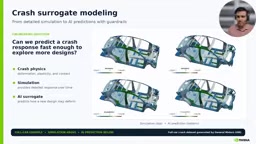
Building Automotive Crash AI Surrogate Models with NVIDIA PhysicsNeMo
An analysis of the NVIDIA PhysicsNeMo crash analysis workflow: how to train a Transolver surrogate model with simulation datasets and package it as an inference API via NIM, covering the complete four-step process of geometry parameterization, data splitting, and error validation.

LangGraph in Production: The Pain of Silent API Changes
Explores the challenge of silent external API changes affecting LangGraph agents in production, analyzes monitoring and testing limits, and proposes semantic validation and regression testing defenses.