AI SDK OpenAI 2.0.143 Released: Structured Output and Prompt Caching Optimizations
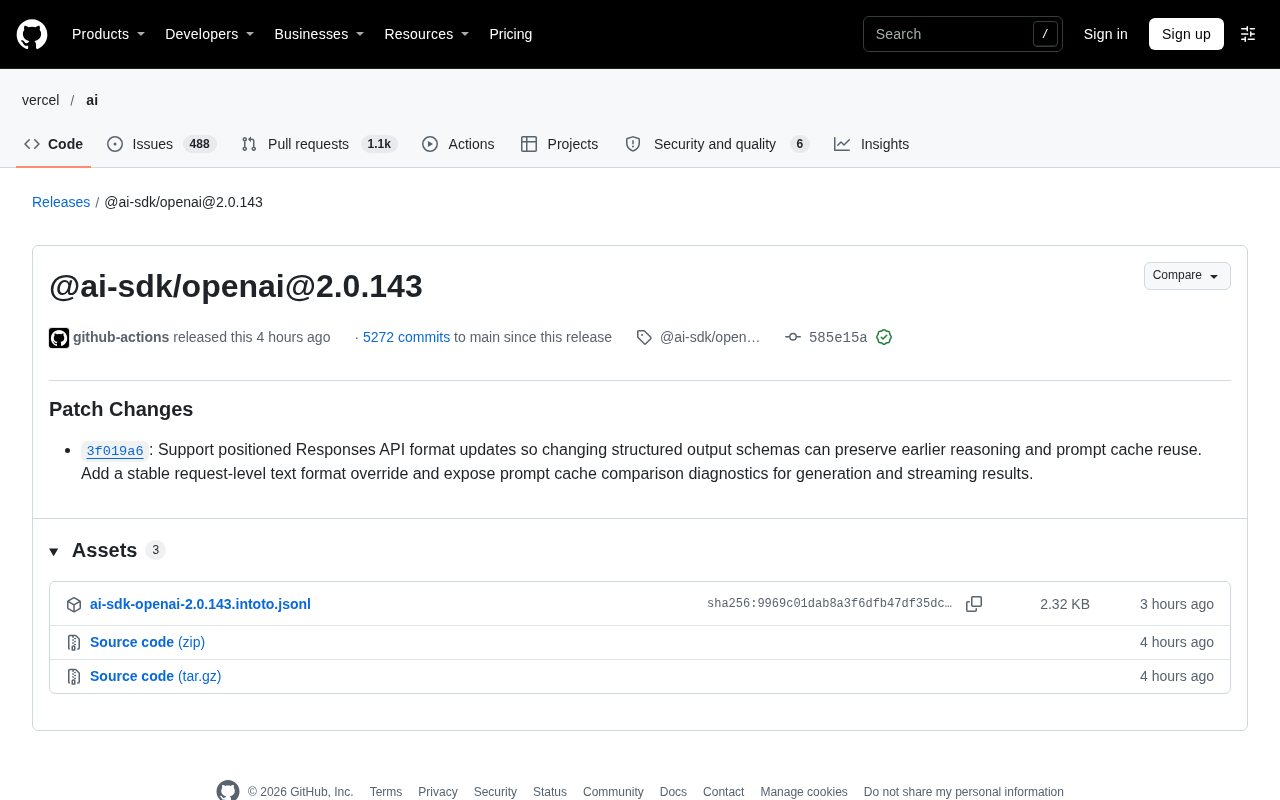
AI SDK OpenAI 2.0.143 optimizes reasoning preservation and cache reuse for Responses API structured outputs.
AI SDK's OpenAI provider module released patch version 2.0.143, enhancing the Responses API structured output workflow in three areas: positional format updates that preserve prior reasoning and reuse prompt caches when schemas change, a stable request-level text format override for mixed-call architectures, and prompt cache comparison diagnostics for both generation and streaming results. Overall, it is a pragmatic update focused on cost and observability.
The OpenAI provider module of AI SDK has released version 2.0.143. This update focuses on format support for the Responses API, particularly around preserving reasoning and reusing prompt caches in structured output scenarios. For developers who rely on structured outputs, this is a patch update worth paying attention to.
Core Update: Positional Responses API Format
This version introduces a key capability — support for positional Responses API format updates. Simply put, when developers adjust the schema of structured outputs, the system can now preserve previous reasoning content and reuse the prompt cache.
Previously, modifying the output schema often meant the model had to perform full reasoning from scratch, resulting in extra latency and token consumption. The new version uses positional format handling so that changes only affect the parts that actually changed, reducing unnecessary recomputation. For agent applications and complex workflows that need to iterate on schemas frequently, this can significantly lower reasoning overhead.
Responses API is OpenAI's new-generation conversation and generation interface, existing alongside the earlier Chat Completions API. Its core feature is that it uses an array structure of "input items" to describe conversation history, organizing messages, tool calls, reasoning fragments, and other elements as different types of items in a unified way, making it naturally suited for multi-turn tool calling and structured output scenarios. In the Responses API, reasoning content (reasoning items) previously produced by the model can be sent back along with the conversation history, and the server-side prompt cache matches at the granularity of input prefixes. Precisely because the request body is an ordered sequence of items, "which segment changed" when the format changes has real meaning — this is the premise that makes the "positional" handling described in this article possible.
Structured Outputs refers to constraining model output via JSON Schema so that it strictly conforms to a predefined field structure. OpenAI's implementation attaches the schema to the request and applies constrained decoding during the decoding stage, ensuring the result can be parsed directly. Because the schema itself enters the context as part of the prompt, once the schema text changes, the prompt cache prefix previously established based on the old schema may become invalid, and the model also needs to "understand" the new field constraints anew. Understanding this is necessary to see why a minor schema adjustment incurs both cache misses and reasoning recomputation costs, and to understand why positional diffing can alleviate this problem.
Request-Level Text Format Override
The update also adds a stable request-level text format override mechanism. Developers can specify the text format at the individual request level without relying on global configuration or modifying underlying parameters. This fine-grained control lets different requests switch formats according to their own needs, making it especially suitable for application architectures with mixed multi-scenario calls.
Text format in the Responses API is used to declare the desired output form, with common values including plain text, JSON objects, and structured outputs based on JSON Schema. Previously, such configuration was often bound at the model instance or global client level, and switching required rebuilding the instance or modifying shared configuration. Request-level override moves this configuration down to the parameters of a single call, allowing the same client instance to concurrently handle requests with different output formats, reducing configuration management burden and avoiding interference caused by shared state, which is particularly practical in mixed-call architectures.
Prompt Cache Diagnostics
In addition to functional improvements, version 2.0.143 also exposes prompt cache comparison diagnostics, covering both generation and streaming results. Developers can now view comparison data on cache hits and misses, making it more intuitive to evaluate the actual effectiveness of caching strategies. For teams pursuing cost optimization, this diagnostic capability provides an observability foundation to help identify the causes of cache invalidation.
Prompt Caching is an automatic caching mechanism OpenAI provides for repeated input prefixes: when the beginning of a request matches recent requests, those tokens can be billed at a discounted rate and skip repeated prefill, usually significantly reducing cost and time to first token. The cache matches in fixed-length prefix blocks, so any change within the prefix may invalidate everything after it. Cache hit rate therefore becomes a key metric for measuring the economics of calls, and the role of "comparison diagnostics" is to explicitly expose the number of hit and missed tokens, letting developers determine whether changes fall inside or outside the cache boundary.
Practical Significance for Developers
Overall, although this patch update does not introduce major new features, it makes pragmatic optimizations to the structured output workflow of the Responses API. Reasoning preservation and cache reuse are directly tied to call cost and response speed, while the exposure of diagnostics lowers the barrier to tuning.
If you are building applications that require structured outputs using the OpenAI provider of AI SDK, it is recommended to upgrade to version 2.0.143 and use the new diagnostic capabilities to check the performance of your existing caching strategy.
Conclusion
AI SDK OpenAI 2.0.143 enhances three areas around the Responses API: positional format, request-level format override, and cache diagnostics. The core goal is to make structured output changes more economical and more observable. For developers concerned with reasoning cost and cache efficiency, this is an update worth following.
One-line Summary
AI SDK OpenAI 2.0.143 optimizes reasoning preservation and cache reuse for Responses API structured outputs.
Paragraph Summary
The OpenAI provider module of AI SDK has released patch version 2.0.143, enhancing the structured output workflow of the Responses API in three areas. First, positional Responses API format updates allow developers to preserve previous reasoning content and reuse prompt caches when modifying output schemas, avoiding the latency and token consumption of full recomputation. Second, a stable request-level text format override mechanism lets text format be specified at the individual request level, adapting to mixed multi-scenario calls. Finally, prompt cache comparison diagnostics covering both generation and streaming results help developers assess cache hits and identify causes of invalidation. Overall, this is a pragmatic update focused on cost and observability, with practical value for agent applications that rely on structured outputs.
Related articles

Gemini 4 Neon Review: Benchmark Scores Rival Carbon, API Pricing and Quota Breakdown
Google Gemini 4 Neon is now live, benchmark scores closely tracking Carbon, API pricing 3/15 at twice Hydrogen's rate. This article compiles Bilibili creator testing: Neon can replace 90% of Carbon scenarios, AntiGravity quota consumption is only one-third of Carbon, plus subscription channel restrictions and 2API ban risks.

Gemini 4 Helium Coming Soon? Signals of Google Loosening Subscription Restrictions
Google team member hints releases will continue; community speculates Gemini 4 Helium (Flash Lite) may be next. Subscription ban controversy gets a response as product lead says "Soon," suggesting restrictions may be lifted. This article covers Gemini developments, OpenAI Coding Agent and risk management, Doubao real-time audio-video API, and compute business dynamics.

AI-Assisted React Development in Practice: Optimizing a Video App and Handling Errors
A 14-year veteran developer demonstrates AI-assisted React video app optimization: compressing video from 80MB to 5MB (~94%) via ImageKit, plus reliable error handling and retry mechanisms. Includes planning, code understanding, and verification methods for working with AI.