@ai-sdk/react 4.0.184 Patch Released, MCP Dependency Updated

@ai-sdk/react releases 4.0.184 patch, only syncing @ai-sdk/mcp dependency version.
The article explains the release of @ai-sdk/react 4.0.184. This version is a Patch Changes level release, with the only change being updating the dependency @ai-sdk/mcp to 2.0.103; its own public API, type definitions, and behavior logic are unchanged. The article notes that while such dependency sync releases seem minor, they allow downstream projects to get MCP layer fixes through a single upgrade without manually overriding indirect dependencies. The author recommends upgrading through regular processes, but since dependency updates may indirectly propagate runtime behavior changes, existing tests should still be run after upgrading. The article also observes that this package adopts a high-frequency, small-step release strategy, with patch numbers accumulated to three digits—this cadence reduces per-upgrade risk at the cost of maintaining a certain upgrade frequency.
A Low-Key but Critical Dependency Maintenance
The React binding package @ai-sdk/react in the AI SDK ecosystem has released version 4.0.184. Judging from the GitHub Releases page, this isn't a feature iteration but a typical patch update: the only core change is updating the dependency @ai-sdk/mcp to version 2.0.103.
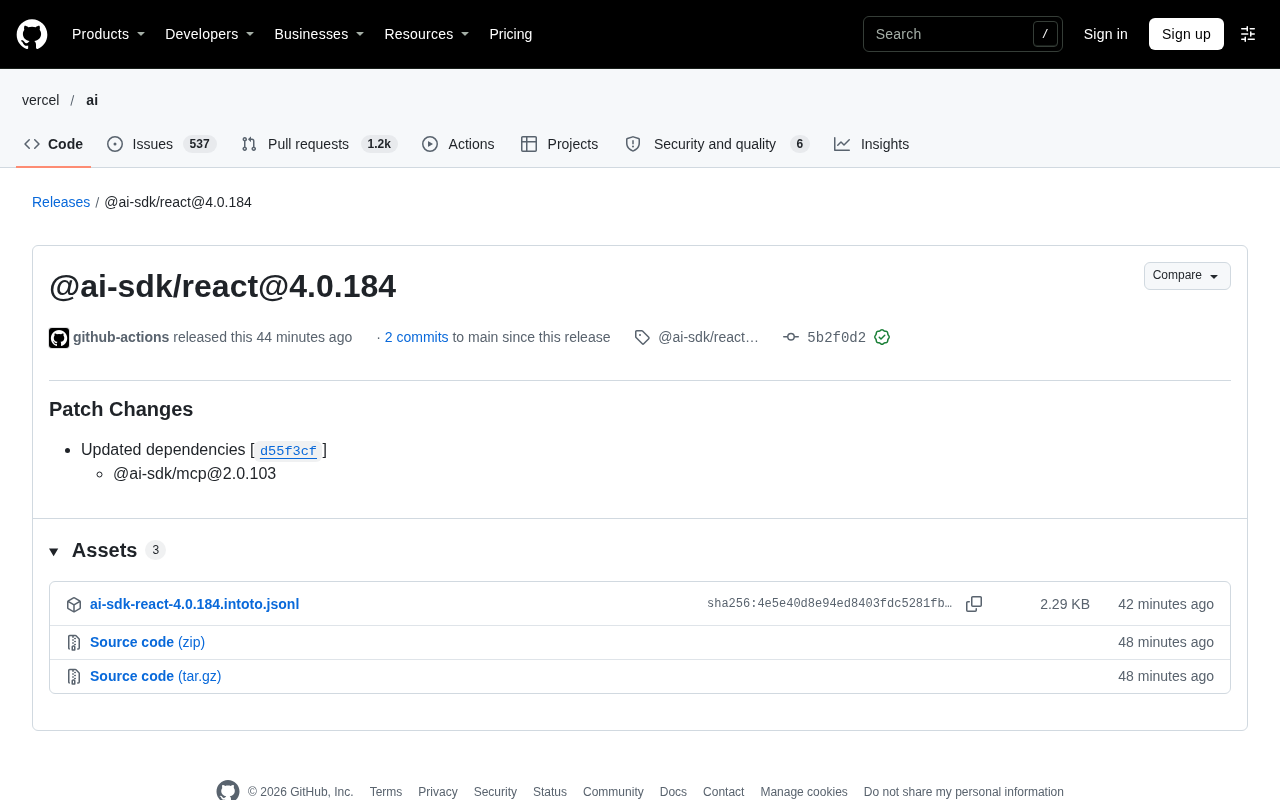
For developers unfamiliar with this toolchain, this version number might just look like another number rolling over. But in real projects, such patches are often the necessary action to keep the entire AI application chain stable.
Breaking Down the Patch
Minimal Scope of Changes
According to the release notes, this version is marked as Patch Changes, the lowest level of update in semantic versioning. There's only one change entry: Updated dependencies, pointing to @ai-sdk/mcp@2.0.103.
This means @ai-sdk/react's own public API is unchanged—no new hooks, no modified type definitions, no adjusted behavior logic. Users upgrading should theoretically perceive no interface-level differences.
Semantic Versioning (SemVer) specifies that version numbers consist of three segments: major, minor, and patch, corresponding to incompatible API changes, backward-compatible feature additions, and backward-compatible bug fixes respectively. Being marked as Patch Changes means the publisher commits that this update introduces no breaking changes. It's worth noting that the patch level only constrains the package's own public API; updates to its dependencies can still change runtime behavior through transitive dependencies, so "patch" doesn't equal "zero risk"—testing steps cannot be skipped.
Why Dependency Updates Warrant a Separate Release
@ai-sdk/mcp can be identified by its name as related to MCP (Model Context Protocol), responsible for context interaction between AI models and external tools/data sources. The React binding layer depends on it, typically to provide client-side capabilities for interfacing with MCP services.
When a dependency package releases a new version, it's common practice for upstream packages to sync version numbers through patch releases. The benefit is that downstream projects encountering bugs or compatibility issues at the MCP layer can get the fixed dependency chain in one upgrade of @ai-sdk/react, without manually overriding indirect dependencies.
MCP (Model Context Protocol) is an open protocol proposed and open-sourced by Anthropic in late 2024, aimed at establishing standardized context interaction between AI models and external tools/data sources. It uses a client-server architecture: the model side acts as a client, calling encapsulated MCP servers through a unified JSON-RPC interface, which can expose capabilities like file systems, databases, and APIs. In the AI SDK ecosystem, @ai-sdk/mcp is the TypeScript implementation of this protocol, handling handshakes, tool discovery, and call orchestration; the React binding layer depends on it so frontend applications can directly interface with MCP services without implementing protocol details themselves. Understanding this dependency layer helps assess the actual impact scope of patch upgrades.
Practical Impact on Developers
Upgrade Recommendations
If you're using @ai-sdk/react in your project, the upgrade cost for this version is nearly zero. No breaking changes, no migration work—just run your regular package manager update.
You might not have noticed that dependency updates can sometimes indirectly change runtime behavior—if @ai-sdk/mcp@2.0.103 itself fixes issues or adjusts internal implementations, those changes propagate up through the dependency chain. So running your existing tests after upgrading is still a prudent practice.
Observing the Release Cadence
From version numbers like 4.0.184, it's clear that @ai-sdk/react adopts a high-frequency, small-step release strategy. The patch version number has accumulated to three digits, indicating the maintenance team prefers frequent small releases to quickly sync dependencies and fixes rather than accumulating them into major releases.
This cadence is user-friendly: short wait times for bug fixes and low risk per upgrade. The trade-off is needing to maintain a certain upgrade frequency—otherwise, falling too far behind makes troubleshooting dependency conflicts more troublesome.
Transitive dependencies refer to dependencies not directly declared by the project but introduced through other dependency packages. In the npm ecosystem, if multiple packages have inconsistent version requirements for the same transitive dependency, the package manager may install multiple copies or trigger version hoisting, leading to hard-to-locate conflicts. Upstream packages syncing their dependency versions through patch releases essentially locks in a verified dependency chain for downstream, significantly reducing the probability of such conflicts—which is why such "no-feature-change" patches are still worth following up on promptly.
Summary
This release has no new features worth writing home about; its value lies in maintaining the cleanliness and synchronization of the dependency chain. For teams building applications with the AI SDK, incorporating such patches into regular upgrade processes is much easier than waiting until compatibility issues arise.
Related articles

ChatGPT Plus Subscription Pitfall Guide: Go/Plus/Pro Tier Comparison and Quick Activation
A complete ChatGPT Plus subscription guide based on a Bilibili tutorial: from registering an account, comparing Go/Plus/Pro tiers, to the practical steps for quickly completing your subscription.

GPT-6.2 Sol/Astra Released! A Step-by-Step ChatGPT Plus Subscription Guide and Tier Comparison
GPT-6.2 Sol/Astra is out—here's a ChatGPT Plus subscription guide: register an account, compare Go/Plus/Pro tiers, and subscribe in a minute.

Comparing Three Channels for Subscribing to GPT Plus in China: Is Website Top-Up the Easiest?
How to subscribe to GPT Plus in China? This article compares website top-up, credit card, and mobile top-up channels—process, cost, and risk—with steps and tips to help you choose wisely.