AI SDK Releases @ai-sdk/zai 3.0.53 Patch Update for Smoother Z.ai Integration

AI SDK releases @ai-sdk/zai 3.0.53 pure patch, upgrading three underlying dependencies to maintain compatibility alignment.
Vercel's AI SDK has released @ai-sdk/zai@3.0.53, a pure patch version with no API changes, whose core content is the synchronized upgrade of three underlying dependencies: @ai-sdk/openai-compatible, @ai-sdk/provider-utils, and @ai-sdk/provider. The article notes that in AI SDK's multi-layer architecture, dependency follow-through in provider packages is practically significant for ensuring multi-model integration stability; unsynchronized minor interface adjustments can cause type inconsistency and abnormal streaming parsing. Z.ai integrates with the AI SDK ecosystem through this official provider package, letting developers call its models via unified interfaces. This upgrade carries low risk; it is recommended to follow up after routine testing and to watch the version constraints of the dependencies being bumped.
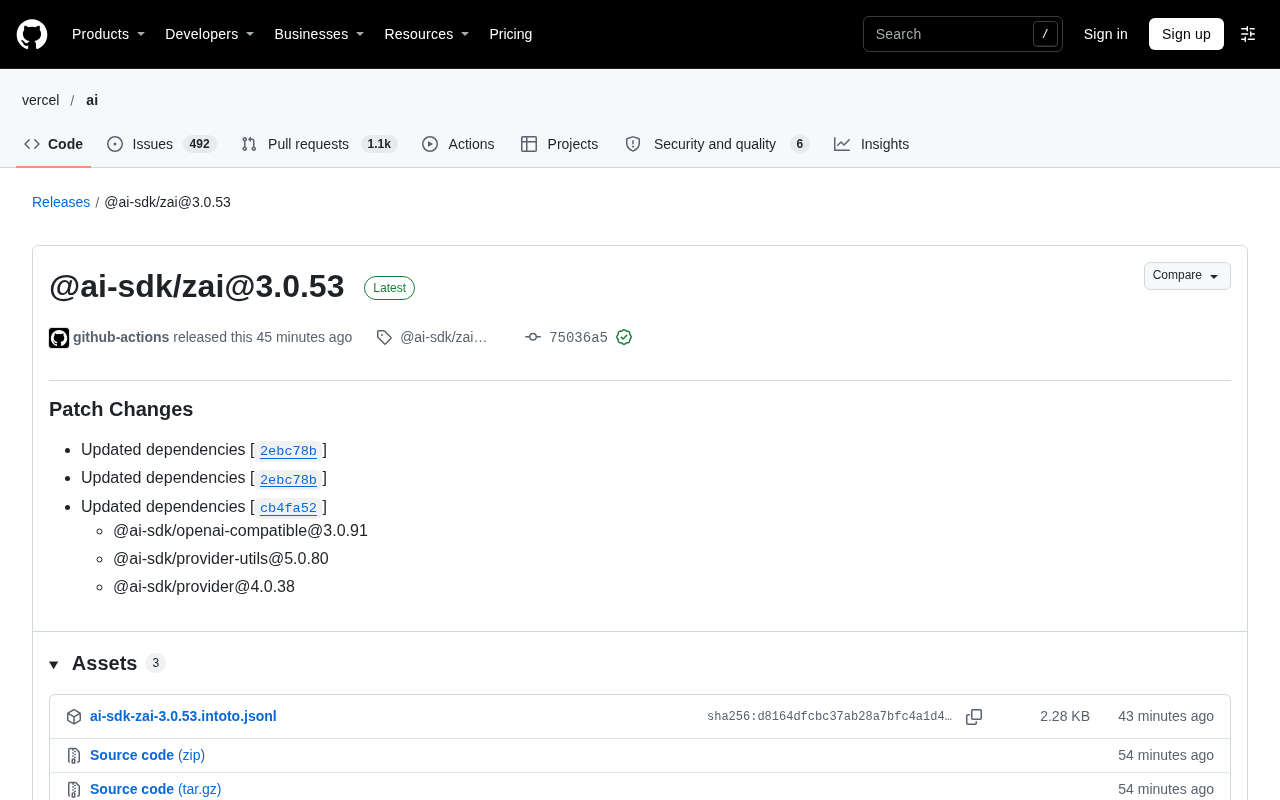
The AI SDK ecosystem has received a quiet but important patch update. Vercel's AI SDK has released @ai-sdk/zai@3.0.53, a pure patch version whose core change is the synchronized upgrade of three underlying dependency packages. For developers already using Z.ai model services, this update represents another step toward alignment in terms of compatibility and stability.
A Patch Update That "Only Touches Dependencies"
Judging from the GitHub release notes, the changes in @ai-sdk/zai@3.0.53 are highly focused: no new APIs, no modifications to public interfaces, and no behavior-level breaking changes. Every item listed in the release notes is "Updated dependencies," covering three packages:
@ai-sdk/openai-compatible@3.0.91@ai-sdk/provider-utils@5.0.80@ai-sdk/provider@4.0.38
This update pattern is not uncommon among AI SDK provider packages. Z.ai's integration layer is built on top of the OpenAI-compatible protocol, so the stability of @ai-sdk/zai depends heavily on the openai-compatible middleware layer and the lower-level provider abstractions. Once upstream dependencies are patched, downstream provider packages need to follow suit; otherwise, version mismatches can easily lead to type incompatibilities or runtime exceptions.
The simultaneous upgrade of all three dependencies indicates that upstream made minor corrections at both the provider utility layer and the protocol layer. After upgrading, developers should theoretically get calling behavior that is more consistent with the latest AI SDK core.
Semantic Versioning (SemVer) and Patch Versions: The npm ecosystem generally follows semantic versioning conventions, with version numbers in the form major.minor.patch. An increment in the patch number (e.g., 3.0.52 → 3.0.53) theoretically contains only backward-compatible bug fixes, introducing neither new features nor breaking changes. This is precisely the basis for calling this version a "pure patch"—it promises low upgrade risk. Note, however, that SemVer is a convention rather than a mandate, and actual behavior still depends on how strictly maintainers adhere to it. In multi-package collaborative projects like AI SDK, patch versions may also include dependency version alignment, so "no interface changes" does not equal "zero changes": fixes in underlying dependencies indirectly affect the runtime behavior of provider packages. Developers should assess upgrade impact based on changelogs and the dependency tree rather than making decisions solely on version numbers.
Why Dependency Upgrades in Provider Packages Deserve Attention
Many developers are in the habit of treating patch versions as "ignorable" updates, but in multi-package ecosystems like AI SDK, dependency synchronization in provider packages is often more important than it appears on the surface.
AI SDK's architecture splits model integration into multiple layers: at the top is the developer-facing ai core package, in the middle are the various provider packages (such as @ai-sdk/zai), and at the bottom are the abstractions and utility functions provided by @ai-sdk/provider and @ai-sdk/provider-utils. When interface contracts in the underlying packages are slightly adjusted, if provider packages don't follow along, problems can arise such as inconsistent type definitions, abnormal streaming response parsing, or inconsistent error-handling paths.
By aligning all three dependencies to the new versions at once, @ai-sdk/zai is effectively ensuring that the Z.ai integration layer stays in sync with the AI SDK mainline. For users who depend on Z.ai in production, keeping up with such patches can reduce the cost of troubleshooting "mysterious" compatibility issues.
The role of @ai-sdk/openai-compatible: It is a general-purpose adapter layer provided by AI SDK for integrating any model service that follows the OpenAI Chat Completions API protocol. Many third-party model vendors (including Z.ai) do not directly implement AI SDK's native interfaces but instead reuse the OpenAI-compatible protocol, so provider packages only need minimal configuration on top of openai-compatible to complete integration. This layer handles common logic such as request construction, response parsing, and streaming chunk processing, making it a critical dependency for provider package stability. When openai-compatible is upgraded, the downstream @ai-sdk/zai must follow suit; otherwise, inconsistent protocol parsing behavior may occur. Understanding this relationship helps developers judge whether an upgrade to a given provider package is worth following.
The division of labor between @ai-sdk/provider and @ai-sdk/provider-utils: @ai-sdk/provider defines the abstract interfaces and type contracts that providers must implement (such as unified interfaces for language models and embedding models), serving as the "specification layer" that all provider packages follow. @ai-sdk/provider-utils, meanwhile, provides utility functions reused when implementing these interfaces, such as streaming response chunk parsing, error normalization, and JSON parsing fault tolerance. One is the contract, the other is the toolbox; minor version adjustments in either often ripple across all downstream provider packages. When these two packages release patches, provider packages that align their versions promptly can ensure that type definitions and utility behavior stay consistent with the AI SDK mainline, avoiding hidden issues such as type mismatches or abnormal streaming parsing.
Z.ai's Position in the AI SDK Ecosystem
As a model service provider, Z.ai integrates with AI SDK through the official provider package @ai-sdk/zai. Its existence allows developers to call Z.ai models using unified interfaces such as generateText and streamText without having to handle protocol adaptation themselves.
The advantage of this integration approach is a clear abstraction hierarchy: developers write one set of code and can switch models by switching providers. The trade-off is a longer chain, where version lag in any link can affect final behavior. The value of patches like @ai-sdk/zai@3.0.53 lies in fixing known deviations in this chain, making upper-layer code behavior more predictable.
For teams still weighing whether to integrate Z.ai, this version itself is not a reason to migrate, but it shows that the provider package is still actively maintained with timely dependency updates—a positive signal.
Upgrade Recommendations
If you are already using @ai-sdk/zai in your project, it is recommended to follow the standard patch upgrade process: update to 3.0.53 and run your existing model invocation tests, with particular attention to whether streaming output and error-handling paths work correctly. Since there are no interface changes this time, the upgrade risk is low.
If you have also pinned versions of @ai-sdk/openai-compatible or @ai-sdk/provider-utils, be aware that this upgrade will bump their version numbers as well; make sure there are no conflicts in your project's version constraints.
For developers who have not yet used this package but are evaluating multi-model integration options, it can be regarded as an actively maintained option. The frequency of patch updates and the speed of dependency follow-through are often practical indicators of whether a provider package is worth relying on long-term.
One-line Summary
AI SDK releases @ai-sdk/zai 3.0.53 as a pure patch, synchronously upgrading three underlying dependencies to maintain compatibility alignment.
Paragraph Summary
Vercel's AI SDK has released @ai-sdk/zai@3.0.53, a pure patch version with no API changes, whose core content is the synchronized upgrade of three underlying dependencies: @ai-sdk/openai-compatible, @ai-sdk/provider-utils, and @ai-sdk/provider. The article notes that in AI SDK's multi-layer architecture, dependency follow-through in provider packages is practically significant for ensuring the stability of multi-model integration; if minor adjustments in underlying interfaces are not synchronized, issues such as type inconsistency and abnormal streaming parsing can arise. Z.ai integrates with the AI SDK ecosystem through this official provider package, allowing developers to call its models via unified interfaces. This upgrade carries low risk; it is recommended to follow up after routine testing, while paying attention to the version constraints of the dependencies being bumped along with it.
Related articles

AI and Mathematicians Collaborate to Prove the Riemann Hypothesis? The Controversy Behind 1.7 Billion Lines of Lean Code
AI and mathematician Levent Alpoge used 17 million lines of Lean code to prove the Riemann Hypothesis? An AnyGeometry definition sparked controversy, yet an independent audit says the logic holds. This article explains the Riemann Hypothesis, the Yes machine controversy, and the real impact on RSA encryption.

PeppermintOS Launches Void Edition: A Lightweight Experience Without SystemD or XLibre
PeppermintOS launches PepVoid based on Void Linux, featuring XFCE and XLibre with a non-SystemD architecture. This article covers installation, software center experience, preinstalled software, and technical verification for users interested in a lightweight non-SystemD distribution.

Clojure Native Apps: Letting AI Reshape Software at Runtime
Explore how Clojure enables native apps to be reprogrammed at runtime by developers or AI, drawing on Emacs' extensibility, and analyzing REPL-driven development, AI collaboration, and challenges.