@ai-sdk/rsc 2.0.309 Released: The Technical Signals Behind a Dependency Update

Vercel AI SDK's rsc package ships a patch update syncing lower-level dependencies, reflecting a high-frequency, small-step release cadence.
Vercel's `@ai-sdk/rsc` released version 2.0.309, a standard patch-level update whose core content is merely synchronizing `@ai-sdk/provider-utils@4.0.61` and `ai@6.0.309`, with no new APIs or breaking changes. The version number 2.0.309 indicates the package has gone through over three hundred patch iterations within the 2.x major version, reflecting the AI SDK ecosystem's coordinated, high-frequency release cadence. Since `@ai-sdk/rsc` targets React Server Components and `provider-utils` unifies interfaces across OpenAI, Anthropic, Google and others, this sync ensures the upper-layer package keeps pace with lower-level changes. Upgrade risk is minimal, but upgrading the core `ai` package alongside is recommended.
The AI SDK shows no signs of slowing down its release cadence. Vercel's @ai-sdk/rsc package recently shipped version 2.0.309, and while it's only a patch-level update, the version number itself tells a story worth paying attention to.
What Actually Changed
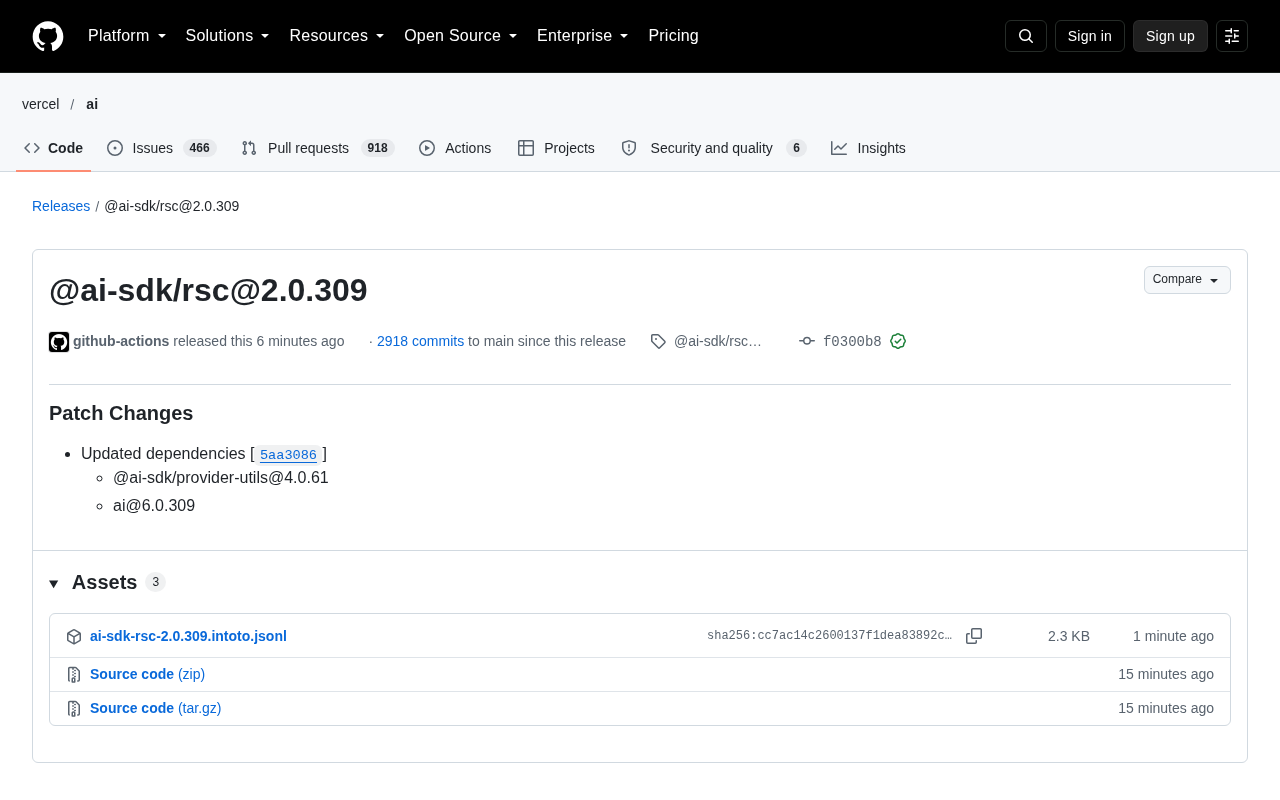
According to the release notes on GitHub, @ai-sdk/rsc@2.0.309 is a standard patch change. The core content is just one line: the dependency @ai-sdk/provider-utils@4.0.61 was updated, and ai@6.0.309 was synchronized.
No new APIs, no breaking changes, not even a bug fix description. From a pure changelog perspective, this is a routine dependency sync.
But it's exactly this kind of "nothing to see here" update that reveals a few things.
Patch-level updates follow Semantic Versioning (SemVer): version numbers take the form major.minor.patch, where an increment in the patch number indicates a backward-compatible bug fix or internal adjustment that introduces no new features and breaks no existing APIs. By contrast, a minor version represents backward-compatible feature additions, while a major version signals potentially breaking changes. In the npm ecosystem, dependency ranges like ^2.0.0 allow automatic upgrades to any 2.x.y version, so patch releases are typically pulled in silently by downstream projects at install time. Understanding the boundaries of patch-level changes helps determine whether a release warrants manual intervention—in most cases, patch updates just need a normal upgrade, with risk concentrated mainly in scenarios where shared dependencies get unexpectedly bumped.
What 309 Patches Means
The version number 2.0.309 is itself informative. Going from 2.0.0 to 2.0.309 means this package has gone through over three hundred patch iterations within the 2.x major version.
This high-frequency, small-step release cadence typically reflects one of two possibilities: either the package is under active maintenance, where any upstream dependency change triggers a synchronized release; or the underlying dependency (such as provider-utils) iterates at an extremely high rate, forcing upper-layer wrappers to keep up.
Given that this update touches both @ai-sdk/provider-utils@4.0.61 and ai@6.0.309, the latter explanation seems more plausible—the entire AI SDK ecosystem is advancing in coordination, and version alignment across sub-packages is a routine engineering operation.
Where the RSC Package Fits in the AI SDK
To understand the significance of this update, you first need to grasp the role @ai-sdk/rsc plays in the AI SDK ecosystem.
This package primarily targets React Server Components scenarios, providing utility functions and hooks for calling AI capabilities within an RSC environment. Compared to the core ai package, it focuses more on how server components integrate with streaming AI responses.
provider-utils, meanwhile, is a lower-level abstraction layer responsible for unifying interface differences across AI providers (OpenAI, Anthropic, Google, etc.). provider-utils jumped from 4.0.60 to 4.0.61—patch-level, yes, but any adjustment in the underlying utility layer can affect upper-layer request construction and response parsing logic.
So this "just updating dependencies" operation actually ensures the RSC package stays current with the latest behavior of provider-utils.
React Server Components (RSC) is a programming model introduced in React 18 and gradually maturing in the new architecture. It allows components to render on the server and directly access resources available only server-side—databases, file systems—without going through an API layer. In AI application scenarios, RSC's advantages are particularly pronounced: model API keys can stay on the server, streaming responses can be pushed directly from server components to the client, and no sensitive credentials need to be exposed in between. @ai-sdk/rsc is precisely the adapter layer designed for this model, providing utilities like createStreamableUI and createAI that bridge the AI SDK's streaming capabilities with RSC's rendering mechanism. Note that RSC currently relies primarily on server frameworks that support the model, such as the Next.js App Router—if your project uses a traditional client-side rendering architecture, this package won't apply.
Practical Impact on Developers
If you're using @ai-sdk/rsc in your project, the recommendation for this update is simple: just upgrade normally.
Patch versions don't involve API changes, so upgrade risk is extremely low. One thing worth noting, though—since the core ai package was also synchronized to 6.0.309, if your project depends on both ai and @ai-sdk/rsc, it's advisable to upgrade them together to maintain version consistency.
For developers still on 1.x, the 2.x series has already gone through over three hundred patches, so stability and feature coverage should be quite mature by now—migration is worth considering.
What the Release Cadence Says About AI SDK's Engineering Culture
Vercel's AI SDK project has long been known for rapid iteration. This release was automatically published by github-actions, the commit carries a GPG verification signature, and the entire process is highly automated.
2918 commits accumulated on the main branch—this number reflects a codebase under continuous, high-frequency development. Automated patch-level releases combined with semantic versioning management allow every package in the dependency chain to promptly receive upstream fixes.
For teams building products on the AI SDK, this cadence means two things: first, you can get underlying fixes and improvements fairly quickly; second, you need a dependency update strategy to avoid falling too far behind and accumulating upgrade costs.
Semantic versioning and automated releases are the engineering foundation behind this phenomenon. The Vercel AI SDK uses tools like Changesets to manage versions: each change first submits a description file, then at release time a bot aggregates them and uniformly bumps version numbers across packages, generates changelogs, and CI automatically pushes to npm. Combined with GPG signatures, this verifies that release artifacts genuinely come from a trusted pipeline rather than local manual operations. This pattern is especially common in monorepos—a single repository containing ai, @ai-sdk/rsc, @ai-sdk/provider-utils and other interdependent packages, where any package change can trigger cascading version alignment. It delivers high-frequency, traceable release records, but also means that downstream projects that go long without updating will see version gaps widen rapidly.
One-line Summary
Vercel AI SDK's rsc package ships a patch update, synchronizing lower-level dependencies and reflecting a high-frequency, small-step release cadence.
Paragraph Summary
Vercel's @ai-sdk/rsc released version 2.0.309, a standard patch-level update whose core content is merely synchronizing two dependencies—@ai-sdk/provider-utils@4.0.61 and ai@6.0.309—with no new APIs or breaking changes. The article notes that the version number 2.0.309 means the package has gone through over three hundred patch iterations within the 2.x major version, reflecting the entire AI SDK ecosystem's coordinated, high-frequency, small-step release cadence. @ai-sdk/rsc targets React Server Components scenarios, while the underlying provider-utils unifies interface differences across vendors like OpenAI, Anthropic, and Google—so this dependency sync essentially ensures the upper-layer package keeps pace with lower-level behavior changes. For developers, upgrade risk is extremely low, but upgrading the core ai package alongside is recommended to maintain version consistency.
Related articles

Free Unlimited Claude Code Solution: Agnes AI + CC Switch Setup Guide
No paid subscription needed — pair the free AI platform Agnes AI with the open-source tool CC Switch to provide a backend for Claude Code, enabling unlimited free calls to text, image, and video models. This guide covers the full setup, test results, and usage boundaries.

A Complete Zero-Cost Guide to Getting Started with Claude Code for Beginners in China
A beginner's guide to Claude Code for users in China: two installation methods (command line and IDE plugin), full configuration steps for replacing the official API with the free domestic LongCat model, and a hands-on demo of building a small tool with natural language, plus tips.

When the NSA Gets Involved: The AI Supply Chain Crisis Behind Open-Source CVEs and API Key Hijacking
Multiple open-source projects disclosed severe CVEs in one day, PHP flaws alarmed the FBI, and Railway and OpenCode were breached with API keys stolen. This article breaks down the vulnerability window, AI-accelerated exploitation, and the AI supply chain crisis behind the API key black market, with a developer defense checklist.