AI SDK RSC 2.0.318 Patch Update: Dependency Upgrades and Version Alignment

@ai-sdk/rsc releases patch 2.0.318, syncing dependency versions with no new features.
The @ai-sdk/rsc package in Vercel's AI SDK ecosystem releases version 2.0.318, a routine Patch Changes level maintenance update with no new feature interfaces. The core change upgrades the dependency @ai-sdk/provider-utils to 4.0.63 and syncs the ai package to 6.0.318. The article notes that @ai-sdk/rsc is an adaptation layer for React Server Components scenarios, with its version number typically linked to the core ai package to ensure consistent API behavior. For developers, the impact is primarily at the dependency resolution level, and both packages should be adjusted together during upgrades to avoid version mismatches. Under the high-frequency patch strategy, such updates are low-risk; production projects are advised to review the commit change scope before upgrading to confirm that provider-related behavior has not been unexpectedly altered.
Vercel's AI SDK ecosystem has received a routine patch update. The @ai-sdk/rsc package has released version 2.0.318. This update primarily focuses on dependency synchronization and does not introduce new feature interfaces.
Update Overview
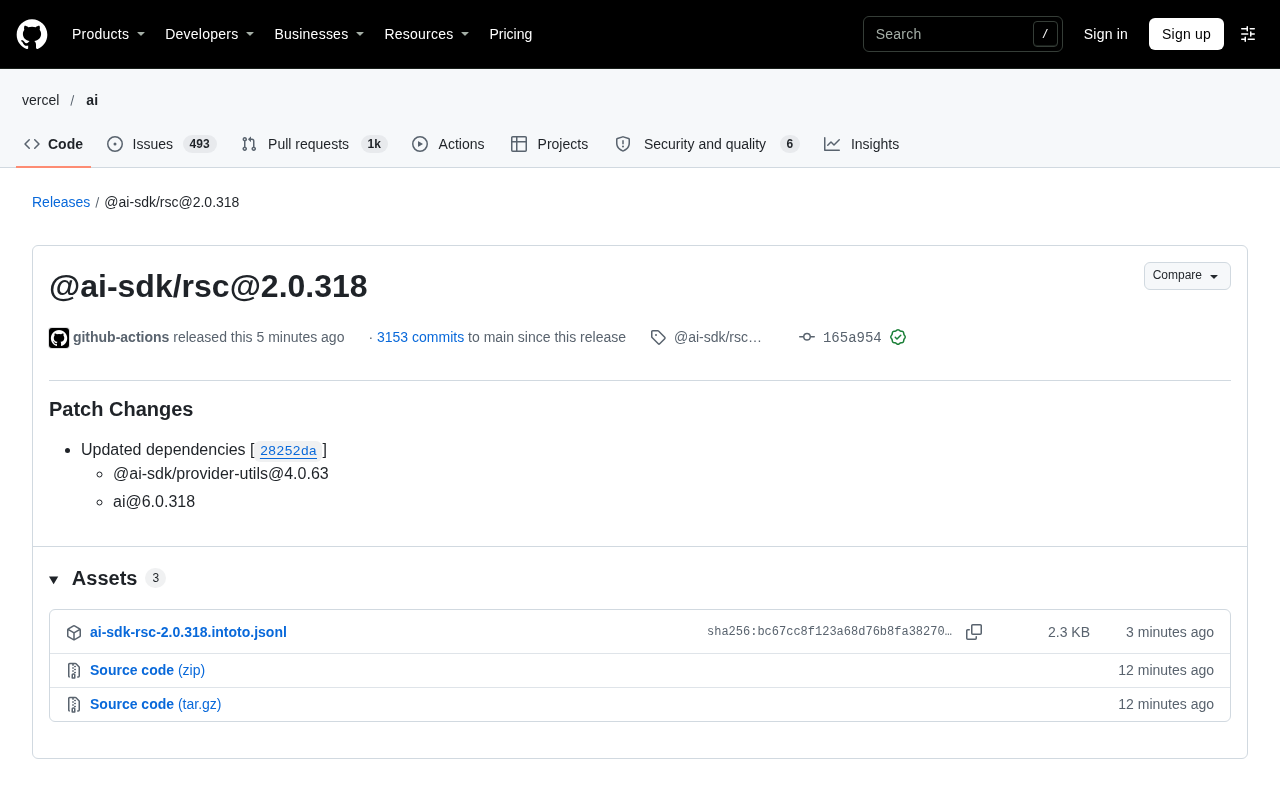
According to the release notes on GitHub, @ai-sdk/rsc@2.0.318 is a Patch Changes level modification. The core change is the update of two dependency packages: @ai-sdk/provider-utils upgraded to 4.0.63, and the ai package synchronized to version 6.0.318.
Such patch releases are quite common in the AI SDK's iteration cadence. As an adaptation layer for React Server Components scenarios, @ai-sdk/rsc typically keeps its version number in sync with the core ai package to ensure consistent API behavior. The simultaneous update of both dependencies indicates that the maintenance team is unifying the version baseline within the ecosystem.
The Role of the RSC Adaptation Layer in AI SDK
To understand the significance of this update, it's necessary to first clarify the role of @ai-sdk/rsc. The core package ai of the AI SDK provides foundational capabilities such as model invocation, streaming responses, and tool calling, while @ai-sdk/rsc encapsulates these capabilities into interfaces adapted for React Server Components.
In frameworks that support RSC, such as Next.js App Router, developers can directly initiate model requests from server components and let the framework handle streaming UI updates. This pattern reduces the burden of client-side state management and brings AI interactions closer to the server-side rendering approach. The version of @ai-sdk/rsc following the core package release is precisely to ensure that this layer of encapsulation does not become disconnected from the underlying capabilities.
React Server Components (RSC) is a component rendering pattern proposed by the React team, where components execute on the server by default and their code is not bundled into the client bundle. The key difference between RSC and Server-Side Rendering (SSR) is that SSR still sends the component's JavaScript to the client for hydration, whereas RSC component logic remains entirely on the server, sending only the serialized UI description to the client. This makes RSC naturally suited for performing sensitive or heavyweight operations such as database queries and external API calls, and it also perfectly aligns with the need for AI model invocations to hide API keys and avoid exposing credentials on the client. Next.js's App Router is currently the most mainstream RSC implementation vehicle, and the interface design of @ai-sdk/rsc is also built around this runtime environment.
Practical Impact of the Dependency Update on Developers
For projects currently using @ai-sdk/rsc, the impact of this patch is primarily at the dependency resolution level. @ai-sdk/provider-utils is the utility package in the AI SDK that handles provider abstraction, responsible for unifying interface differences across different model providers; its upgrade to 4.0.63 typically brings corrections to provider adaptation details.
The synchronized update of ai@6.0.318 means that the RSC adaptation layer maintains a version correspondence with the core package. If a project locks both packages simultaneously, they should be adjusted together during upgrades to avoid type or runtime issues caused by version mismatches. According to the release notes, no breaking changes are indicated, placing this within the scope of a smooth upgrade.
@ai-sdk/provider-utils is the utility layer within the AI SDK used to smooth over differences between model providers. Its typical responsibilities include: defining a unified provider interface specification, handling chunking and parsing of streaming responses, encapsulating request retries and error mapping, and managing model IDs and configuration validation. It does not directly target end developers but is jointly depended upon by the ai core package and various provider packages (such as OpenAI and Anthropic adapter packages). Therefore, patch upgrades to this package often manifest as underlying compatibility fixes or edge-case handling rather than surface-level API changes. Understanding this layer helps assess upgrade risk: if a project does not directly reference the internal APIs of @ai-sdk/provider-utils, it typically only needs to follow the version constraints of the ai package.
How to View High-Frequency Patch Releases
The AI SDK adopts a high-frequency patch release strategy, with the last digit of the version number growing rapidly. This cadence imposes dependency management requirements on consumers: on one hand, patch versions are generally low-risk and suitable for regular follow-up; on the other hand, since @ai-sdk/rsc and the ai package versions are linked, consistency between the two must be noted during upgrades.
For production projects, it is recommended to review the change scope of the corresponding commit before upgrading to confirm that provider-related behavior has not been unexpectedly altered. For experimental projects, directly following the latest patch typically poses no significant burden.
Semantic Versioning (SemVer) specifies the version number format as MAJOR.MINOR.PATCH: a major version change indicates incompatible API changes, a minor version indicates backward-compatible feature additions, and a patch number indicates backward-compatible bug fixes. The Patch Changes mentioned in the article correspond to the patch level, which theoretically does not include breaking changes. However, in practice, when a package locks multiple internal dependencies simultaneously, patch upgrades can still cause issues due to dependency version mismatches—this is precisely why the article emphasizes that @ai-sdk/rsc and the ai package need to be upgraded in sync. Additionally, npm's ^ and ~ version range semantics are worth noting: ~ only allows the patch number to float, while ^ allows the minor version number to float; different locking strategies affect how high-frequency patches actually arrive.
Summary
@ai-sdk/rsc@2.0.318 is a maintenance release primarily focused on dependency synchronization. It does not bring new features but maintains version alignment between the RSC adaptation layer and the AI SDK core package. For developers, the value of such updates lies in ecosystem consistency rather than feature increments. Teams following the AI SDK can handle it through the regular patch process while paying attention to subtle changes in @ai-sdk/provider-utils.
Related articles

SparkBots AI: Extract Key Information from Webpages and PDFs in Seconds
SparkBots AI is a trainable webpage and PDF information extraction tool claiming sub-second answers with no hallucination. This article analyzes its differences from general LLMs, use cases, and open questions.

Cluinn: A Real-Time AI Assistant for Mac Calls That Answers Questions Mid-Meeting
Cluinn is a real-time AI assistant for Mac calls that answers questions mid-meeting instead of summarizing afterward, with Smart Cards for unanswered questions, Coach goal reviews, and AI dictation—supporting Apple silicon Macs.

Kestrix: Redefining CI Trigger Logic with DAG and HCL
Kestrix is a repo-agnostic CI control plane that defines pipelines in HCL and parses them into a DAG, running tasks only when declared repos change, with React Flow live logs and outbound-HTTPS-only remote runners.