AI SDK Svelte 4.0.336 Patch Released: AI App Development Toolchain Continues to Evolve
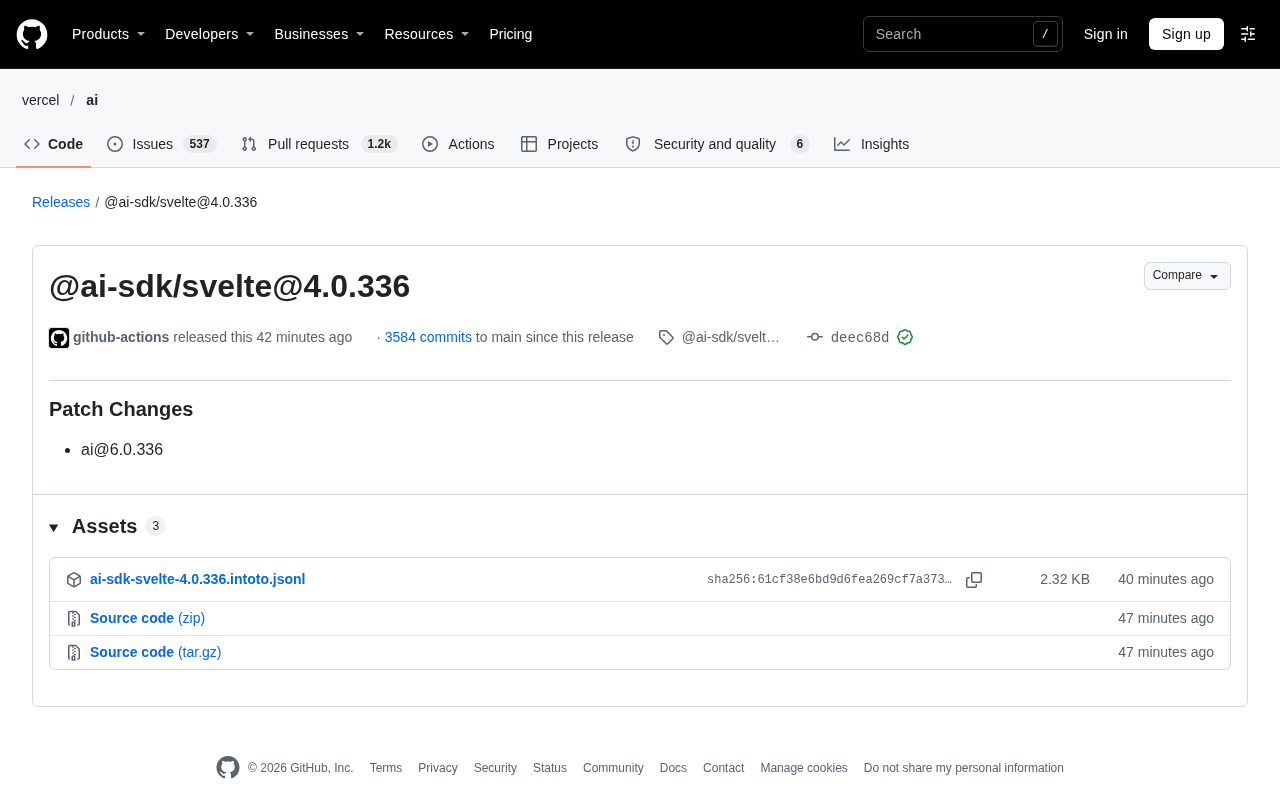
@ai-sdk/svelte releases patch 4.0.336, syncing the ai@6.0.336 dependency and emphasizing version alignment.
@ai-sdk/svelte in Vercel's AI SDK ecosystem has released patch version 4.0.336, with the core change being syncing the dependency version of the core package ai@6.0.336. This update was completed automatically by GitHub Actions, and the commit carries a GPG-verified signature, reflecting the project's mature automated release process. The article points out that although the patch update is small, it carries the responsibility of aligning the versions of the adaptation layer and the core package, and developers should ensure that the two versions are consistent to avoid inconsistent API behavior. At the same time, frequent minor version iterations reflect the project's active maintenance status. Developers are advised to focus on version sync rather than the version number itself, and to pay attention to the official changelog for information on feature evolution.
A Low-Key Patch Update That Reflects the AI SDK's Continuous Refinement
The AI SDK ecosystem under Vercel has once again seen a minor version iteration. On GitHub, @ai-sdk/svelte has released version 4.0.336, a patch-level update whose core change is syncing the dependency version of ai@6.0.336. For developers building AI applications with Svelte, this is a routine but necessary follow-up.
According to the release record, this update was completed automatically by GitHub Actions, and the commit message shows that 3584 commits have been merged into the main branch since the previous version. This means that although the version number only moved by one small patch, the codebase accumulated and integrated a great deal during this period.
The Practical Significance of a Patch Update
Many developers overlook patch versions, thinking they are "just minor fixes." But patch updates to foundational toolchains like the AI SDK often carry the responsibility of aligning versions with the main ai package. As the adaptation layer for the Svelte framework, @ai-sdk/svelte needs to stay in version sync with the core ai package to ensure that capabilities such as streaming responses, tool calls, and structured output work properly in Svelte components.
This time, the trailing number of 4.0.336 matches that of ai@6.0.336, indicating that the two were released as a matched pair. If you use both packages in your project, you should keep them consistent when upgrading to avoid inconsistent API behavior caused by version mismatch.
Semantic Versioning (SemVer) is the foundation for understanding this kind of patch update. SemVer divides version numbers into a major version, a minor version, and a patch number, in the format MAJOR.MINOR.PATCH. An increment in the patch number usually indicates a backward-compatible bug fix and does not include new features or breaking changes. However, in toolchains like the AI SDK, patch updates sometimes also serve the purpose of dependency alignment—that is, the adaptation package and the core package identify their paired relationship by sharing the same patch number. Developers can use the ^ or ~ prefixes in package.json to control the range of allowed automatic upgrades. For example, ~4.0.336 allows only patch-level updates, while ^4.0.336 allows minor version updates. Understanding these rules helps you enjoy automatic fixes while avoiding accidentally introducing incompatible changes.
The Maturity of the Automated Release Process
The release record shows traces of GitHub Actions automation as well as commits with GPG-verified signatures (the key ID starts with B5690EEE). This process shows that the release pipeline of the AI SDK project is already quite mature: after code is merged, version releases, tagging, and changelog generation are all triggered automatically.
For users, this automation means a more stable release cadence and a more traceable version history. Although this update lists no breaking changes or new features, a standardized release process is itself a signal of the project's reliability.
GPG signature verification is a cryptographic signing mechanism for Git commits and tags, used to confirm the authenticity and integrity of the source of a commit. A GPG (GNU Privacy Guard) key pair consists of a public key and a private key. Developers sign commits with the private key, and others can use the public key to verify whether the signature is valid. In open source projects, GPG signatures can prevent commits from being tampered with or forged, enhancing supply chain security. The key ID shown in the commit record (such as B5690EEE) is the last eight digits of the public key fingerprint, making it easy to quickly identify the signer. Combined with GitHub Actions automated releases, GPG signatures ensure that every step from code merge to version release is traceable and verifiable, which is an important layer of trust assurance for downstream projects that depend on the SDK.
How Developers Should Respond
For projects using @ai-sdk/svelte, it is recommended to pin the version in dependency management or use a compatible range, and to confirm whether the ai main package version matches before upgrading. Since this is a patch update, it usually does not involve API changes and carries low risk.
If you are evaluating whether to use the AI SDK to build Svelte applications, this kind of frequent minor version iteration reflects the state of an actively maintained open source project. Compared with SDKs that are not updated for a long time, frequent patch releases mean that issues can be fixed faster and changes in upstream AI provider interfaces can be followed more quickly.
Focus on Version Sync, Not the Version Number Itself
In the AI SDK ecosystem, framework adaptation packages such as @ai-sdk/svelte and @ai-sdk/react have a linked version relationship with the core ai package. What developers really need to pay attention to is the version consistency between the adaptation package and the core package, rather than merely looking at whether the version number of a particular package is high or low. The release of 4.0.336 this time is essentially a version alignment action.
Whether future versions will introduce new features or API adjustments related to Svelte 5 is not reflected in the current release record. It is recommended to follow the official AI SDK changelog for more complete information on feature evolution.
One-line Summary
@ai-sdk/svelte releases patch 4.0.336, syncing the ai@6.0.336 dependency, emphasizing version alignment.
Paragraph Summary
@ai-sdk/svelte in Vercel's AI SDK ecosystem has released patch version 4.0.336, whose core change is syncing the dependency version of the core package ai@6.0.336. This update was completed automatically by GitHub Actions, and the commit carries a GPG-verified signature, reflecting the project's mature automated release process. The article points out that although the patch update is small, it carries the responsibility of aligning the versions of the adaptation layer and the core package, and developers should ensure that the two versions are consistent to avoid inconsistent API behavior. At the same time, frequent minor version iterations reflect the project's active maintenance status. Developers are advised to focus on version sync rather than the version number itself, and to pay attention to the official changelog for information on feature evolution.
Related articles
Fear of AI Is Spreading: A Technologist's Confession
A Hacker News post 'I'm Scared of AI' sparks debate with 212 points and 247 comments, showing AI anxiety spreading from the public into the tech community itself.

Unkernel: Compiling the Linux Kernel to WebAssembly
The Unkernel project compiles a real Linux kernel to WebAssembly, making it possible to run a complete kernel in the browser. This article covers its technical principles, challenges, and prospects.
New Claude Sonnet Model Tested: Performance Approaches Opus with Less Thinking
Anthropic quietly tests a new Sonnet model in Claude Code—performance approaches Opus 5.5 with far fewer thinking tokens, plus Codex transfer optimization, xAI's low-level rewrite, Google Antigravity updates, and the AI science understanding gap.