AI SDK Svelte 4.0.339 Released: The Ecosystem Coordination Behind a Minor Version Update

@ai-sdk/svelte releases patch 4.0.339, aligned in sync with core package ai@6.0.339.
The article reports the coordinated patch release of @ai-sdk/svelte 4.0.339 and core package ai 6.0.339. This update is a Patch Changes release, automatically built and published via GitHub Actions with GPG signature verification. It introduces no new features; its core significance is the version alignment between the Svelte adapter layer and the core SDK. The article notes that the AI SDK adopts a unified cross-framework interface strategy, maintaining adapters for React, Svelte, Vue, and others, and that adapters following the core package's cadence helps developers assess compatibility and reduce migration costs. For heavy users, patch versions may imply dependency fixes and type adjustments, so upgrades should ensure both packages share the same version and focus validation on streaming output and message state management modules on a separate branch.
The AI SDK ecosystem has received another routine update. @ai-sdk/svelte has released version 4.0.339, while the core package ai has been updated to 6.0.339. Judging from the highly synchronized version numbers, this looks more like a coordinated release within the ecosystem than an isolated feature iteration. For developers building AI applications with Svelte, this update means improved version alignment and easier dependency management.
What the Version Update Actually Contains
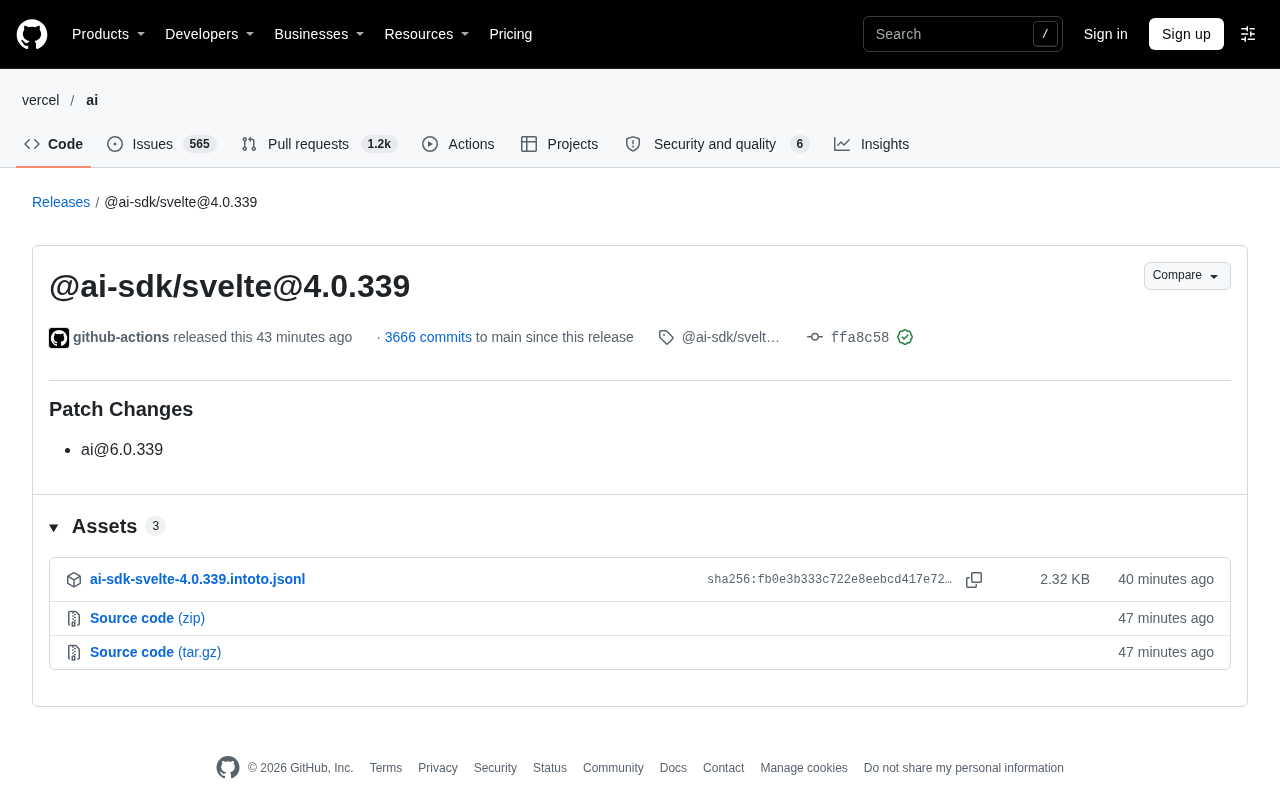
According to the GitHub Releases page, @ai-sdk/svelte@4.0.339 is marked as a Patch Changes release—a patch-level update. The linked change entry points to ai@6.0.339, indicating that the Svelte adapter layer has been synchronized with the core SDK's release cadence.
This release pattern is not uncommon in the AI SDK project. The Svelte package is itself a wrapper layer of the Vercel AI SDK for the Svelte framework, and its version number typically corresponds to the core ai package. When upgrading, developers can more intuitively determine whether the Svelte adapter layer matches the core SDK version currently in use.
From the commit history, this release reflects the state of the main branch after 3,666 commits. The build and release process was automated via GitHub Actions and includes a verified GPG signature. The maturity of the automated release pipeline is also the foundation that allows these high-frequency minor version updates to proceed reliably.
Why Minor Version Updates Are Worth Noticing
Looking at the version number alone, 4.0.339 might seem like an insignificant patch. But for teams that use the AI SDK extensively, the significance of patch versions often lies in the details: dependency conflict fixes, minor adjustments to type definitions, and compatibility improvements in build artifacts. These changes won't appear prominently in the changelog, yet they can affect the actual build results of a project.
The AI SDK's release cadence has always been fairly dense, with tight version linkage between the core package and framework adapter packages. The benefit of this strategy is that fixes can quickly reach users across frameworks; the cost is that developers need to pay more attention to version alignment. If you use both ai and @ai-sdk/svelte in your project, keeping their version numbers consistent is a basic practice for avoiding runtime exceptions.
Interestingly, the change notes on this release page are very concise, listing only Patch Changes and the associated core version, without elaborating on technical details. This is normal for automated patch releases, but it also means that developers who want to understand the specific fixes need to trace back to the corresponding commits or the core package's change history.
Under the Semantic Versioning (SemVer) specification, an increment in the patch number (such as 4.0.338 → 4.0.339) should, in principle, contain only backward-compatible bug fixes and internal implementation adjustments, and theoretically should not introduce breaking changes. However, in high-frequency release projects like the AI SDK, patch versions often include tightened type definitions and transitive dependency upgrades—changes that can still trigger compilation errors in strictly typed TypeScript projects.
Therefore, a reasonable expectation for patch upgrades is: low runtime risk, but build-time risk is not zero. Using a lockfile (such as pnpm-lock.yaml) and running full type checks and integration tests in CI is the standard practice for coping with high-frequency patch releases.
Svelte's Position in AI Application Development
Svelte has continued to gain attention in the frontend community in recent years, attracting many developers with its compile-time optimization and concise reactive model. The AI SDK's provision of a Svelte adapter layer means that Svelte developers can integrate large model capabilities in a way that follows the framework's conventions, without having to handle low-level logic such as streaming responses and tool calling themselves.
From an ecosystem perspective, the AI SDK maintains adapter packages for multiple frameworks—React, Svelte, Vue, and others—forming a unified cross-framework interface. The value of this approach lies in reducing migration costs: when a team's tech stack changes, the AI integration layer does not need to be rebuilt from scratch. The continued updates to @ai-sdk/svelte show that this adapter line is still actively maintained rather than being a marginalized add-on.
For Svelte teams evaluating AI integration options, the frequency of version updates is itself a signal: high-frequency patch releases usually indicate that a project is in active development with fast issue response times. Of course, frequent upgrades also require a matching dependency management strategy, such as pinning version numbers and adding build verification in CI.
The AI SDK's framework adapter layer is essentially a re-encapsulation of the core package's capabilities. Take @ai-sdk/svelte as an example: it wraps capabilities provided by the ai core package—such as streamText, generateText, and tool calling—into interfaces that conform to Svelte's reactive syntax, for example, streaming state subscriptions based on Svelte stores. The key constraint this brings is that there is an implicit interface contract between the adapter package and the core package. Once the core package's internal API is slightly adjusted, the adapter package must be released in sync to ensure consistency between types and runtime behavior. This is also the fundamental reason the AI SDK keeps the two version numbers strictly aligned—matching version numbers are themselves an explicit declaration of contract compatibility.
Once you understand this, it becomes clear why patch-level synchronized releases are worth noticing: they often carry the distribution of core package fixes to users across frameworks.
Upgrade Recommendations and Caveats
If you plan to upgrade to 4.0.339, it is recommended to first confirm whether the ai core package in your project has been synchronized to 6.0.339. When the two version numbers match, the interface contract between the adapter layer and the core SDK is best guaranteed.
Second, although patch versions carry lower risk, it is still recommended to complete upgrade validation on a separate branch, focusing on modules that interact closely with the AI SDK, such as streaming output and message state management. The automated release pipeline ensures build consistency, but it cannot replace your project's own integration tests.
Finally, keep an eye on subsequent updates on the GitHub Releases page. The AI SDK iterates quickly, and a single patch update contains limited information, but by stringing together changes across multiple versions, you can often grasp the project's evolution direction more clearly.
Conclusion
@ai-sdk/svelte@4.0.339 is a typical ecosystem-coordinated patch release, with the core takeaway being the version alignment between the Svelte adapter layer and ai@6.0.339. It introduces no new features but maintains the continuity of the AI SDK's cross-framework support. For AI application developers on the Svelte stack, keeping the adapter package and core package versions synchronized is more practically meaningful than chasing the contents of a single update.
Related articles

Pure-Code Video Generation Tested: Which AI Model Actually Follows Instructions?
A Bilibili creator tested three AI models' pure-code video generation with unified prompts and three revisions each: Xiaonaomao has a high ceiling but lacks stability, GPT 6.2 Extra models well but only follows half the instructions, and OPAS 5.5 remains the benchmark.

GPT-6 Six-Tier Hands-On Test: Astra Ultra Dominates but Bills Double
GPT-6 six-tier test: Astra Ultra sweeps 3:0 in 3D tasks thanks to sub-agents and runs 14% faster, but hidden backend bills make its real cost 2.6x single-threaded.

GPT-6.2 Astra vs Fable 5.2: Huge Cost-Efficiency Gap Across 12 Real-World Tests
Bilibili creator tests GPT-6.2 Astra vs Fable 5.2 across 12 real tasks: Fable wins 7-5 but costs 7.2x more and takes nearly 5x longer. Token efficiency emerges as the key selection metric.