@ai-sdk/tool-bash 1.0.5 Update: Bash Tool Patch for AI SDK

@ai-sdk/tool-bash releases patch 1.0.5, syncing the ai@7.0.151 dependency.
The Bash tool invocation package @ai-sdk/tool-bash in the AI SDK ecosystem has released patch version 1.0.5, introducing no new features or breaking changes. Its core is syncing the dependency version of ai@7.0.151, with two commits included. The article explains the package's role in encapsulating terminal execution capability in AI applications and notes that, per semantic versioning conventions, a patch version should contain only backward-compatible fixes. Because the release notes are limited and the GitHub Release page showed a loading error, developers need to check commit records or the diff to understand the specific changes. The article recommends running regression tests on the Bash tool invocation path after upgrading, and from an ecosystem perspective notes that this update reflects the AI SDK trend of encapsulating system capabilities as independent tool packages and decoupling model capability from the execution environment. It also reminds developers to pay attention to the completeness of release notes and version auditing for critical dependencies.
A Low-Key Patch Update
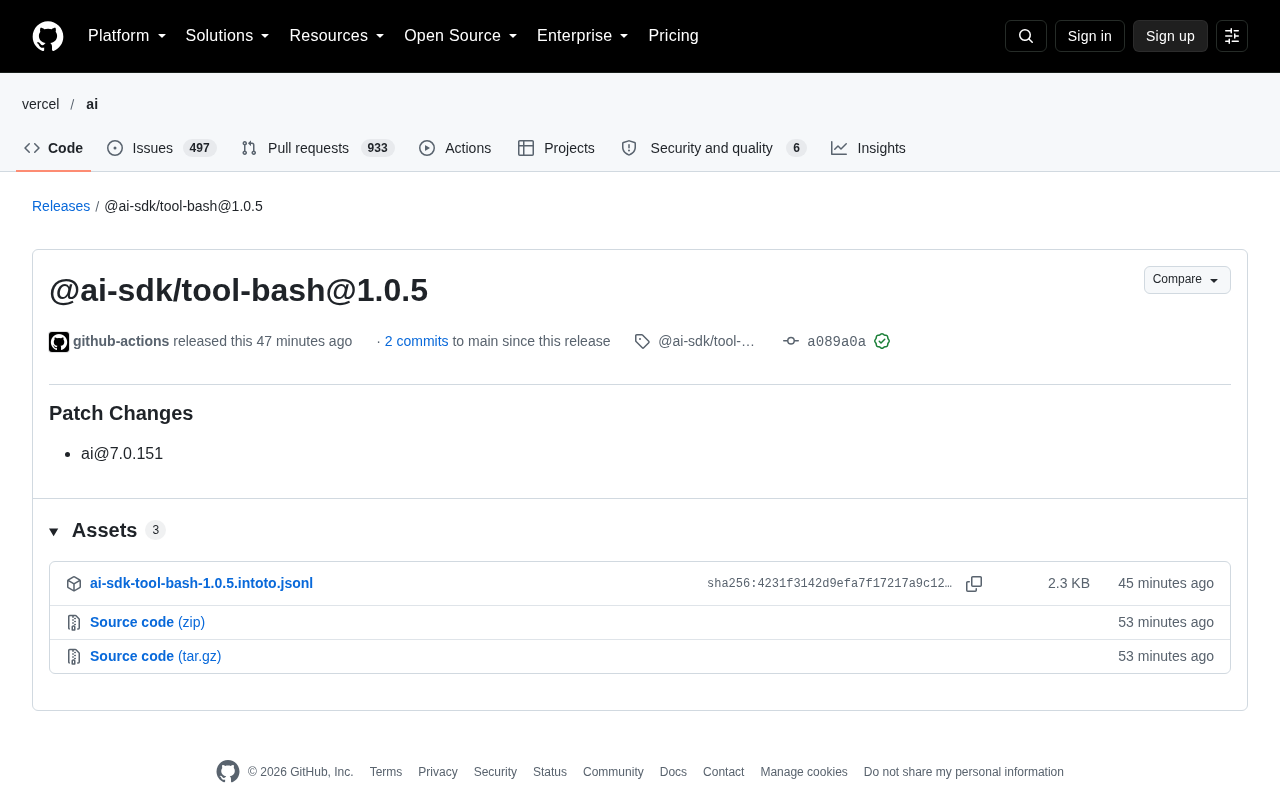
@ai-sdk/tool-bash, the package responsible for Bash tool invocation in the AI SDK ecosystem, has released version 1.0.5. This is a patch-level update that introduces no new features or breaking changes. Its main purpose is to sync version dependencies alongside the release of ai@7.0.151, and it includes two small commits.
For developers building tool-calling capabilities with the AI SDK, patch updates like this typically mean underlying coordination and stability fixes rather than interface changes. As a result, the upgrade cost is low, but attention should be paid to aligning peer dependency versions.
What the Version Number Means
@ai-sdk/tool-bash is the module in the AI SDK that wraps Bash command execution capability as a tool. It is commonly used in AI application scenarios that require the model to operate a terminal environment, such as automated script generation and execution, and code-interpreter-style interactions.
This 1.0.5 release is a patch version. Per semantic versioning conventions, it should contain only backward-compatible bug fixes. The release notes list only "Patch Changes" and point to ai@7.0.151, indicating that the core of this update is dependency adjustment rather than independent functional improvements.
Semantic Versioning (SemVer) is a versioning convention widely adopted in the open-source ecosystem, with the format MAJOR.MINOR.PATCH. A MAJOR version change indicates incompatible API modifications, MINOR indicates backward-compatible feature additions, and PATCH indicates backward-compatible bug fixes. This update of @ai-sdk/tool-bash from 1.0.x to 1.0.5 is a PATCH-position change, so in theory it should not contain any breaking changes. However, SemVer is only a convention, not an enforced specification, and in practice version numbers may not always perfectly match the changes. This is one reason developers are advised to check commit records or diffs directly.
Peer dependency is a dependency type in npm package management that indicates a dependency the current package expects the host project to install and provide itself, rather than one installed directly by the package. In modular ecosystems like the AI SDK, the tool package @ai-sdk/tool-bash typically declares the core package ai as a peer dependency to ensure that the tool package and core package use the same instance at runtime and avoid version conflicts. Therefore, "syncing ai@7.0.151" in this update is essentially an adjustment to the peer dependency version range. When upgrading, you need to confirm that the ai version in your project aligns with it; otherwise, peer dependency warnings or inconsistent runtime behavior may occur.
Practical Impact on Developers
Upgrade Recommendations
If you already use @ai-sdk/tool-bash in your project and your AI SDK core package version is close to ai@7.0.151, you can upgrade directly to 1.0.5. Since it is a patch update, it is not expected to break existing calling code.
Points to Note
The release notes provide very limited information and do not list specific fixes or change details. The GitHub Release page also showed an error while loading tags and assets, preventing some metadata from displaying properly. This means that if developers want to understand the specific changes in this update, they may need to check the commit records (2 commits) or the diff directly rather than relying on the release notes.
Toolchain Stability
For AI applications that rely on the Bash tool for production environment operations, although patch updates may seem minor, when command execution paths are involved, it is recommended to run a regression test after upgrading to confirm that tool invocation parameter parsing and execution result formats have not changed unexpectedly.
Regression testing refers to re-running existing test cases after modifying code or upgrading dependencies to confirm that previously working functionality has not been accidentally broken. For a tool package that wraps Bash command execution, its invocation path involves multiple stages, including parsing tool invocation parameters from model output, command assembly, execution, and result formatting. A subtle change in any stage can cause behavioral drift. Since the release notes for this version do not disclose specific changes, running a regression test on tool invocation parameter parsing and execution result formats after upgrading is a low-cost but clearly beneficial risk control measure.
Ecosystem Perspective: The Tooling Trend in the AI SDK
The AI SDK's encapsulation of system capabilities like Bash into independent tool packages reflects a current trend in AI application development: decoupling model capability from the execution environment and composing complex workflows through standardized tool interfaces. The continued maintenance of @ai-sdk/tool-bash shows that this toolchain is still actively iterating.
However, the limited transparency of information in this release also reminds developers to pay attention to the completeness of release notes in open-source projects. For critical dependencies, version auditing based on the lockfile and commit history is more reliable than simply looking at version numbers.
One-line Summary
@ai-sdk/tool-bash releases the 1.0.5 patch update, syncing the ai@7.0.151 dependency.
Paragraph Summary
The Bash tool invocation package @ai-sdk/tool-bash in the AI SDK ecosystem has released patch version 1.0.5. It introduces no new features or breaking changes; its core is syncing the dependency version of ai@7.0.151 and it includes two commits. The article explains the package's role in encapsulating terminal execution capability in AI applications and notes that, per semantic versioning conventions, a patch version should contain only backward-compatible fixes. Because the release notes are limited and the GitHub Release page showed a loading error, developers need to check commit records or the diff to understand the specific changes. The article recommends running regression tests on the Bash tool invocation path after upgrading, and from an ecosystem perspective notes that this update reflects the AI SDK trend of encapsulating system capabilities as independent tool packages and decoupling model capability from the execution environment. It also reminds developers to pay attention to the completeness of release notes and version auditing for critical dependencies.
Related articles

AI Digital Twin in Action: Using DOT to Automatically Track Bugs and User Feedback
DOTS engineers demonstrate how AI digital twin DOT collects cross-platform user feedback, categorizes issue themes, opens threads to investigate bug root causes, and submits PRs—showcasing a complete AI agent workflow for defect triage with auditable design.

Why Transistors Are No Longer Flat: The Evolution from Planar to Gate-All-Around
Transistor evolution from planar to FinFET to gate-all-around: why gates went from three-sided to four-sided wrapping to suppress short-channel effects and leakage current, extending Moore's Law.

Swarm Intelligence = a Single RL Agent? A Proof of Multi-Armed Bandit Equivalence
A paper proves that collective decision-making through local imitation in swarms is mathematically equivalent to single-agent reinforcement learning: N blind imitators act as N parallel environment samples, with an effective learning rate of 1/N. This article explains the derivation and implications of the Maynard-Cross Learning algorithm.