AI SDK Toolkit Update: Web Fetch 1.0.1 Patch Analysis
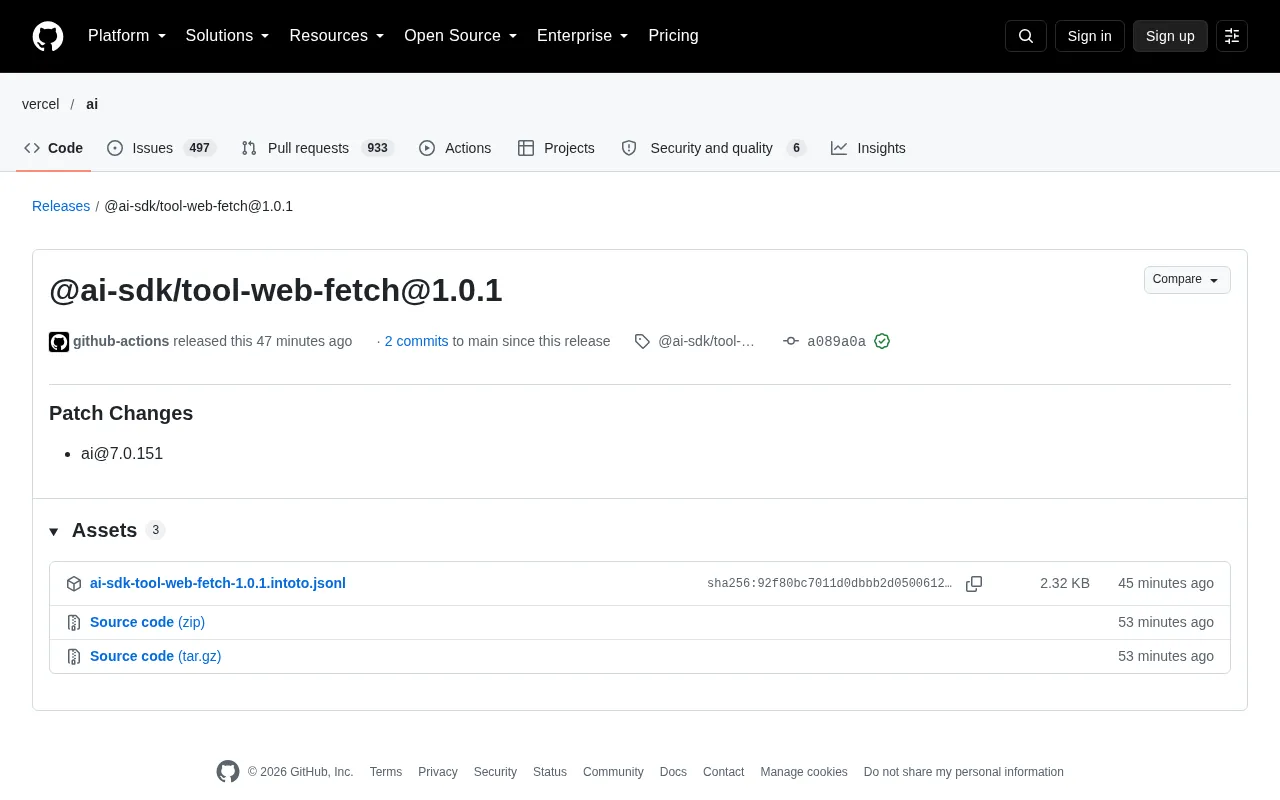
@ai-sdk/tool-web-fetch releases patch 1.0.1, aligning its ai package dependency to 7.0.151.
The @ai-sdk/tool-web-fetch package in the AI SDK ecosystem has released patch 1.0.1. The core change is bumping the dependency on the core library ai to 7.0.151; this is a compatibility fix that introduces no new features. This tool provides web fetching for AI applications and is often used in RAG and agent workflows. Developers should watch version matching between the core package and tool packages, refresh lockfiles when upgrading, and verify web fetching calls in a test environment, especially for streaming responses and tool call result parsing. Projects not involving internet capabilities can ignore this update. The release was automated by GitHub Actions with GPG signature verification.
The @ai-sdk/tool-web-fetch package in the AI SDK ecosystem has released version 1.0.1. This is a small patch update that mainly fixes version alignment with the core library ai@7.0.151. For developers building AI applications, especially those that need to fetch information from the internet in real time, this update is modest in scope but involves dependency consistency and toolchain stability, so it is worth noting.
Patch Contents: Version Alignment and Dependency Fixes
According to the GitHub release record, @ai-sdk/tool-web-fetch@1.0.1 is a Patch Changes release and contains only two commits. The core change is bumping the dependency on the ai package to 7.0.151. Patches like this usually do not introduce new features; instead, they fix compatibility issues caused by iteration in the core library, such as API signature changes, type definition updates, or adjustments to internal utility functions.
From the release process perspective, this version was automatically built and signed by GitHub Actions, and the commit carries a GPG verification marker, indicating a standardized release pipeline. For projects using a monorepo or dependency locking, upgrades need to pay attention to version matching between the main ai package and @ai-sdk/tool-web-fetch to avoid runtime errors caused by version mismatch.
Semantic Versioning (SemVer) and Patch Updates
In the npm ecosystem, version numbers follow Semantic Versioning (SemVer), in the format major.minor.patch. An increment to the patch number (the last digit in 1.0.1, for example) usually indicates a backward-compatible bug fix that introduces no new features and does not break existing APIs; a minor version increment indicates new backward-compatible functionality; a major version increment may contain breaking changes. As a Patch Changes release, @ai-sdk/tool-web-fetch@1.0.1 means developers can upgrade relatively safely, but they should still pay attention to whether the version of its ai dependency is synchronized, because the patch fix may rely on underlying fixes released at the same time in the core library.
Monorepo and Dependency Locking
A monorepo means managing multiple related packages in the same code repository. The AI SDK ecosystem adopts this model: the core ai package and surrounding tool packages are released independently but share the release process. Dependency locking (such as package-lock.json and pnpm-lock.yaml) pins the exact version of each package in the dependency tree to ensure consistent installation results across environments. When a tool package releases a patch and bumps its dependency version on the core package, projects using lockfiles may still resolve to an older ai version if they do not actively update, resulting in version mismatch. Therefore, upgrades require refreshing the lockfile as well and validating dependency consistency in CI.
Practical Impact on Developers
@ai-sdk/tool-web-fetch is part of the AI SDK toolset and is typically used to let large models call web fetching capabilities while generating responses to obtain real-time page content. Such tools are very common when building RAG (Retrieval-Augmented Generation) applications and agent workflows. The 1.0.1 patch means the tool's own interface remains stable, but the underlying dependencies need to be updated in sync.
If you have pinned the version of ai in your project, it is advisable to check the specific changes in 7.0.151 in the changelog before upgrading. If your project uses automatic dependency resolution with pnpm or npm, a regular update will pull in this patch. For production environments, it is recommended to verify in a test environment that calls to the web fetching tool work properly, especially in scenarios involving streaming responses and parsing of tool call results.
RAG (Retrieval-Augmented Generation)
RAG is a technical paradigm in which a large model retrieves external knowledge before generating a response. A typical process is: convert the user's question into vectors or keywords, retrieve relevant snippets from a document library or live web pages, then insert the retrieval results as context into the prompt and let the large model generate an answer. Compared with relying only on static knowledge in the model parameters, RAG can provide more timely and traceable information. The web fetching capability provided by @ai-sdk/tool-web-fetch is one common way for RAG to obtain real-time page content, so its version compatibility with the core library directly affects the stability of the retrieval pipeline.
Agents and Tool Calling
An agent refers to a system driven by a large model that can autonomously plan steps and call external tools to complete tasks. The tool calling mechanism lets the model output structured call requests (such as fetching a URL), which are executed by the runtime and then returned to the model to continue reasoning. Such scenarios usually involve streaming responses—where the model returns incremental content while generating—as well as parsing and concatenating call results. If a toolkit patch involves changes to type definitions or internal utility functions in the core library, it may affect serialization of call requests and result parsing. Therefore, after upgrading, focus on validating the full pipeline of streaming output and multi-turn tool calls.
Observations from a Version Management Perspective
The AI SDK adopts a high-frequency, small-version iteration strategy. The core ai package and surrounding tool packages (such as @ai-sdk/tool-web-fetch) have separate version numbers, but dependency synchronization is maintained through patch releases. This model helps fix issues quickly, but it also requires developers to pay attention to consistency in the dependency tree. In this release, an error message appeared when loading the GitHub page; this is a page rendering issue and does not affect the package itself.
From an ecosystem perspective, independent versioning of tool packages allows developers to introduce web fetching capabilities as needed without upgrading the entire SDK. Projects that only use text generation and do not need internet tools can ignore this update; agent projects that rely on internet capabilities are advised to follow this patch to ensure compatibility with the core library.
Upgrade Recommendations
Check the version combination of ai and @ai-sdk/tool-web-fetch in your project, and confirm that ai is not lower than 7.0.151. Add dependency consistency checks to the CI process to avoid tool call failures caused by stale lockfiles. If you encounter abnormal parsing of web fetching results, prioritize investigating version mismatch rather than the tool logic itself.
One-line Summary
@ai-sdk/tool-web-fetch releases patch 1.0.1, aligning its ai dependency to 7.0.151.
Paragraph Summary
The @ai-sdk/tool-web-fetch package in the AI SDK ecosystem has released patch version 1.0.1. The core change is bumping the dependency on the core library ai to 7.0.151; this is a compatibility fix that introduces no new features. The tool provides web fetching capabilities for AI applications and is commonly used in RAG and agent workflows. The article recommends that developers pay attention to version matching between the core package and tool packages, refresh lockfiles when upgrading, and verify web fetching calls in a test environment, especially in scenarios involving streaming responses and parsing of tool call results; projects not involving internet capabilities can ignore this update. The release was completed automatically by GitHub Actions and carries GPG signature verification.
Related articles

New Trailer for 'Everest: The Other Side' Released: Ski Mountaineers Take On Ski Descent of the North Face
National Geographic's 'Everest: The Other Side' trailer follows pro ski mountaineers attempting Everest's Direct North Face and the first ski descent, with rare North Face footage and life-or-death avalanche moments.
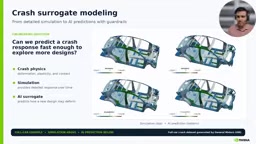
Building Automotive Crash AI Surrogate Models with NVIDIA PhysicsNeMo
An analysis of the NVIDIA PhysicsNeMo crash analysis workflow: how to train a Transolver surrogate model with simulation datasets and package it as an inference API via NIM, covering the complete four-step process of geometry parameterization, data splitting, and error validation.

LangGraph in Production: The Pain of Silent API Changes
Explores the challenge of silent external API changes affecting LangGraph agents in production, analyzes monitoring and testing limits, and proposes semantic validation and regression testing defenses.