AI SDK Toolkit web-fetch Releases Patch Update

@ai-sdk/tool-web-fetch releases 1.0.34 patch, paired with ai@7.0.184 and auto-signed by GitHub Actions.
The `@ai-sdk/tool-web-fetch` package in the AI SDK ecosystem has released patch version 1.0.34, automatically published by the GitHub Actions bot, with commit hash prefix `71aa4dd` and a GitHub verified signature (GPG key ID `B5690EEEBB952194`). The release notes categorize it as Patch Changes, i.e., backward-compatible bug-fix level, with low upgrade risk. The release page also lists the companion `ai@7.0.184` core package, indicating a version pairing relationship; versions should be checked for compatibility when upgrading. The original release information does not detail specific fix entries, and the Assets section failed to fully display due to a page loading error; developers are advised to install via npm and follow subsequent commit records to learn the actual changes.
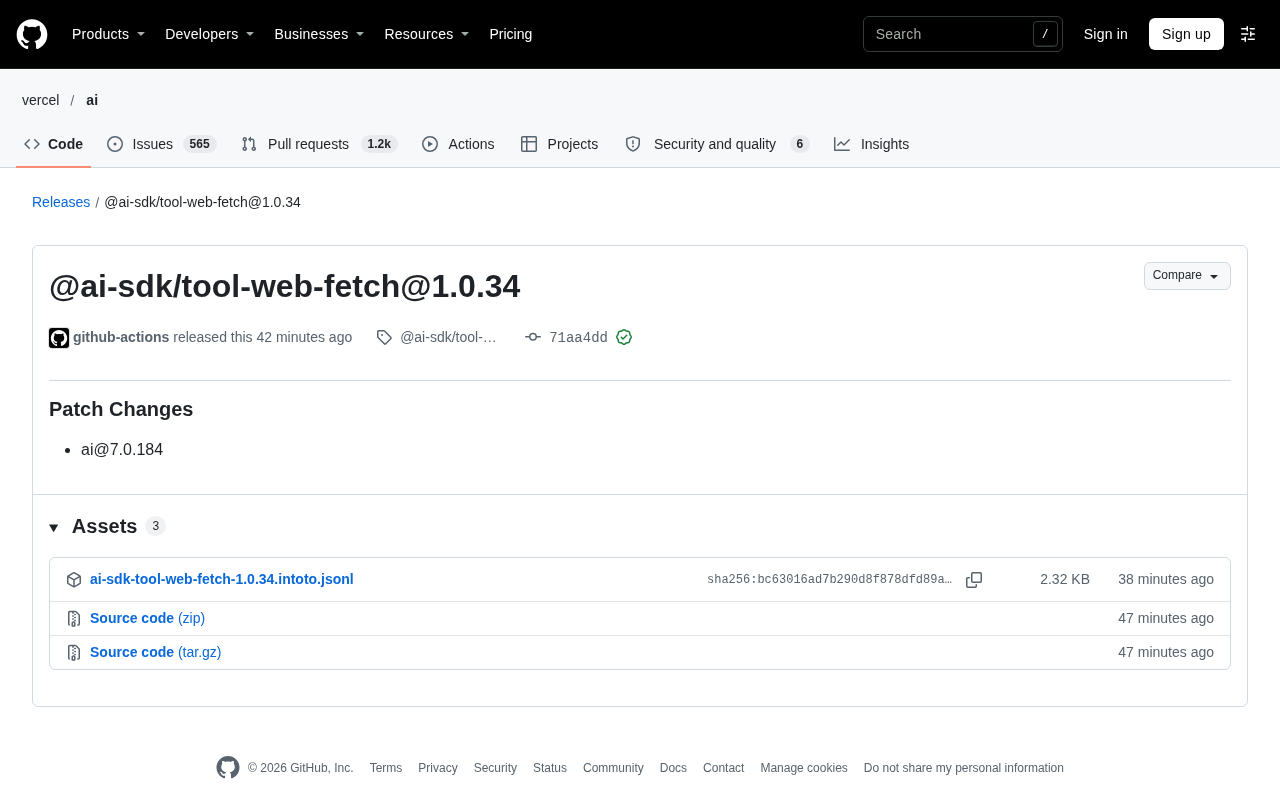
The @ai-sdk/tool-web-fetch package in the AI SDK ecosystem has released version 1.0.34. This is a patch-level update, automatically published by GitHub Actions, with the commit verified via GPG signature.
Basic Version Information
According to the GitHub release page, @ai-sdk/tool-web-fetch@1.0.34 was published by github-actions at 23:26 on 27 Nov. The commit hash prefix is 71aa4dd, and the commit was created on GitHub.com with GitHub's verified signature, using GPG key ID B5690EEEBB952194.
The release notes mark this as Patch Changes. It also lists the associated ai@7.0.184, which typically means this toolkit patch update has a dependency or companion relationship with the core ai package version 7.0.184.
Significance of the Patch Update
Under semantic versioning, an increment of the patch version number (the third digit) generally corresponds to backward-compatible bug fixes. For a toolkit like @ai-sdk/tool-web-fetch, a patch update may involve corrections to network request logic, improvements to error handling, or minor adjustments to type definitions.
The original release information does not detail the specific changes, but it clearly categorizes this as Patch Changes rather than a minor or major update. Developers can therefore judge that the upgrade risk is low and suitable for smooth replacement in existing projects.
Semantic Versioning (SemVer) is a versioning convention in the three-part format MAJOR.MINOR.PATCH: a major version increment indicates incompatible API changes, a minor version increment indicates new functionality added in a backward-compatible manner, and a patch increment indicates backward-compatible bug fixes. The core value of SemVer is that it lets dependents judge upgrade risk from the version number alone—when you see a patch number change, you can usually auto-upgrade with confidence; when you see a major version change, you need to review breaking changes. In the npm ecosystem, range specifiers like ^1.0.34 are based on this convention: they allow automatic retrieval of patches and minor updates within the 1.x range, but will not cross into 2.0.0. However, SemVer is only a convention, not an enforced constraint; in practice, projects still need to consult release notes and changelogs to judge the impact of an upgrade.
Relationship with ai@7.0.184
The release page presents ai@7.0.184 alongside this toolkit update. In the AI SDK's modular design, there is a version pairing relationship between toolkits and the core package. Patch updates to a toolkit often need to be paired with the latest version of the core package to get the full functionality and fixes.
For developers building applications with the AI SDK, it is recommended to check the version of the ai package when upgrading @ai-sdk/tool-web-fetch, to avoid abnormal tool-calling behavior caused by version mismatch.
The AI SDK's modular split refers to separating core capabilities and specific tool capabilities into different npm packages: the ai package provides foundational abstractions such as model invocation, streaming responses, and tool-call orchestration, while toolkits like @ai-sdk/tool-web-fetch provide implementations of specific tools such as web fetching in plugin form. Developers install them on demand, avoiding the size and dependency cost of unused features. Under this structure, toolkits typically declare ai as a peerDependency or specify a reasonably wide compatibility range, with the host application deciding the core package version, thereby reducing the risk of multiple copies of ai being installed in the same dependency tree. Therefore, checking the ai version when upgrading a toolkit is necessary: if the toolkit uses tool-calling protocol fields introduced only in a newer core package, an older ai version may fail to correctly parse its return values.
Automation and Trustworthiness of the Release Process
This release was completed by the github-actions bot, a typical continuous integration/continuous delivery process. The commit carries a GitHub verified signature, indicating the code source is traceable. GitHub's vigilant mode notice also indicates that the repository has verification requirements for commit signatures, which improves supply chain security to some extent.
The Assets section on the release page shows 3 asset files, but an error occurred during page load, so the complete asset list was not displayed. This does not affect the availability of the version itself; interested developers can install this version directly via npm or a package manager.
GPG commit signing and vigilant mode are provenance trust mechanisms provided by GitHub. Developers sign commit content with a GPG private key, and GitHub verifies the signature using the public key registered in the repository. Once verification passes, the commit displays a Verified badge and shows the ID of the key used (in this case B5690EEEBB952194). Vigilant mode is a stricter repository setting: when enabled, unsigned commits or commits that fail verification are explicitly marked as Unverified rather than the default gray status, making forgery or tampering easier to detect. Such mechanisms are part of software supply chain security, and together with npm provenance attestations and two-factor authentication, they help ensure that "this package really comes from trusted code." Note that a signature only proves the commit was created by someone holding the corresponding private key; it does not mean the code has undergone a security audit.
Summary
@ai-sdk/tool-web-fetch@1.0.34 is a routine patch release, with the core information centering on the version number, the companion ai@7.0.184, and the automated signed release process. Since the original release notes do not provide specific fix entries, developers are advised to follow the repository's subsequent commit history to learn the actual change details.
One-line Summary
@ai-sdk/tool-web-fetch releases 1.0.34 patch, paired with ai@7.0.184 and auto-signed by GitHub Actions.
Paragraph Summary
The @ai-sdk/tool-web-fetch package in the AI SDK ecosystem has released patch version 1.0.34, automatically published by the GitHub Actions bot, with commit hash prefix 71aa4dd and a GitHub verified signature (GPG key ID B5690EEEBB952194). The release notes categorize it as Patch Changes, i.e., backward-compatible bug-fix level, possibly involving minor adjustments to network request logic, error handling, or type definitions, with low upgrade risk. The release page also lists the companion ai@7.0.184 core package, indicating a version pairing relationship between the toolkit and the core package; versions should be checked for compatibility when upgrading to avoid abnormal tool-calling behavior. The original release information does not detail specific fix entries, and the Assets section failed to fully display due to a page loading error; developers are advised to install via npm and follow subsequent commit records to learn the actual changes.
Related articles

Pure-Code Video Generation Tested: Which AI Model Actually Follows Instructions?
A Bilibili creator tested three AI models' pure-code video generation with unified prompts and three revisions each: Xiaonaomao has a high ceiling but lacks stability, GPT 6.2 Extra models well but only follows half the instructions, and OPAS 5.5 remains the benchmark.

GPT-6 Six-Tier Hands-On Test: Astra Ultra Dominates but Bills Double
GPT-6 six-tier test: Astra Ultra sweeps 3:0 in 3D tasks thanks to sub-agents and runs 14% faster, but hidden backend bills make its real cost 2.6x single-threaded.

GPT-6.2 Astra vs Fable 5.2: Huge Cost-Efficiency Gap Across 12 Real-World Tests
Bilibili creator tests GPT-6.2 Astra vs Fable 5.2 across 12 real tasks: Fable wins 7-5 but costs 7.2x more and takes nearly 5x longer. Token efficiency emerges as the key selection metric.