AI SDK Topaz 3.0.11 Patch Release: Dependency Update Analysis
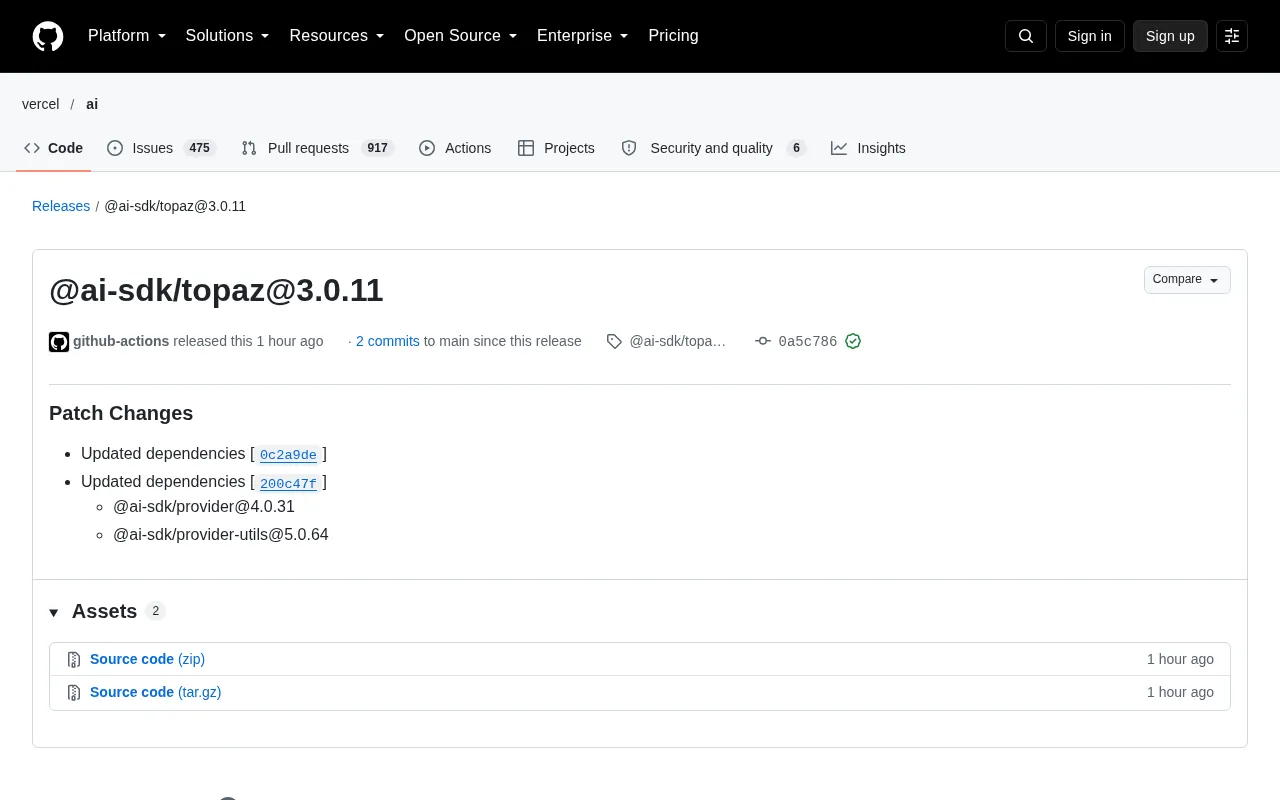
The AI SDK's Topaz module releases patch 3.0.11, only synchronously upgrading two core dependencies.
@ai-sdk/topaz in the AI SDK ecosystem releases patch version 3.0.11 with no new features, only upgrading @ai-sdk/provider to 4.0.31 and @ai-sdk/provider-utils to 5.0.64. These two packages handle the model provider interface specification and common utility functions, respectively, and are core to the AI SDK's layered architecture; their iterations typically bring underlying fixes and compatibility optimizations. The article advises developers to include such maintenance updates in their regular upgrade process: verify in a test environment, check lock files and the dependency tree, watch version constraints in monorepos, and review underlying dependency changelogs to reduce compatibility risks and stay consistent with the ecosystem.
Introduction
The Topaz module in the AI SDK ecosystem recently released version 3.0.11. As a patch version, this update introduces no new features and instead focuses on synchronized dependency upgrades. For developers building applications with the AI SDK, understanding the significance of these minor version updates helps with better management of project dependencies and upgrade strategies.
Version Update Details
According to the release notes on GitHub, the changelog for @ai-sdk/topaz@3.0.11 is explicitly labeled as "Patch Changes." The specifics include two dependency updates:
- Updated dependency
@ai-sdk/providerto version 4.0.31 - Updated dependency
@ai-sdk/provider-utilsto version 5.0.64
These two dependencies are important components of the AI SDK core architecture. @ai-sdk/provider defines the interface specification for model providers, while @ai-sdk/provider-utils provides the common utility functions needed when building providers. Their version iterations typically fix underlying issues or optimize compatibility, so this Topaz update is essentially a synchronized upgrade to ensure the module stays aligned with core dependencies.
Impact of the Dependency Updates
Although the release notes do not describe in detail which specific issues were fixed, dependency version bumps often imply indirect improvements. For example, @ai-sdk/provider 4.0.31 may include stability fixes for certain provider interfaces, while @ai-sdk/provider-utils 5.0.64 may optimize the performance or type definitions of utility functions. For developers, upgrading to version 3.0.11 ensures the project uses the latest dependency combination, reducing potential compatibility risks.
In Semantic Versioning (SemVer), a patch version corresponds to the third digit of the version number, for example from 3.0.10 to 3.0.11. The SemVer convention is: a major version change indicates incompatible API modifications, a minor version change indicates backward-compatible feature additions, and a patch number change is only for backward-compatible bug fixes. Therefore, patch versions in principle do not contain breaking changes, and upgrade risk is low. However, in dependency chain scenarios, patch versions may indirectly introduce transitive dependency updates. Developers should still verify the actual resolved version combination through lock files (such as package-lock.json, pnpm-lock.yaml) to avoid unexpected incompatibilities.
Lock files record the exact versions and integrity hashes of the project dependency tree, ensuring consistent installation results across different environments. When Topaz 3.0.11 requires a higher version of @ai-sdk/provider, the package manager will re-resolve dependencies based on the lock file and version range constraints; if other packages in the project impose stricter upper version bounds on @ai-sdk/provider, resolution conflicts may occur. In such cases, you can explicitly specify versions through the package manager's overrides/resolutions fields, or use commands such as npm ls @ai-sdk/provider to inspect the dependency tree.
The AI SDK adopts a layered architecture: @ai-sdk/provider defines a unified Provider interface (LanguageModelV1, etc.), and implementation packages from various model vendors (such as @ai-sdk/openai, @ai-sdk/anthropic) integrate according to this specification; @ai-sdk/provider-utils encapsulates shared logic such as streaming response parsing, tool calling serialization, error handling, and type validation for reuse by each Provider. This separation decouples the core protocol from specific vendor implementations, so upper-layer application code does not need to be aware of underlying provider differences. When Provider interfaces or utility functions change, all modules that depend on them need to synchronously upgrade their dependency versions—this is precisely the main purpose of patch versions like Topaz 3.0.11: to keep all packages in the ecosystem consistent at the protocol layer.
Recommendations for Developers
When faced with such patch updates, developers should evaluate their project's dependency lock files. If the project directly depends on @ai-sdk/topaz, it is recommended to upgrade first in a test environment to verify compatibility with existing code. Since it is a patch version, the likelihood of breaking changes is low, but you should still pay attention to version constraints of other packages in the dependency chain.
For projects managed with a monorepo or workspaces, you can leverage the package manager's automatic resolution to let the new version of Topaz automatically pull in updated dependencies. At the same time, it is recommended to review the changelogs of @ai-sdk/provider and @ai-sdk/provider-utils to fully understand the underlying changes.
Conclusion
@ai-sdk/topaz@3.0.11 is a typical maintenance release that maintains ecosystem consistency through dependency updates. Although the update content is limited, it reflects the AI SDK team's continued commitment to dependency management. Developers should incorporate it into their regular upgrade process to ensure project stability and security.
One-line Summary
The Topaz module of the AI SDK releases patch version 3.0.11, only synchronously upgrading two core dependencies.
Paragraph Summary
@ai-sdk/topaz in the AI SDK ecosystem releases patch version 3.0.11 with no new features, only upgrading the dependencies @ai-sdk/provider to 4.0.31 and @ai-sdk/provider-utils to 5.0.64. These two packages are responsible for the model provider interface specification and common utility functions, respectively, and are core components of the AI SDK's layered architecture; their version iterations typically bring underlying fixes and compatibility optimizations. The article recommends that developers incorporate such maintenance updates into their regular upgrade process: first verify in a test environment, check dependency lock files and the dependency tree, pay attention to version constraints in monorepos, and review the changelogs of underlying dependencies to reduce potential compatibility risks and keep the project consistent with the ecosystem.
Related articles

New Trailer for 'Everest: The Other Side' Released: Ski Mountaineers Take On Ski Descent of the North Face
National Geographic's 'Everest: The Other Side' trailer follows pro ski mountaineers attempting Everest's Direct North Face and the first ski descent, with rare North Face footage and life-or-death avalanche moments.

Building Automotive Crash AI Surrogate Models with NVIDIA PhysicsNeMo
An analysis of the NVIDIA PhysicsNeMo crash analysis workflow: how to train a Transolver surrogate model with simulation datasets and package it as an inference API via NIM, covering the complete four-step process of geometry parameterization, data splitting, and error validation.

LangGraph in Production: The Pain of Silent API Changes
Explores the challenge of silent external API changes affecting LangGraph agents in production, analyzes monitoring and testing limits, and proposes semantic validation and regression testing defenses.