AI SDK Topaz 3.0.15 Released: Documentation Improvements and Dependency Updates
AI SDK's @ai-sdk/topaz releases 3.0.15 patch, unifying documentation format and synchronizing underlying dependencies.
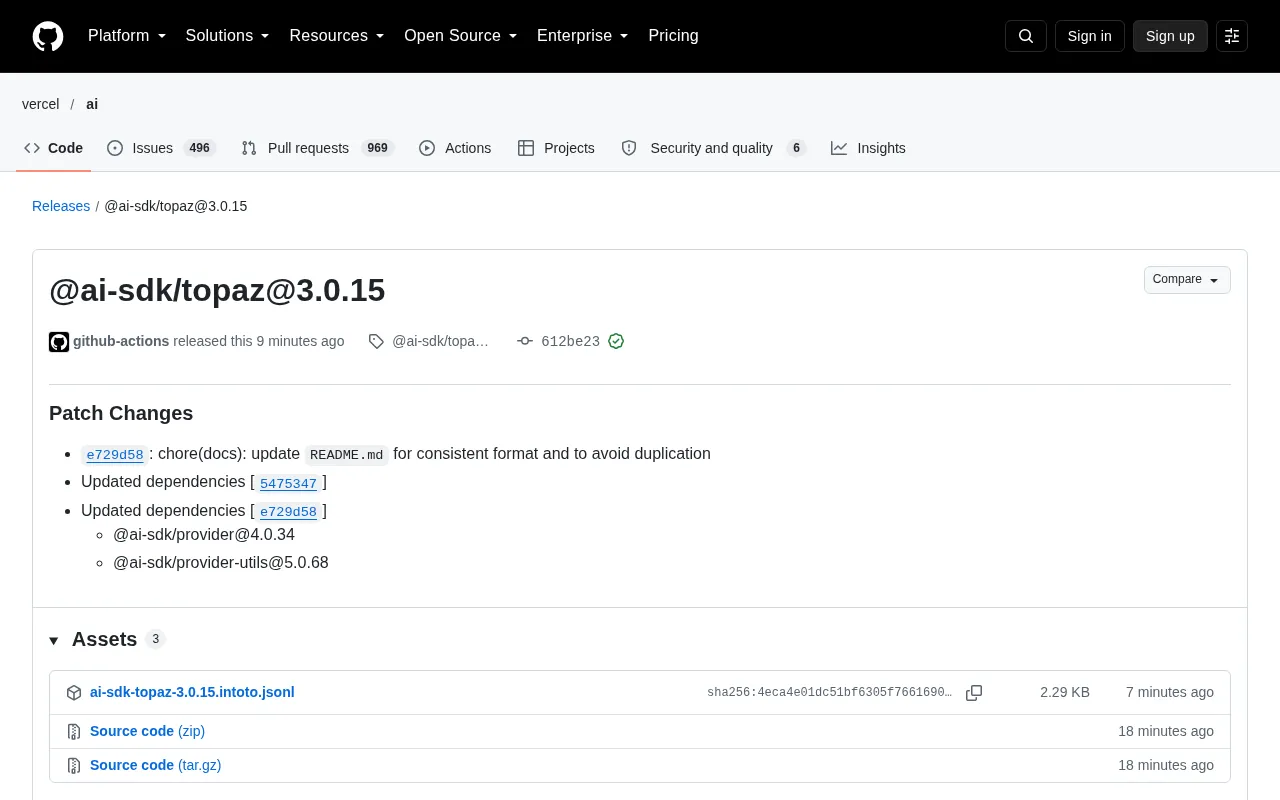
`@ai-sdk/topaz` releases patch version 3.0.15 with no functional changes. This update includes two changes: first, adjusting README.md via commit to unify format and eliminate duplicate content, reducing developer lookup costs; second, upgrading `@ai-sdk/provider` to 4.0.34 and `@ai-sdk/provider-utils` to 5.0.68 to ensure version compatibility with other AI SDK components. As a semantic version patch increment, it is backward-compatible with low upgrade risk, automatically published by a GitHub Actions bot with GPG-signed commits. The article notes that such frequent maintenance releases, though small in change, reflect project activity and ongoing investment in developer experience and supply chain standards.
The @ai-sdk/topaz package in the AI SDK ecosystem has released version 3.0.15. This is a patch update that mainly involves standardizing documentation format and synchronizing underlying dependency upgrades. Although it contains no functional changes, it reflects the project's ongoing maintenance and attention to developer experience.
Patch Contents: Dual Maintenance of Documentation and Dependencies
According to the release notes on GitHub, this update includes two core changes.
README Documentation Format Unification
Commit e729d58 specifically adjusts README.md with the goal of "updating README.md to maintain format consistency and avoid duplication." In open-source projects, the README is often the first entry point for developers encountering a library, and confusing formatting or redundant content directly affects onboarding efficiency. While this change is subtle, it is a typical developer experience (DX) optimization—by reducing duplicate information and unifying layout, the documentation becomes clearer and easier to read.
For engineers relying on AI SDK for application development, continuous documentation maintenance means lower lookup costs and fewer ambiguities. Especially when projects iterate quickly, keeping documentation in sync with code is work that maintainers must invest in long-term.
Dependency Package Version Synchronization
This release also updates the following dependencies:
@ai-sdk/providerupdated to 4.0.34@ai-sdk/provider-utilsupdated to 5.0.68
These dependencies are important components of the AI SDK abstraction layer. @ai-sdk/provider typically defines the interface specifications for model providers, while @ai-sdk/provider-utils provides shared utility functions. Synchronizing these underlying package versions helps ensure compatibility between @ai-sdk/topaz and other AI SDK components, reducing runtime issues caused by version mismatches.
In the npm ecosystem, dependency versions are usually declared as ranges, e.g., ^4.0.34 means versions no lower than 4.0.34 in the 4.x series are allowed. When multiple packages share the same underlying dependency, if they declare incompatible ranges, package managers like npm will install multiple copies in node_modules, causing the same module to have two instances, inconsistent type definitions, and even silent issues like failed instanceof checks. Synchronizing the versions of @ai-sdk/provider and @ai-sdk/provider-utils essentially narrows the space for such version drift, making the dependency tree flatter and types more unified, thereby reducing compatibility friction during cross-package collaboration.
Signals Behind the Version Number
3.0.15 is a patch version, which according to semantic versioning means no breaking changes or new features are introduced—only backward-compatible fixes and maintenance. For production users, such updates are typically low-risk and safe to upgrade.
From the release record, this version was automatically published by the github-actions bot on October 24, and the commit was verified with GPG signature. Automated release pipelines and signing mechanisms are common practices in modern open-source projects to ensure supply chain security—the former improves release efficiency, while the latter helps users confirm the trustworthiness of code origin.
Semantic Versioning (SemVer) stipulates that a version number consists of three parts: major, minor, and patch, in the form MAJOR.MINOR.PATCH. An increment in the major version indicates breaking changes that are not backward-compatible; an increment in the minor version indicates new features added in a backward-compatible manner; and an increment in the patch version indicates only backward-compatible bug fixes and maintenance changes. By this convention, seeing 3.0.15 immediately tells you: compared to 3.0.14, it will not change the behavior of any existing API, so upgrade risk is minimal. However, note that SemVer is a community convention rather than a mandatory standard, and whether a project strictly follows it depends on the maintainer's discipline. Therefore, before upgrading production dependencies, it is still advisable to check the release notes or changelog for confirmation.
GPG signature verification is a common practice in open-source supply chain security. The committer (or CI bot) signs the commit object with a private key, and anyone can use the corresponding public key to verify that the commit was indeed created by the holder of the private key and that the content has not been tampered with. GitHub displays a "Verified" badge next to the commit and supports requiring signed commits on protected branches. Combined with GitHub Actions automated releases, this mechanism makes the questions "who published it and whether the published content was altered" verifiable, helping to some extent prevent supply chain attacks such as forged commits after account compromise or malicious replacement of dependency packages.
Practical Impact on Developers
If you are using @ai-sdk/topaz in your project, this update will not change the behavior of existing APIs. It is recommended to upgrade during your regular dependency maintenance window to get the latest documentation and dependency alignment. If you also use @ai-sdk/provider or @ai-sdk/provider-utils, upgrading will improve version consistency and reduce potential compatibility friction.
For developers following the AI SDK ecosystem, such frequent patch releases also send a message: the project is actively maintained, and the underlying abstraction layer is continuously being refined. Although the changes in a single patch are small, the long-term accumulation of documentation standards and dependency governance is an important foundation for whether an SDK can be widely adopted.
Summary
@ai-sdk/topaz@3.0.15 is a maintenance-focused patch release, with emphasis on documentation format unification and dependency version synchronization. It brings no new capabilities but reflects the project's attention to developer experience and supply chain standards. For users, simply upgrade at your regular cadence; for observers, such updates are one of the reference signals for judging project health.
Related articles

New Trailer for 'Everest: The Other Side' Released: Ski Mountaineers Take On Ski Descent of the North Face
National Geographic's 'Everest: The Other Side' trailer follows pro ski mountaineers attempting Everest's Direct North Face and the first ski descent, with rare North Face footage and life-or-death avalanche moments.
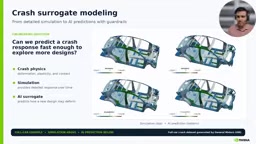
Building Automotive Crash AI Surrogate Models with NVIDIA PhysicsNeMo
An analysis of the NVIDIA PhysicsNeMo crash analysis workflow: how to train a Transolver surrogate model with simulation datasets and package it as an inference API via NIM, covering the complete four-step process of geometry parameterization, data splitting, and error validation.

LangGraph in Production: The Pain of Silent API Changes
Explores the challenge of silent external API changes affecting LangGraph agents in production, analyzes monitoring and testing limits, and proposes semantic validation and regression testing defenses.