AI SDK TUI 1.0.141 Released: A Seemingly Uneventful Patch Update

@ai-sdk/tui 1.0.141 is a pure dependency-sync patch release with no feature changes.
Vercel's AI SDK ecosystem published a patch update: @ai-sdk/tui bumps from 1.0.140 to 1.0.141. The single commit only syncs the upstream `ai` package to 7.0.140. This is a typical dependency-driven release in a monorepo, automatically run by GitHub Actions with signature verification. The article reminds developers that in the fast-moving AI SDK toolchain, the core `ai` package (7.x) and the surrounding TUI package (1.0.x) follow different versioning strategies, patch releases carry very little signal on their own, and what's truly worth tracking is the core package's direction. Day-to-day maintenance should focus on lockfile resolution, distinguish change cadence between core and surrounding packages, and trust automated release pipelines.
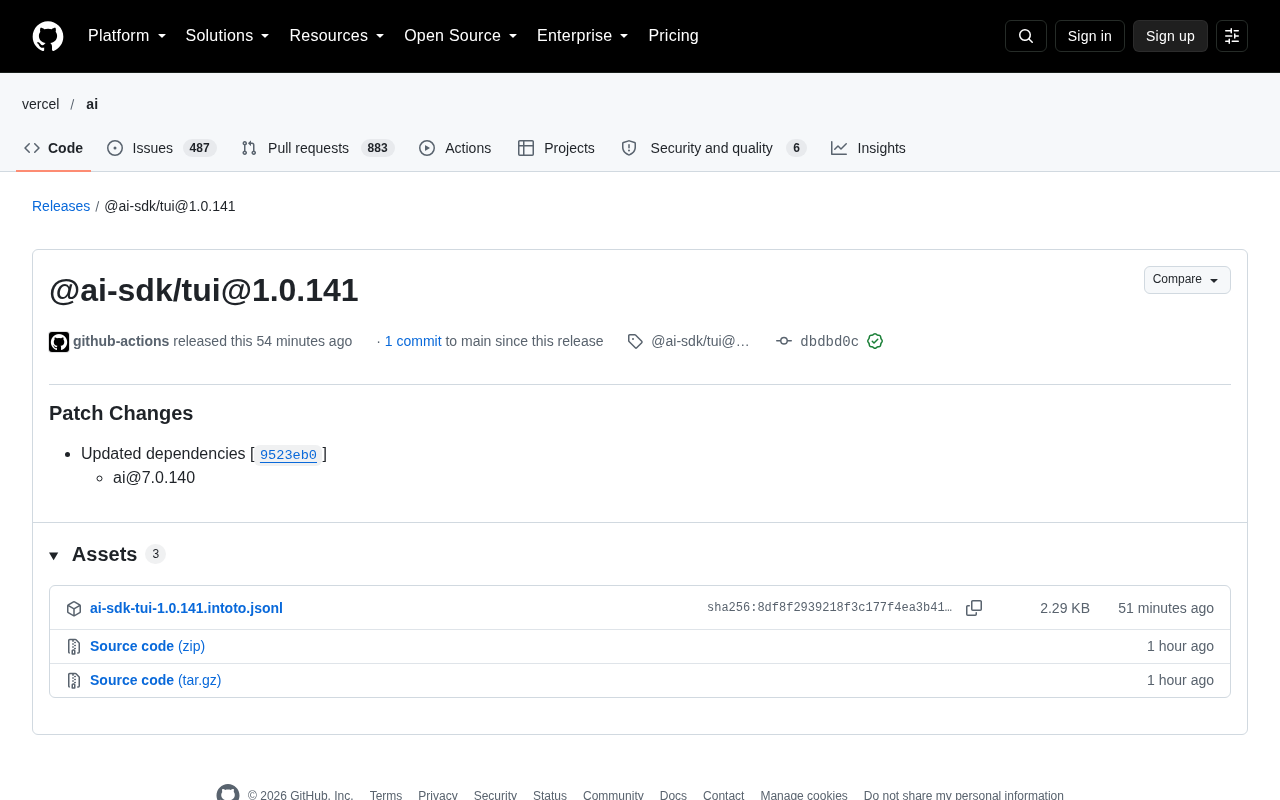
Vercel's AI SDK ecosystem has another minor iteration. @ai-sdk/tui@1.0.141 has been released on GitHub — a standard patch-level update, bumping from 1.0.140 to 1.0.141, containing just a single commit.
What Changed: A Dependency-Driven Release
According to the changelog, there's only one core item: Updated dependencies [9523eb0], ai@7.0.140. In other words, @ai-sdk/tui itself introduces no new features or behavioral changes — the version bump was entirely triggered by the upstream ai package upgrading to 7.0.140.
Releases like this are very common in monorepo ecosystems. AI SDK uses a multi-package collaborative management approach: when the core ai package changes, surrounding packages that depend on it automatically sync their dependency declarations through automated workflows and publish new patch versions, ensuring downstream users get a verified-compatible combination when installing.
The release was executed by the github-actions bot, and the commit carries a GitHub verification signature (GPG key ID: B5690EEEBB952194), indicating the entire process goes through a trusted automated CI channel with no manual intervention.
Monorepo is an engineering pattern where multiple related packages are developed collaboratively in a single repository. AI SDK adopts this structure: the core ai package, surrounding packages like @ai-sdk/tui and @ai-sdk/react, all live in the same repository and reference each other via the workspace protocol.
The biggest benefit of a monorepo is transparent dependency relationships and controllable release cadence — when an upstream package changes, CI can automatically identify which downstream packages are affected, batch-bump versions, run tests, and publish new packages. The trade-off is that version numbers can easily "decouple": the core package might already be at 7.x while the wrapper layer is still at 1.0.x. This isn't a problem — it's a strategic choice: only bump the major version when you actually change the API, and use patches to follow dependencies the rest of the time. Understanding this makes it clear why @ai-sdk/tui's version jumps don't reflect any functional changes of its own.
Why Patch Updates Are Still Worth Noticing
For most developers, seeing a patch update usually means ignoring it outright. But in a rapidly evolving toolchain like AI SDK, dependency synchronization itself is a signal.
The version number ai@7.0.140 means AI SDK has entered the 7.x major version cycle, while @ai-sdk/tui maintains a 1.0.x cadence. The two packages have different versioning strategies: the core package carries API evolution, while the TUI package is more of a stable interaction-layer wrapper. This version number misalignment is normal in the ecosystem, but it also reminds users — before upgrading, it's best to confirm the specific changes in the ai package rather than just looking at the TUI package's version jumps.
For developers using AI SDK to build terminal interaction interfaces, the practical impact of this update is close to zero. If your project locks to a specific minor version of the ai package, keep an eye on whether version conflicts arise during dependency resolution.
Semantic Versioning (SemVer) uses three numbers — major.minor.patch — to express the nature of changes: a major version change represents incompatible API changes, a minor version represents backward-compatible new features, and a patch represents backward-compatible bug fixes. By convention, patch updates should be "safe" upgrades.
But SemVer is just a convention, not a mandate. When a patch release is triggered not by its own code fixes but by a dependency upgrade, the actual changes introduced may come from the upgraded package. In the npm/pnpm ecosystem, range declarations like ^1.0.0 automatically pull the latest compatible version, so a single patch release can trigger a chain of dependency resolution changes. This is why the article emphasizes looking at the lockfile rather than the changelog version number — SemVer tells you "it should be fine," but the lockfile tells you "what's actually installed."
How to Handle These Releases
If you're using @ai-sdk/tui, there are a few principles to follow for routine maintenance.
Focus on the lockfile, not the version number. The actual resolution results recorded in package-lock.json or pnpm-lock.yaml are more telling than changelog version numbers. Patch updates usually don't break compatibility, but lockfile diffs let you quickly determine whether unexpected dependency changes have been introduced.
Distinguish the change cadence of core packages vs. surrounding packages. Changes to the ai package often carry API-level significance, while packages like @ai-sdk/tui mostly follow along. Focusing on the core package filters out a lot of low-information notifications.
Trust the automated process. This release was completed by GitHub Actions with signature verification, indicating the AI SDK team has engineering constraints in place for the release process. This level of automation itself reflects project maturity and is more trustworthy than manually published packages.
Summary
@ai-sdk/tui@1.0.141 is a pure dependency-sync release with no feature changes and no breaking changes. Treat it as a routine maintenance record — what's truly worth tracking is the evolution direction of the ai package behind it. For terminal application developers relying on AI SDK, keeping dependencies updated and watching lockfile changes is a more efficient maintenance approach than reading through every patch note.
One-line Summary
@ai-sdk/tui 1.0.141 is a pure dependency-sync patch release with no feature changes.
Paragraph Summary
Vercel's AI SDK ecosystem has published a patch update: @ai-sdk/tui bumps from 1.0.140 to 1.0.141, containing just one commit that syncs the upstream ai package to 7.0.140. This is a common dependency-driven release in monorepo ecosystems, automatically executed by GitHub Actions with signature verification — no manual intervention, no feature or breaking changes. The article uses this to remind developers: in the rapidly evolving AI SDK toolchain, the core ai package (7.x) and surrounding TUI package (1.0.x) have different versioning strategies; patch updates carry very low signal themselves, and what's truly worth tracking is the core package's evolution direction. Routine maintenance should focus on lockfile resolution results, distinguish the change cadence of core vs. surrounding packages, and trust automated release processes.
Related articles

Free Unlimited Claude Code Solution: Agnes AI + CC Switch Setup Guide
No paid subscription needed — pair the free AI platform Agnes AI with the open-source tool CC Switch to provide a backend for Claude Code, enabling unlimited free calls to text, image, and video models. This guide covers the full setup, test results, and usage boundaries.

A Complete Zero-Cost Guide to Getting Started with Claude Code for Beginners in China
A beginner's guide to Claude Code for users in China: two installation methods (command line and IDE plugin), full configuration steps for replacing the official API with the free domestic LongCat model, and a hands-on demo of building a small tool with natural language, plus tips.

When the NSA Gets Involved: The AI Supply Chain Crisis Behind Open-Source CVEs and API Key Hijacking
Multiple open-source projects disclosed severe CVEs in one day, PHP flaws alarmed the FBI, and Railway and OpenCode were breached with API keys stolen. This article breaks down the vulnerability window, AI-accelerated exploitation, and the AI supply chain crisis behind the API key black market, with a developer defense checklist.