@ai-sdk/tui 1.0.156 Released: Dependency Sync and Toolchain Stability
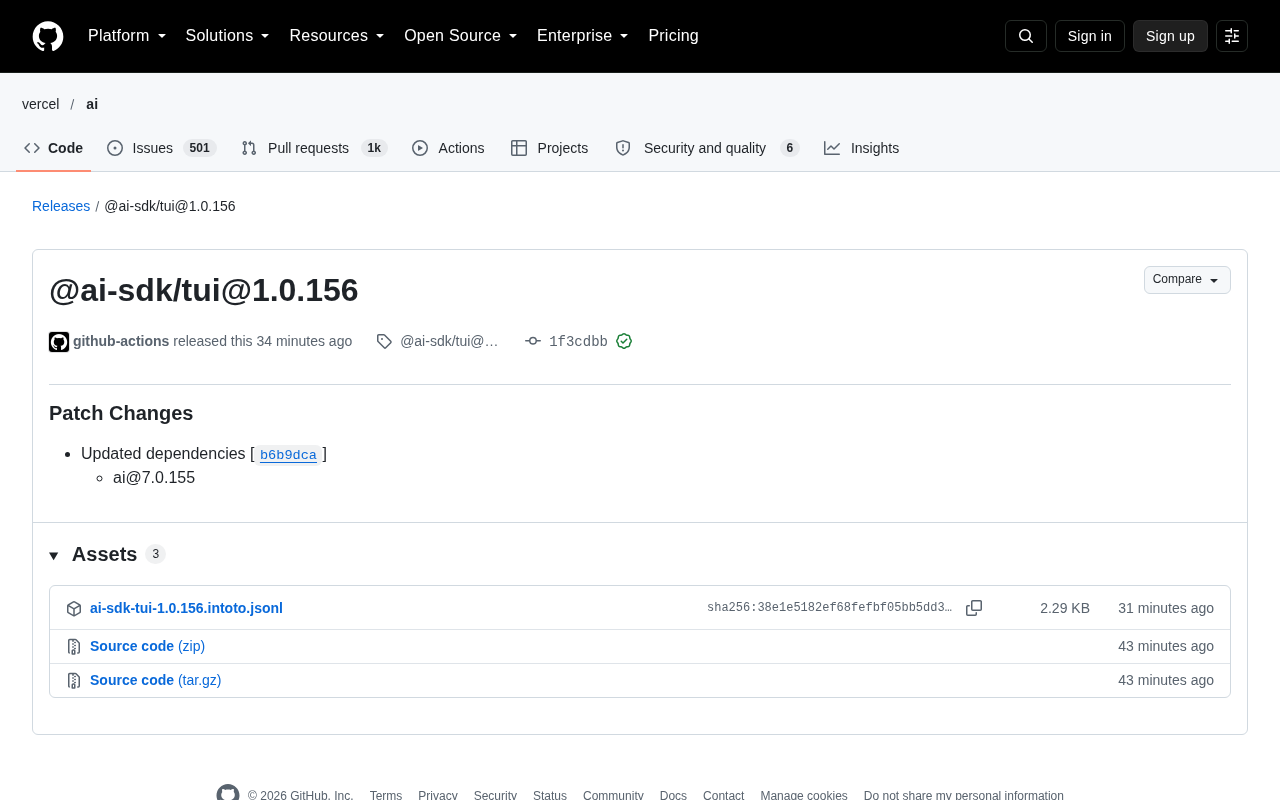
@ai-sdk/tui releases patch 1.0.156, only syncing dependencies to ai@7.0.155 with no functional changes.
@ai-sdk/tui has released patch version 1.0.156, with the changelog showing only a dependency sync to ai@7.0.155 — no new APIs or breaking changes. The article notes that the TUI package itself doesn't carry AI logic but serves as a terminal UI wrapper that follows the version cadence of the underlying ai package; version mismatches can cause inconsistent type definitions or runtime behavior deviations. This version was auto-published by github-actions with GPG signature verification on the commit, reflecting supply chain regularity. For upgrade advice, projects with pinned versions can merge routinely, while projects using range versions should run tests and prioritize reviewing the contents of commit b6b9dca in ai@7.0.155 before assessing whether TUI-side adaptation is needed.
A Release With No "New Features"
To the maintainers, this is just routine. @ai-sdk/tui has released patch version 1.0.156, and the changelog contains just one core line: Updated dependencies [b6b9dca] ai@7.0.155. No new APIs, no breaking changes, no feature previews.
But behind that line lies an easily overlooked distribution logic: the TUI package itself contains no AI logic — it pulls the version of the ai package into alignment as a dependency. When ai@7.0.155 enters the ecosystem through commit b6b9dca, TUI needs to follow promptly; otherwise, users may encounter version mismatches when installing or upgrading.
Why Dependency Sync Matters in a Patch Release
The AI SDK package system is a layered collaboration: the ai package carries core capabilities such as model invocation, streaming responses, and tool orchestration, while @ai-sdk/tui provides the terminal UI layer's interaction wrapper. When the two versions don't match, it may look like npm simply resolved two versions, but in practice it can manifest as mismatched type definitions or subtle runtime behavior deviations.
This release handles it directly — pointing TUI's dependency declaration to ai@7.0.155. For projects that depend directly on @ai-sdk/tui, upgrading reduces duplicate instances in the dependency tree; for developers assembling terminal UIs with the ai package themselves, it's also a reminder: the version cadence across SDK layers isn't fully synchronized, and lock files and dependency ranges need periodic review.
Semantic Versioning (SemVer) is the conventional foundation for dependency management in the npm ecosystem. Version numbers take the form MAJOR.MINOR.PATCH: major version changes represent incompatible breaking changes, minor versions represent backward-compatible new features, and patch versions represent backward-compatible bug fixes. @ai-sdk/tui increments its patch digit from 1.0.x, which by convention means this release contains no breaking changes and introduces no new APIs — consistent with the changelog showing only a dependency update. Note that pre-release versions, build metadata, and some packages' non-strict adherence to SemVer all mean the version number itself carries limited information, so assessing impact should still be based on the actual changes.
Dependency range syntax also affects upgrade behavior: ^1.0.0 allows installing the latest version under 1.x, ~1.0.0 allows only patch-level updates, and an exact version fully pins it. Range versions offer convenience but also make the lock file the only reliable record of the actually running version.
Release Process Regularity as Seen in Commit Records
The GitHub release page also shows that this version was published by the github-actions bot, and commit 1f3cdbb was created on GitHub.com with a verified signature, GPG key ID B5690EEEBB952194. This information matters to those sensitive to supply chain security: it confirms the artifact came from the repository's automated release pipeline, not a manual push from some local environment.
Automated releases combined with commit signing are a standard defense line for open-source projects at the distribution stage. For teams embedding the AI SDK into production systems, checking release provenance and signature status is more practically valuable than caring about the last digit of a version number.
GPG commit signing is a provenance verification mechanism provided by Git: developers use a private key to generate a signature over the commit content, and others can use the corresponding public key to verify that the commit was indeed created by the key holder and that the content hasn't been tampered with. GitHub displays a "Verified" badge for commits with verified signatures; the GPG key ID B5690EEEBB952194 mentioned in the article identifies that key.
In automated release scenarios, signing serves more to prove the artifact went through the repository's established CI pipeline rather than a manual operation in some local environment. However, signing only guarantees commit provenance and integrity — it is not equivalent to a security audit of the code content. Supply-chain-sensitive teams typically also assess measures such as dependency locking, build artifact verification, and least-privilege release permissions.
Usage Advice: How to Handle This Kind of Patch Release
If you've pinned the version of @ai-sdk/tui in your project, this upgrade is unlikely to change code behavior — merge it at your usual cadence. If you use a range version (e.g., ^1.0.0), this patch will be pulled automatically on install; after upgrading, it's advisable to run your existing tests, focusing on terminal interaction and streaming output behavior.
More worthy of attention is the change in the ai package itself. TUI is merely following along this time; the real behavioral differences come from commit b6b9dca introduced in ai@7.0.155. Before upgrading, review that commit's changes first, then assess whether adaptation on the TUI side is needed. This troubleshooting order — "look at the underlying layer first, then the wrapper layer" — is more prudent than upgrading the entire dependency tree directly.
Lock files such as package-lock.json, pnpm-lock.yaml, or yarn.lock record the exact version and integrity hash of every package in the dependency tree, and are key to ensuring consistent installs across environments. When the wrapper-layer TUI and the underlying ai package versions mismatch, two instances of the same package may appear in the lock file, leading to issues like duplicate type definitions or broken runtime singletons.
When handling this kind of sync-type patch, you can first use your package manager's dependency tree inspection command to confirm whether the ai package has been deduplicated, then decide whether to update only the lock file or also adjust dependency ranges. For SDKs that collaborate across multiple packages, regularly reviewing lock files and dependency ranges often prevents hidden failures better than chasing the latest version numbers.
Consensus Across Multiple Perspectives
This information comes from a single RSS source, and the release page itself describes the version content very minimally, so the analysis of behavioral impact is reasonable inference based on package dependency relationships, not explicit statements in the release notes. What can be confirmed as fact: the patch version exists, dependencies were updated, the release was done through an automated pipeline, and the commit carries signature verification. As for the specific impact of changes within ai@7.0.155, that should be based on that package's own release records.
One-line Summary
@ai-sdk/tui releases patch 1.0.156, only syncing dependencies to ai@7.0.155 with no functional changes.
Paragraph Summary
@ai-sdk/tui has released patch version 1.0.156, with the changelog showing only a dependency sync to ai@7.0.155 — no new APIs or breaking changes. The article notes that the TUI package itself doesn't carry AI logic but serves as a terminal UI wrapper that follows the version cadence of the underlying ai package; version mismatches can cause inconsistent type definitions or runtime behavior deviations. This version was auto-published by github-actions with GPG signature verification on the commit, reflecting supply chain regularity. For upgrade advice, projects with pinned versions can merge routinely, while projects using range versions should run tests and prioritize reviewing the contents of commit b6b9dca in ai@7.0.155 before assessing whether TUI-side adaptation is needed.
Related articles

74M-Parameter Open-Source Model Partially Outperforms Jev AI in Testing
Fastino AI's Glider 2.5 models, with just 74M–300M parameters, reportedly outperform Jev AI in some guardrail benchmarks per YouTube testing, run on consumer hardware, and even play Doom. We analyze small models' competitiveness and deployment value on specific tasks.

Gemini 4 Argon Hands-On: Aggressive Pricing, 3D Capabilities Need Coaching
Gemini 4 Argon hands-on: limited-time $2/$10 pricing, million-token output, strong 3D and reverse-engineering work, but weak front-end aesthetics and zero-shot ability need coaching.

Build Your Own ChatGPT with Flutter and Gemini API: Streaming Chat in 200 Lines of Code
Learn to build a ChatGPT-like AI chat app with Flutter and the Gemini API: secure API keys via Firebase AI Logic, stream replies with sendMessageStream, maintain memory with chat sessions—all in under 200 lines of code.