@ai-sdk/tui 1.0.171 Released: The Signal Behind a Patch Update

@ai-sdk/tui releases 1.0.171 patch version, reflecting standardized dependency governance and automated release processes.
The article uses the @ai-sdk/tui 1.0.171 patch release as an entry point to analyze the engineering significance behind a seemingly mundane release record. The core of this version is following the underlying ai package to 7.0.170, which is a pure dependency update. The article points out that continuous, small-scale patch releases following semantic versioning rules are reliable signals of project health and maintenance discipline, reducing upgrade costs for integrators. The release is automatically completed by GitHub Actions with GPG signatures, indicating that the process from merge to release has achieved automation and traceability. The article also discusses the underestimated value of TUI as a lightweight AI interaction interface and provides action recommendations for developers in different roles: users should verify version combinations and follow up with low-cost upgrades, while evaluators can view this as evidence of active project maintenance.
A Seemingly Ordinary Release
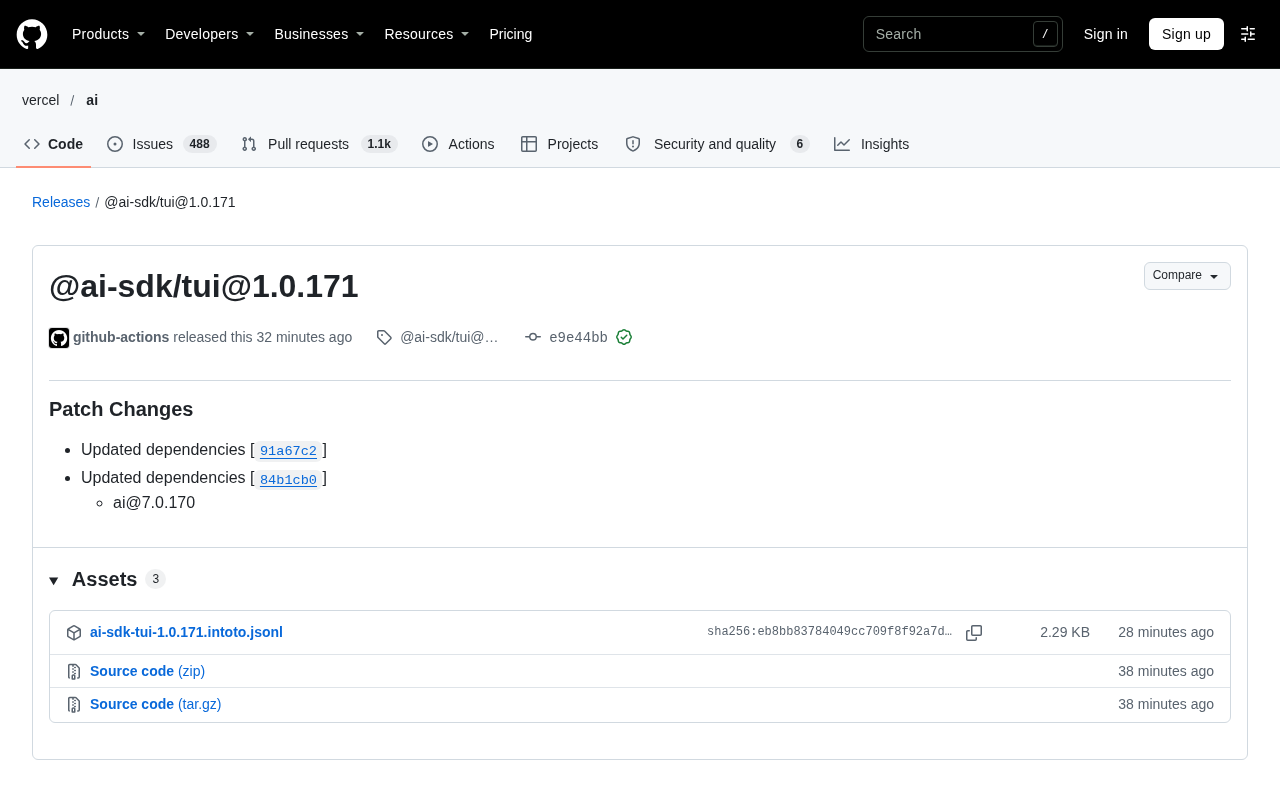
On GitHub, a release record quietly appeared, automatically created by GitHub Actions: the @ai-sdk/tui package released version 1.0.171. The commit message is terse to the point of being cold—a few lines of dependency updates, an associated ai package version number change, and nothing more. No exciting new feature list, no lengthy changelog, just a patch-level version number bump.
For readers unfamiliar with the AI SDK ecosystem, this might just be a notification that gets quickly scrolled past. But for developers building terminal interaction applications with Vercel AI SDK, these seemingly mundane patch releases reflect the rhythm of project maintenance and the maturity of engineering practices.
Dependency Governance Behind the Patch
This @ai-sdk/tui 1.0.171 version is marked as patch changes, with the core content being dependency updates. Two dependency update entries appear in the release record, one of which points to ai@7.0.170. This means the tui package is following the latest fixes in the underlying ai package, rather than introducing breaking changes.
In the JavaScript ecosystem, dependency management has always been a barometer of project health. A project that continuously, incrementally, and regularly updates dependencies is generally more trustworthy than one that stagnates for long periods or suddenly jumps major versions. @ai-sdk/tui choosing to sync upstream changes with patch versions shows that the maintenance team respects semantic versioning rules—not packaging internal fixes as feature updates, nor using version numbers for marketing.
This approach is equally friendly to integrators. Developers using @ai-sdk/tui can automatically receive these fixes through version ranges without modifying their own code. Patch updates reduce the cognitive burden of upgrade decisions.
Semantic Versioning (SemVer) is the conventional version number specification in the JavaScript ecosystem, formatted as major.minor.patch. A major version change indicates incompatible API modifications, a minor version increase indicates backward-compatible feature additions, and a patch number increment represents only backward-compatible bug fixes. Projects following this specification allow integrators to automatically receive patch and minor version updates through version ranges in dependency declarations (such as ^1.0.0) without worrying about breaking existing code. Conversely, if maintainers stuff internal refactoring or feature changes into patch versions, it can bring surprises to downstream. Therefore, a pure patch release is often seen as a signal that the maintainer is honoring the contract.
Changesets is a widely used version management and changelog tool in the JavaScript ecosystem, commonly found in monorepo projects. When developers submit code, they need to attach a changeset file describing the change type (patch, minor, major) and explanation; during release, the tool aggregates these files, automatically calculates new version numbers for each package, generates changelogs, and triggers the release process. Combined with GitHub Actions, it can achieve a pipeline from merging PRs to releasing new versions. The "patch changes" marker mentioned in the article and the automatically generated release records are typical products of this kind of toolchain.
The Value of TUI as an AI Interaction Interface
The existence of @ai-sdk/tui itself points to an underestimated direction: the position of Terminal User Interface (TUI) in the AI toolchain. While most discussions focus on web chat interfaces and desktop applications, TUI provides a lightweight, composable interaction method that stays close to developer workflows.
The terminal environment has no rendering overhead, no complex state management frameworks, and is naturally suitable for rapid prototyping and building command-line AI assistants. A well-maintained TUI component library means developers can access AI capabilities using familiar terminal paradigms without being held hostage by frontend tech stacks. @ai-sdk/tui continuing to release patch versions shows that this path has real use cases supporting it.
TUI (Terminal User Interface) refers to interactive interfaces drawn in pure text terminals through characters, ANSI escape sequences, and cursor control, commonly seen in tools like htop, vim, and lazygit. Compared to GUI, TUI does not depend on graphics stacks and browser engines, has low resource usage, can be used remotely via SSH, and naturally integrates into developers' command-line workflows. In AI tool scenarios, TUI is suitable for building streaming output, multi-turn conversations, file selection, and other interactions while remaining lightweight and scriptable. However, TUI is also limited by terminal capabilities, and complex layouts and rich media displays still need to be handled by web or desktop interfaces.
Maturity of the Automated Release Process
The release record was triggered by the github-actions bot, and the commit has been verified by GitHub signature. These two details are worth examining separately.
Automated releases mean the version rhythm does not depend on manual operations by individuals, reducing human delays and omissions. Combined with patch notes generated by tools like changesets, the release process has achieved automation from code merge to version number advancement. For open source projects, this is an important indicator of maintainability—maintainers do not need to repeat mechanical labor with each release.
Signature verification provides another layer of assurance. The commit carries a GPG key signature, indicating that the code source is traceable. In the context of increasing attention to supply chain security, this practice, while basic, constitutes the starting point of the trust chain.
GPG-signed commits refer to developers cryptographically signing Git commit objects with their private keys, and others can use the corresponding public key to verify that the commit was indeed created by the claimed author and that the content has not been tampered with. GitHub displays a "Verified" badge for signed commits. In the open source supply chain, signature verification is a fundamental step in establishing source credibility, but it only guarantees the source and integrity of the commit—it does not equate to the code having undergone security auditing. For bot commits that rely on automated releases, the signature mechanism is equally important because it can prove that the release action was indeed triggered by a trusted CI pipeline, not an impersonator.
What Developers Should Pay Attention To
Facing this release information, developers in different roles can extract different action items. If you are using @ai-sdk/tui in your project, checking whether the version combination of tui and ai packages in your dependency lock file matches is worth a few minutes. Patch updates usually mean upstream has fixed certain edge cases, and the cost of following up with upgrades is extremely low.
If you are evaluating whether to introduce this package, the signal this release record conveys is: the project is actively maintained, the release process is standardized, and the version strategy is restrained. It does not promise a feature roadmap, but it demonstrates engineering discipline.
The original release information includes the associated commit hash for the dependency update but does not elaborate on the specific fix content. For teams that need complete change details, it is recommended to directly consult the repository's commit history and the corresponding ai package release notes for more accurate upgrade decisions.
One-line Summary
@ai-sdk/tui releases version 1.0.171 patch, reflecting standardized dependency governance and automated release processes.
Paragraph Summary
The article uses the @ai-sdk/tui 1.0.171 patch release as an entry point to analyze the engineering significance behind a seemingly mundane release record. The core of this version is following the underlying ai package to 7.0.170, which is a pure dependency update. The article points out that continuous, small-scale patch releases following semantic versioning rules are reliable signals of project health and maintenance discipline, reducing upgrade costs for integrators. The release is automatically completed by GitHub Actions with GPG signatures, indicating that the process from merge to release has achieved automation and traceability. The article also discusses the underestimated value of TUI as a lightweight AI interaction interface and provides action recommendations for developers in different roles: users should verify version combinations and follow up with low-cost upgrades, while evaluators can view this as evidence of active project maintenance.
Related articles

Gemini 4 Neon Review: Benchmark Scores Rival Carbon, API Pricing and Quota Breakdown
Google Gemini 4 Neon is now live, benchmark scores closely tracking Carbon, API pricing 3/15 at twice Hydrogen's rate. This article compiles Bilibili creator testing: Neon can replace 90% of Carbon scenarios, AntiGravity quota consumption is only one-third of Carbon, plus subscription channel restrictions and 2API ban risks.

Gemini 4 Helium Coming Soon? Signals of Google Loosening Subscription Restrictions
Google team member hints releases will continue; community speculates Gemini 4 Helium (Flash Lite) may be next. Subscription ban controversy gets a response as product lead says "Soon," suggesting restrictions may be lifted. This article covers Gemini developments, OpenAI Coding Agent and risk management, Doubao real-time audio-video API, and compute business dynamics.

AI-Assisted React Development in Practice: Optimizing a Video App and Handling Errors
A 14-year veteran developer demonstrates AI-assisted React video app optimization: compressing video from 80MB to 5MB (~94%) via ImageKit, plus reliable error handling and retry mechanisms. Includes planning, code understanding, and verification methods for working with AI.