@ai-sdk/tui 1.0.173 Update: Iterating the Terminal AI App Development Kit
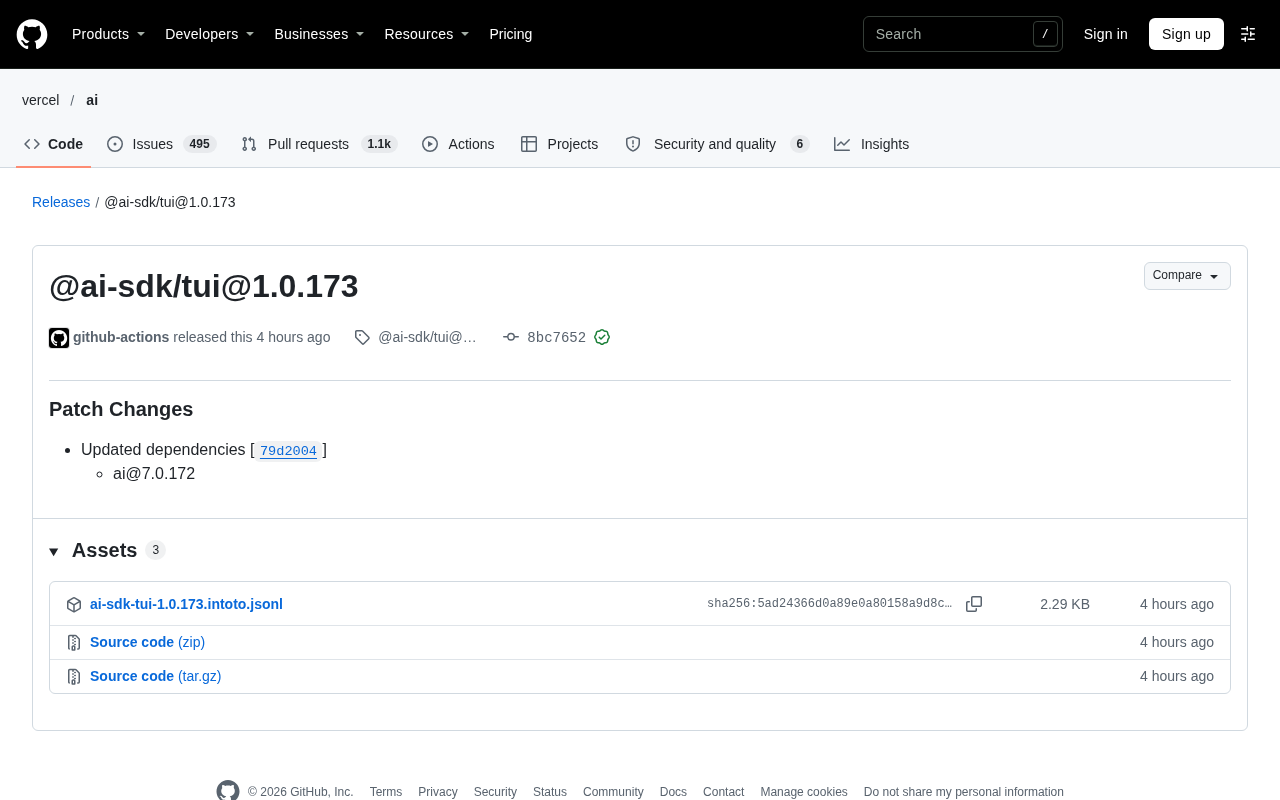
Vercel's @ai-sdk/tui releases patch 1.0.173, syncing dependency ai@7.0.172.
Vercel's terminal interface extension package `@ai-sdk/tui` has released version 1.0.173, a typical dependency-sync patch whose only change is upgrading the underlying `ai` package to 7.0.172. The article notes that as the terminal interface layer in the AI SDK ecosystem, its version iterations follow the core `ai` package to keep terminal interaction behavior consistent with the latest SDK and avoid hidden compatibility issues from version drift. TUIs are an underappreciated AI toolchain direction thanks to fast startup, low resource usage, and suitability for remote and server environments; `@ai-sdk/tui` lets developers build terminal interfaces with the familiar AI SDK paradigm. For teams already using the package, upgrade risk is low, but verifying streaming output and session-state integrations is recommended; first-time evaluators should focus on terminal scenario coverage and core SDK integration cost.
Vercel's @ai-sdk/tui has released version 1.0.173. This is an AI SDK extension package for building terminal user interfaces (TUIs). This update is a patch release, with the core change being a synchronized upgrade of the underlying dependency ai@7.0.172.
A Typical Dependency-Sync Release
Judging from the changelog, 1.0.173 contains only one Patch Change: updating the dependency ai to version 7.0.172. This fits the release cadence of this series — as the terminal interface layer within the AI SDK ecosystem, @ai-sdk/tui's version iterations typically follow updates to the core ai package, ensuring that developers working with terminal interaction capabilities get behavior and interfaces consistent with the latest AI SDK, rather than maintaining compatibility on their own.
This "small steps, fast iteration" strategy is especially important for projects with long dependency chains. Terminal applications usually need to work closely with capabilities like model invocation, streaming responses, and tool calling. A patch update to the underlying ai package may involve subtle fixes in request handling or streaming parsing, and timely synchronization avoids hidden issues caused by version drift.
Why Terminal AI Interfaces Deserve Attention
Terminal user interfaces (TUIs) are becoming an underappreciated direction in the AI toolchain. Compared with browser or desktop GUIs, TUIs have the advantages of fast startup, low resource usage, and ease of running on servers and in remote environments. They also allow high-frequency operations via the keyboard, making them well suited to the command-line workflows developers use every day.
@ai-sdk/tui is positioned to let developers build these interfaces using the familiar AI SDK paradigm: consolidating model invocation, session management, streaming output, and similar capabilities into the terminal, rather than requiring developers to piece together terminal rendering logic and AI interaction logic from scratch. For teams looking to embed AI assistants into CLI tools, ops scripts, or local development environments, components like these can significantly reduce integration costs.
Vercel AI SDK is an open-source TypeScript toolkit from Vercel. Its core package ai provides a unified model invocation interface (generateText, streamText, etc.) and connects to multiple model services such as OpenAI, Anthropic, and Google through a provider adapter layer. Its design goal is to let frontends and Node.js backends use the same API to handle streaming responses, tool calling, and structured output (such as generateObject), and to connect with the UI layer through React Hooks (useChat, useCompletion). @ai-sdk/tui extends this paradigm to the terminal environment, so its version number maintains a synchronized dependency relationship with the ai package — essentially ensuring that "the same set of SDK semantics" does not diverge in terminal scenarios.
TUI (Terminal User Interface) refers to interactive interfaces built in plain-text terminals through character drawing, cursor control, and keyboard events. Typical examples include htop, lazygit, vim, and Node.js-based libraries such as Ink and Blessed, as well as Textual (Python). Unlike GUIs, TUIs rely on ANSI escape sequences for layout and redrawing, usually use differential rendering to reduce flicker, and capture keystrokes through standard input without requiring a mouse. This form factor naturally fits SSH remote sessions, container environments, and CI/server scenarios, with resource overhead measured in KB. Embedding AI sessions into a TUI requires handling incremental rendering of streaming tokens, scroll viewports for long conversations, and state management for interruption and retry — precisely the complexity that @ai-sdk/tui aims to consolidate.
The Value of Patch Releases and Usage Recommendations
Looking only at the contents of 1.0.173, it is not a feature release but more of an ecosystem alignment. For developers already using @ai-sdk/tui in their projects, the risk of this type of patch release is usually low, but it is still recommended to run integration tests related to streaming output and session state after upgrading to confirm that terminal rendering behaves consistently with the underlying ai package.
If you are new to this package, you can treat 1.0.173 as a current stable baseline: it represents the package's ongoing maintenance on the 1.0.x series and its synchronization with the ai 7.x mainline. When evaluating whether to adopt it, focus on how well it covers terminal interaction scenarios and whether your team's existing tech stack already uses Vercel AI SDK. If you are already using it, the terminal layer is a natural extension; if not, you should first assess the integration cost of the core SDK.
Semantic Versioning (SemVer) specifies version numbers in the form major.minor.patch (e.g., 1.0.173), where an increment in the patch position represents backward-compatible bug fixes, an increment in the minor position represents backward-compatible new features, and an increment in the major position may include breaking changes. Under this convention, 1.0.173 is a patch release and theoretically does not change the public API. However, note that the actual impact of dependency-sync patches depends on what changed in the upgraded dependency: if ai@7.0.172 has adjustments in streaming parsing or request retry logic, the behavior of the terminal layer may change accordingly. Therefore, "patch means safe" is only an empirical judgment and should still be verified with integration tests.
What to Watch Next
Dependency synchronization itself does not constitute a feature commitment. What is worth watching next is whether @ai-sdk/tui will add more complete terminal component capabilities in future versions, and how it will handle persistence and state recovery for multi-turn sessions in the terminal — these are the keys to determining whether a TUI solution can move from "usable" to "good to use."
One-line Summary
Vercel's @ai-sdk/tui releases patch version 1.0.173, synchronizing the dependency ai@7.0.172.
Paragraph Summary
Vercel's terminal interface extension package @ai-sdk/tui has released version 1.0.173. This is a typical dependency-sync patch release, with the only change being an upgrade of the underlying ai package to 7.0.172. The article notes that as the terminal interface layer within the AI SDK ecosystem, this package's version iterations always follow the core ai package to ensure that terminal interaction capabilities stay consistent with the latest SDK behavior and avoid hidden compatibility issues caused by version drift. TUIs are an underappreciated direction in the AI toolchain due to their fast startup, low resource usage, and suitability for remote and server environments. The value of @ai-sdk/tui lies in enabling developers to build terminal interfaces using the familiar AI SDK paradigm. For teams already using this package, upgrade risk is low, but it is recommended to verify integrations related to streaming output and session state; for first-time evaluation, focus on its coverage of terminal interaction scenarios and the integration cost of the core SDK.
Related articles

Gemini 4 Neon Tested in Blender: Cheap but Not the King
Bilibili creator tests Gemini 4 Neon in Blender across five rounds vs Claude Fable, Opus, and GPT. Neon's detail nears Fable but animation still lags; at $44 vs Fable's $52, cheaper Argon under $14 is the value surprise.
Gemini 4 Neon Hands-On: Can It Challenge Opus 5.5?
Google released 4 Gemini 4 models in 49 days. We test whether Neon can challenge Opus 5.5 across benchmarks, real video tasks, and subscription costs.

Former Inmate Reveals Psychopath Ratio in Prison: About 200 Out of Every 880
Former inmate Larry Lawton shares on Lex Fridman's podcast that about 200 of 880 life-sentence inmates are psychopaths—a 23% ratio. He explores the blurred line between good and evil, social dynamics in prison, and wisdom from dark experiences.