AI SDK TUI 1.0.185 Patch Released: The Ecosystem Significance Behind a Minor Version Update

@ai-sdk/tui releases patch 1.0.185, reflecting the norm of high-frequency automated iteration in the AI SDK ecosystem.
The article uses the release of the `@ai-sdk/tui` 1.0.185 patch as an entry point to analyze the ecosystem mechanisms behind this routine update. The release is automatically completed by the GitHub Actions bot with signature verification, reflecting the "small, rapid steps" continuous delivery model of mature open-source projects. It further explains the positioning of `@ai-sdk/tui` as a terminal interface component in the AI SDK family, responsible for presenting low-level capabilities such as model invocation and streaming responses in command-line interactive form. Linked to `ai@7.0.184`, it illustrates the chain release relationships between packages in a monorepo ecosystem. The author advises developers to view patch updates rationally: upgrade as needed, follow changelogs, and view commit diffs when necessary, noting that understanding this release rhythm is more valuable than memorizing specific version numbers.
A Seemingly Ordinary Patch Update
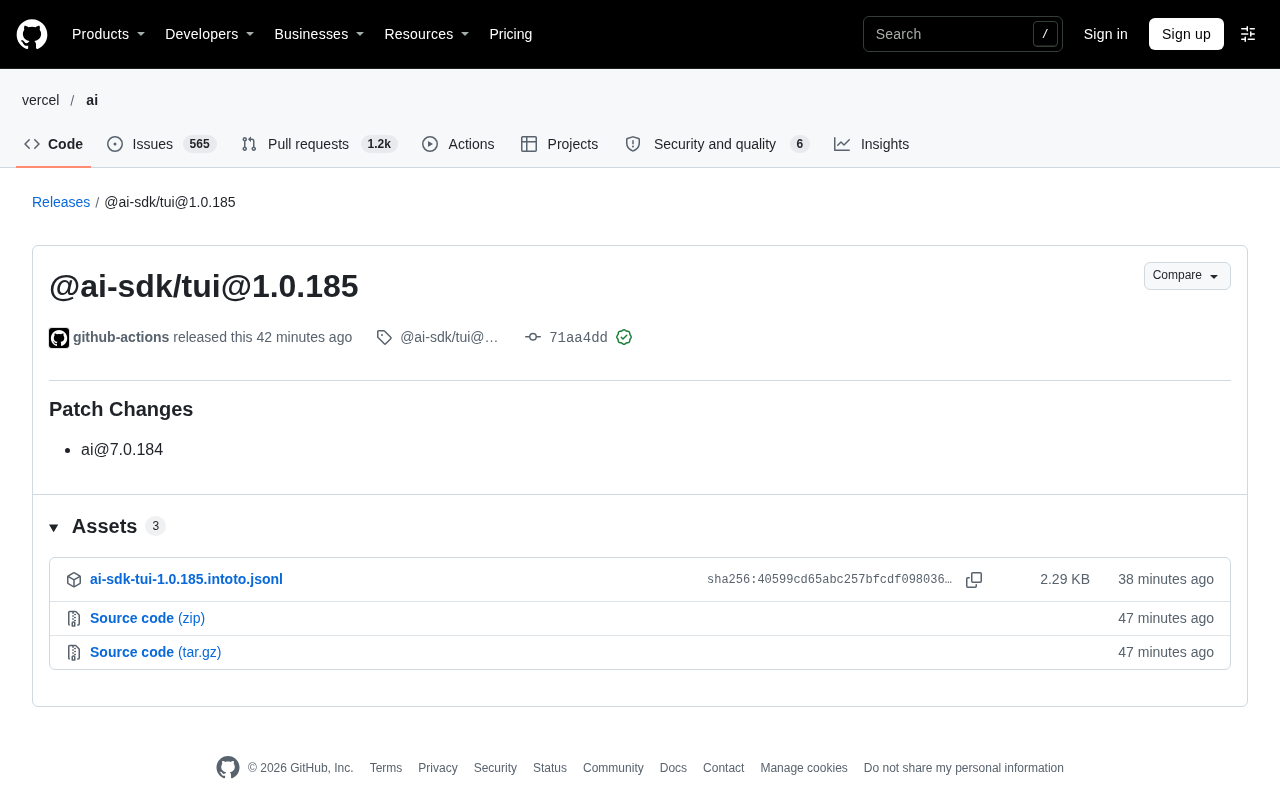
On GitHub, @ai-sdk/tui released version 1.0.185. This is a patch-level update, automatically published by the github-actions bot, accompanied by changes from ai@7.0.184. Judging from the version number and release method, this looks more like a routine action in the daily iteration of the AI SDK ecosystem rather than a version with major feature changes.screenshot
In semantic versioning, a patch version means backward-compatible bug fixes. For developers depending on @ai-sdk/tui, such updates can usually be safely upgraded without worrying about API breakage. What's really worth paying attention to is the event-driven release process it reflects and the maintenance rhythm of the SDK ecosystem.
Semantic Versioning (SemVer) is a version numbering convention widely adopted in the open-source ecosystem, formatted as major.minor.patch (e.g., 1.0.185). A major version change indicates incompatible API modifications, a minor version increase indicates backward-compatible new features, and a patch number increment represents only backward-compatible bug fixes. According to this convention, 1.0.185 means that @ai-sdk/tui has undergone 185 backward-compatible fix updates since the release of 1.0.0, and has not yet introduced breaking changes or new features. The value of semantic versioning lies in enabling dependents to judge upgrade risk solely from the version number: patch upgrades can usually be accepted automatically, minor upgrades require attention to new features, and major upgrades require evaluating migration costs. This convention is also the basis for automated release tools (such as changesets and semantic-release) to calculate version numbers.
A Mature Signal of Automated Release Processes
The publisher field shows github-actions, indicating that this version release was automatically triggered by a continuous integration pipeline rather than manually operated. The commit record carries GitHub's verified signature (the GPG key ID is public), meaning the chain from commit to release has traceability and integrity verification.
This pattern is becoming increasingly common in mature open-source projects. After developers merge changes, the bot automatically calculates the version number, generates a changelog, tags, and publishes the package. The less manual intervention, the more stable the release frequency—small, rapid steps replace batching up for major versions. The fact that @ai-sdk/tui has reached a patch number like 1.0.185 is itself the result of high-frequency iteration.
GitHub Actions is GitHub's built-in continuous integration and continuous delivery (CI/CD) platform. Developers define trigger conditions (such as push, PR merge, scheduled tasks) and execution steps through YAML workflow files. In the package publishing scenario, a typical process is: tests run automatically after code merge, and if they pass, npm publish is called to publish, with changelogs and Git tags automatically generated. To prevent bot commits from bypassing review, mature pipelines usually combine with GitHub's GPG signature verification mechanism—commits are signed by a bot holding a private key, GitHub displays a "Verified" badge, and the recipient can confirm that the code source has not been tampered with. This mechanism allows the release process to run without manual supervision while retaining a complete traceable chain.
What Role Does @ai-sdk/tui Play in the AI SDK System
Judging from its name, @ai-sdk/tui is a terminal user interface (TUI) component in the AI SDK family. The AI SDK typically provides low-level capabilities such as model invocation, streaming responses, and tool calling, while the TUI layer is responsible for presenting these capabilities in the form of a terminal interactive interface—for example, displaying conversation streams, tool execution status, or streaming output progress in the command line.
For developers building AI command-line tools, the value of such packages lies in saving the cost of reinventing the wheel. Although patch updates add no new features, they often fix rendering issues under edge conditions, timing issues in streaming output, or compatibility issues with the host terminal environment. These issues do not affect the main flow, but they directly affect the user experience.
TUI (Terminal User Interface) refers to a program form that draws an interactive interface with characters in a command-line terminal, as distinct from plain text output or graphical user interfaces (GUI). A typical TUI uses capabilities such as cursor positioning, colors, borders, and scrolling regions to present menus, progress bars, scrollable logs, or real-time streaming content. In AI scenarios, TUIs are especially suitable for displaying large model streaming output—refreshing in real time as characters arrive segment by segment without breaking the layout, while displaying tool call status side by side. Common underlying libraries for implementing TUIs include Node.js's Ink (rendering to the terminal based on React) and Go's Bubble Tea. @ai-sdk/tui sits at this layer, encapsulating terminal rendering details so that developers can build AI command-line applications declaratively.
Dependency Linkage Behind the Patch
This release is also associated with changes from ai@7.0.184. In monorepos or tightly coupled package ecosystems, a patch is often triggered by changes in upstream dependencies. A fix in the upstream ai package may require @ai-sdk/tui to publish a new version synchronously to align dependency versions.
This also explains why patch versions keep appearing: packages in the ecosystem depend on each other, and a fix in any link can trigger a chain of version releases. For users, keeping dependency versions aligned is more important than chasing the latest version number. When upgrading, it's worth noting whether the release notes mention version requirements for companion packages.
How to View Such Minor Version Updates Rationally
Faced with frequent patch releases, developers easily fall into two extremes: either completely ignoring updates or upgrading every time. A more pragmatic approach is to focus on the change content itself. Patch-level updates usually fix specific issues; if the current project does not encounter the corresponding scenario, you can upgrade at your own pace; if you are troubled by a certain edge issue, it's worth checking the changelog to confirm whether it has been fixed.
In addition, although automated releases are efficient, they also mean that changelogs may be relatively brief. When information is insufficient, directly viewing the diff of the corresponding commit is often more effective than reading the release notes.
Conclusion
@ai-sdk/tui@1.0.185 itself has no dramatic story, but it demonstrates a norm in the AI developer tool ecosystem: continuous iteration driven by automated pipelines, maintaining stability through high-frequency small patches. Understanding this release rhythm is more valuable than remembering a specific version number.
One-line Summary
@ai-sdk/tui releases patch 1.0.185, reflecting the norm of high-frequency automated iteration in the AI SDK ecosystem.
Paragraph Summary
The article uses the release of the @ai-sdk/tui 1.0.185 patch version as an entry point to analyze the ecosystem mechanisms behind this routine update. The release is automatically completed by the GitHub Actions bot with signature verification, reflecting the continuous delivery model of "small, rapid steps" in mature open-source projects. The article further explains the positioning of @ai-sdk/tui as a terminal interface component in the AI SDK family, responsible for presenting low-level capabilities such as model invocation and streaming responses in the form of command-line interaction. This update is associated with ai@7.0.184, illustrating the chain release relationship between packages in the monorepo ecosystem. The author suggests that developers view patch updates rationally: upgrade as needed, pay attention to changelogs, and directly view commit diffs when necessary, and points out that understanding this release rhythm is more valuable than remembering specific version numbers.
Related articles

Pure-Code Video Generation Tested: Which AI Model Actually Follows Instructions?
A Bilibili creator tested three AI models' pure-code video generation with unified prompts and three revisions each: Xiaonaomao has a high ceiling but lacks stability, GPT 6.2 Extra models well but only follows half the instructions, and OPAS 5.5 remains the benchmark.

GPT-6 Six-Tier Hands-On Test: Astra Ultra Dominates but Bills Double
GPT-6 six-tier test: Astra Ultra sweeps 3:0 in 3D tasks thanks to sub-agents and runs 14% faster, but hidden backend bills make its real cost 2.6x single-threaded.

GPT-6.2 Astra vs Fable 5.2: Huge Cost-Efficiency Gap Across 12 Real-World Tests
Bilibili creator tests GPT-6.2 Astra vs Fable 5.2 across 12 real tasks: Fable wins 7-5 but costs 7.2x more and takes nearly 5x longer. Token efficiency emerges as the key selection metric.