@ai-sdk/valibot 3.0.57 Released: A Minor Dependency Update

@ai-sdk/valibot 3.0.57 is a routine patch that syncs [email protected] with no functional changes.
`@ai-sdk/[email protected]` is a routine patch release in the Vercel AI SDK ecosystem, with the sole change being a dependency bump to `@ai-sdk/[email protected]`. No new features or breaking changes are introduced. The package bridges the lightweight Valibot schema library into AI SDK's tool calling and structured output workflows, offering a smaller bundle footprint than Zod. The aligned patch version number reflects a unified monorepo release pipeline, likely powered by Changesets. For existing integrations, upgrade risk is minimal — consider using Renovate or Dependabot to track such patch updates automatically.
Release Overview
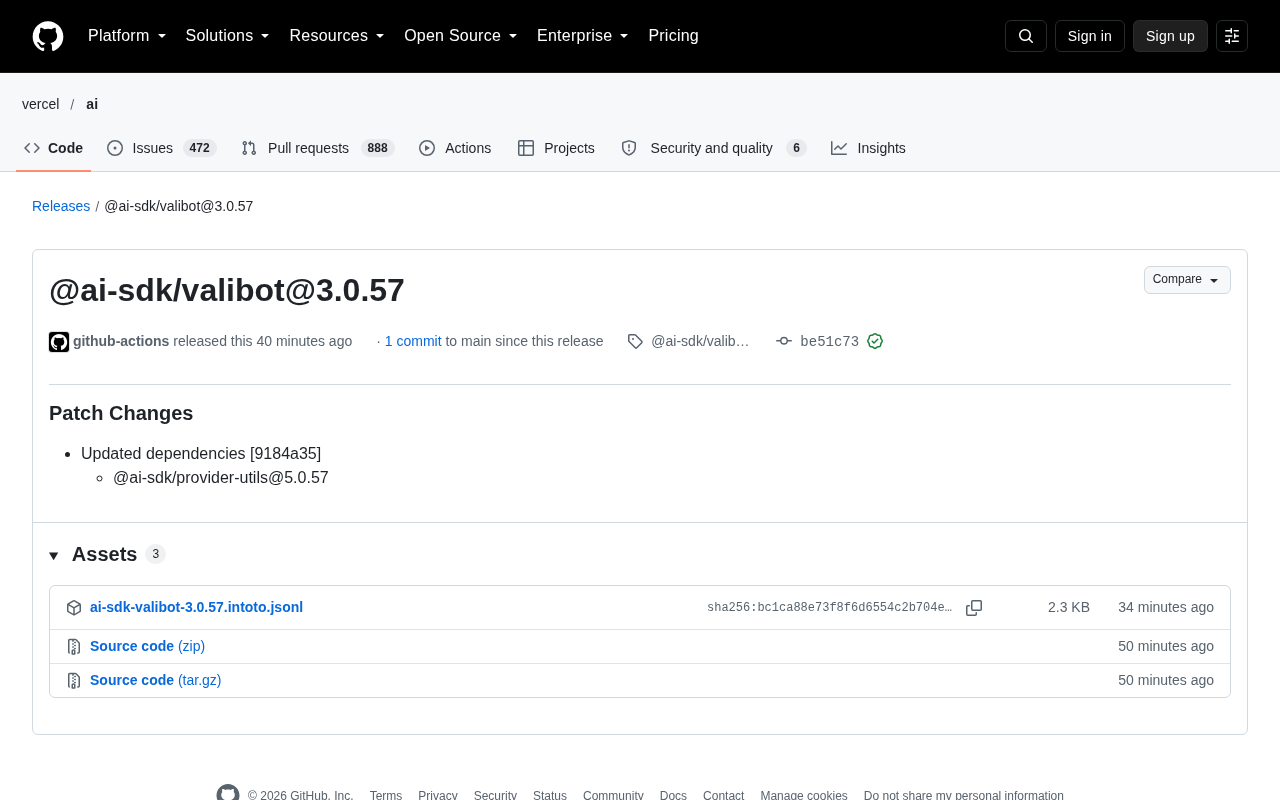
@ai-sdk/valibot is a component package within the Vercel AI SDK ecosystem that integrates Valibot — a lightweight schema validation library — into the AI SDK workflow. The newly released 3.0.57 is a typical patch-level update, automatically published by GitHub Actions on October 8th and signed via GitHub's verified GPG key (ID: B5690EEEBB952194).
The release history shows a single commit to main since the previous version, indicating a very narrow scope of change focused entirely on dependency synchronization.
What Changed
According to the official Changelog, this release contains exactly one change:
- Updated dependencies [9184a35]: Bumped the dependency
@ai-sdk/[email protected].
This means 3.0.57 introduces no new features and no breaking changes — it simply aligns with the updated version of the underlying utility library provider-utils. This kind of update is very common in monorepo projects that follow Semantic Versioning (SemVer): when a shared base package is upgraded, dependent packages publish a patch release to ensure version consistency and compatibility across the entire SDK ecosystem.
What This Means for Developers
For developers using the Vercel AI SDK with Valibot for structured data validation, this is a low-risk routine upgrade. Patch releases typically fix bugs or sync dependencies without changing existing API contracts, so updating with confidence is generally safe.
Within the AI SDK, Valibot is commonly used to define schemas and perform runtime validation for model tool calling and structured output. Compared to the heavier Zod, Valibot is known for its smaller bundle size and modular design — making it well-suited for frontend-sensitive or resource-constrained environments. The @ai-sdk/valibot package exists precisely to let developers declare output structures in the Valibot style within AI SDK, while still gaining full type safety.
Background: Tool Calling & Structured Output Tool calling refers to the ability of a large language model to invoke predefined external functions or APIs based on user intent, passing structured arguments to those functions. Structured output requires the model's response to conform to a specific data format (e.g., JSON Schema) rather than free-form text. Both rely on schema definitions to constrain the shape of model output, while runtime validation libraries like Valibot or Zod verify whether the actual model response matches the expected structure and provide type-level guarantees for downstream business logic. Valibot's key advantage over Zod lies in its tree-shakeable modular architecture — each validation function is imported independently, resulting in a final bundle size that can be several times smaller than Zod's. This is a significant advantage in Edge Runtime or browser-based AI scenarios.
Versioning and Maintenance Cadence
One detail worth noting: the patch number of @ai-sdk/valibot (3.0.57) aligns with that of its dependency @ai-sdk/provider-utils (5.0.57). This further confirms that the project uses a unified release pipeline — likely powered by a tool like Changesets — to batch-manage versions across monorepo packages, incrementing the patch number for all sub-packages together in CI.
This high-frequency, fine-grained release strategy reflects the active iteration pace of the Vercel AI SDK. For consumers, it's advisable to configure automated dependency update tools like Renovate or Dependabot to track these patch releases, rather than tracking them manually.
Background: Changesets Changesets is a version management tool designed specifically for monorepos (a single repository managing multiple npm packages). When committing code, developers attach a "changeset" file describing the type of change (major/minor/patch) and its scope. The CI pipeline then aggregates these files at release time, calculates the appropriate version bumps for each sub-package, and batch-updates
package.jsonfiles and Changelogs. This mechanism allows large SDKs — like Vercel AI SDK with dozens of sub-packages — to maintain coordinated version numbers while avoiding the errors and omissions of manual maintenance. The aligned patch numbers seen here (both at.57) are a direct result of the pipeline cascading version bumps to upstream packages whenever a base package is updated.
Summary
@ai-sdk/[email protected] is a purely dependency-driven update with no functional changes. It reflects the Vercel AI SDK ecosystem's consistent and disciplined maintenance cadence rather than any major new capability. For projects already using this package, the upgrade cost is minimal. For developers who haven't encountered it yet, this is a good entry point for understanding how the AI SDK uses modular package design to support multiple validation libraries.
Related articles

The Chaotic Aesthetics of Apple's HomeView Ad: A Marketing Code Only Parents Can Read
Apple's HomeView smart display ad ditches minimalist style for chaotic family mornings to win over parents. We analyze why it confuses most viewers but resonates instantly with families — and the trade-offs and risks of Apple's targeted marketing.

Cerebras CEO Pushes Back on AI Doomerism: Stop Spreading Panic
Cerebras CEO Andrew Feldman publicly pushes back on AI doomerism at TechCrunch Disrupt, arguing excessive risk focus drowns out AI's real opportunities.

Retooling in Minutes: Industrial Next Redefines Factory Robot Flexibility
Industrial Next aims to let factory robots retool in minutes instead of weeks, automating complex delicate tasks and advancing flexible manufacturing and small-batch production.