@ai-sdk/valibot 3.0.70 Patch Update: Dependency Upgrades and Ecosystem Signals

@ai-sdk/valibot 3.0.70 is a pure dependency sync patch, syncing provider-utils to 5.0.70.
@ai-sdk/valibot has released a 3.0.70 patch version on GitHub. The release notes show this update only updates dependencies, including upgrading @ai-sdk/provider-utils to 5.0.70, with no new features or breaking changes. As the AI SDK's schema adapter package, @ai-sdk/valibot has very thin logic of its own, and its health depends on version alignment with the upstream utility layer and the Valibot main package. The article recommends that users upgrade with confidence while checking whether the provider-utils version is consistent, and running type checking and tests in CI. The author further points out that such patches reflect the AI SDK's maintenance model of modular packaging and independent releases per package, and that continuous patch-level follow-up is the lowest-cost stability investment.
The Chain Reaction Behind a "Minor" Version
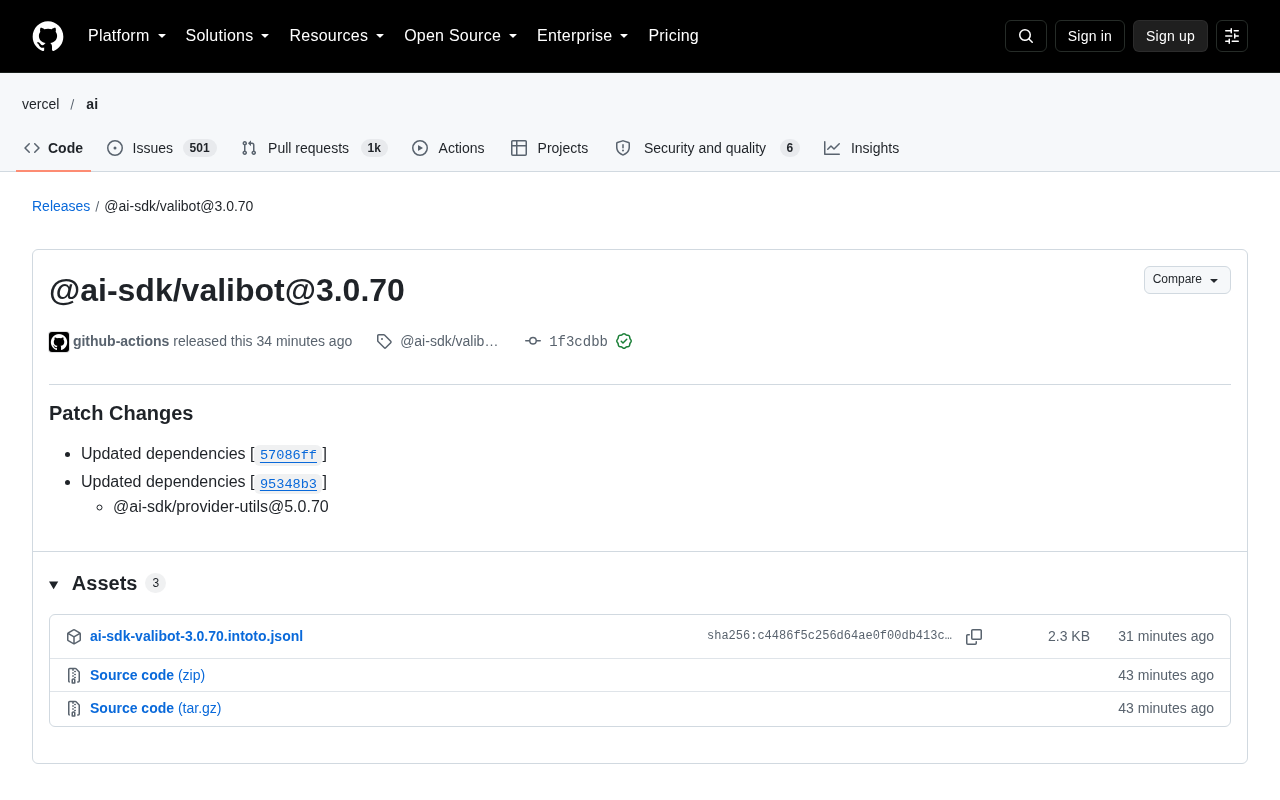
@ai-sdk/valibot has released a 3.0.70 patch version on GitHub. According to the release notes, this update does just one thing: update dependencies, including @ai-sdk/provider-utils@5.0.70. The version number bumps to the third position (patch), indicating no new features and no breaking changes. For developers who routinely use Vercel AI SDK + Valibot for schema validation, this is a routine upgrade that can be safely adopted.
What's Inside the Patch
The Sync Cadence of the Dependency Chain
The release notes list two dependency update records (commits 57086ff, 95348b3), bringing @ai-sdk/provider-utils to 5.0.70. provider-utils is the shared utility layer used by all AI SDK providers, handling request wrapping, streaming, error normalization, and other foundational capabilities. As a schema adapter package, @ai-sdk/valibot has very thin logic of its own, and its health depends almost entirely on version alignment with the upstream provider-utils and the valibot main package. The real value of this kind of patch update lies in keeping the adapter layer in step with the utility layer, avoiding type incompatibilities or runtime behavior differences caused by version drift.
Patch semantics in SemVer: In the Semantic Versioning specification, the three segments of the version number MAJOR.MINOR.PATCH correspond to breaking changes, backward-compatible new features, and backward-compatible bug fixes, respectively. An increment in the patch position theoretically means users can safely upgrade without modifying any code. It's worth noting, however, that SemVer only constrains the "public API" level. In TypeScript ecosystems like the AI SDK, subtle adjustments to type definitions (even when runtime behavior is unchanged) can occur in patches, thereby affecting compile-time code that relies on type inference. Therefore, judging the "safety" of a patch still requires verification through type checking, rather than inferring solely from the version position.
The role of @ai-sdk/provider-utils: It is the underlying utility package split out from the Vercel AI SDK, depended on jointly by individual provider implementations (such as the OpenAI and Anthropic adapters) and schema adapter packages. Its responsibilities include unified HTTP request construction, parsing of Server-Sent Events streaming responses, encoding and decoding of tool call parameters, and normalizing the error structures returned by different vendors into unified exception types. Precisely because it sits in the "waist" of the dependency graph, any patch to it can simultaneously affect the behavioral consistency of multiple upper-layer packages—which is the fundamental reason adapter packages need to stay in lockstep with its version cadence.
Why Patches Are Worth Paying Attention To
Many teams are insensitive to patch versions, but the AI SDK ecosystem iterates quickly, and cross-package type contracts are frequently corrected in patches. If you pin the exact version of @ai-sdk/valibot in your project and don't upgrade for a long time, you may encounter issues locally that have already been fixed upstream in provider-utils. A more sensible approach is to allow automatic patch upgrades while using a lockfile to pin the specific version, balancing consistency and maintainability.
The difference between exact version pinning and lockfiles: Hardcoding "@ai-sdk/valibot": "3.0.70" in package.json is exact pinning and blocks any automatic upgrade; using ^3.0.70 together with a lockfile (package-lock.json, pnpm-lock.yaml, etc.) allows newer patches/minors to be resolved, but the lockfile pins the exact version installed for this run until an update command is explicitly executed. The latter ensures reproducibility within the team and in CI environments while leaving a channel for future proactive upgrades. This is exactly the combination recommended in this article: looser range declarations with the lockfile as a backstop.
Practical Impact on Users
Upgrade Recommendations
This update has no API changes, so the upgrade path should be smooth. For projects using Valibot as the AI SDK tool parameter validation solution, simply upgrade to 3.0.70; if you also depend on @ai-sdk/provider-utils, it's advisable to check whether its version has been aligned to 5.0.70 to avoid two different minor versions coexisting. Running type checking and existing tests once in CI is usually enough to cover the risk.
Ecosystem Signals
A single patch version carries limited information, but it reflects one fact: the AI SDK's modular packaging strategy is running continuously—the core SDK, the provider utility layer, and the various schema adapter packages (Valibot, Zod, etc.) each release independently. For developers, this means finer-grained dependency control, but also the need to more actively track the version matrix of multiple packages. Following releases like this reveals the ecosystem's maintenance activity more clearly than following a single major version.
Summary
@ai-sdk/valibot 3.0.70 is a patch release that is purely a dependency sync. It doesn't change usage, but it reminds teams using the AI SDK that in a modular ecosystem, version alignment is itself a routine maintenance task. Keeping up at the patch level is the lowest-cost stability investment.
One-line Summary
@ai-sdk/valibot 3.0.70 is a pure dependency sync patch, syncing provider-utils to 5.0.70.
Paragraph Summary
@ai-sdk/valibot has released a 3.0.70 patch version on GitHub. The release notes show this update only updates dependencies, including upgrading @ai-sdk/provider-utils to 5.0.70, with no new features or breaking changes. As the AI SDK's schema adapter package, @ai-sdk/valibot has very thin logic of its own, and its health depends on version alignment with the upstream utility layer and the Valibot main package. The article recommends that users upgrade with confidence while checking whether the provider-utils version is consistent, and running type checking and tests in CI. The author further points out that such patches reflect the AI SDK's maintenance model of modular packaging and independent releases per package, and that continuous patch-level follow-up is the lowest-cost stability investment.
Related articles

64-Microphone Acoustic Camera Hands-On: Seeing Sound for $800
Hands-on review of the $800 TD2E acoustic imaging camera: a 64-microphone array localizes sound in real time, covers 2000–100000 Hz including ultrasound, and suits industrial inspection—though the software ecosystem is thin.

Manufacturing Accelerator Re:Build Raises $2.1B, Spins Out Slate Auto
Manufacturing accelerator Re:Build closes $2.1B funding, calling itself "America's answer to Shenzhen," and spins out Slate Auto. Known facts, positioning, and information gaps.

OpenAI's Public Breakthroughs Draw Academic Criticism: Research Transparency in the Spotlight
OpenAI announces math, CS, and physics breakthroughs and claims improved communication, but researchers tell The Verge dissatisfaction is mounting, criticizing selective disclosure and lack of reproducible details as the tension between corporate research and open science resurfaces.