AI SDK Voyage 2.0.59 Released: Dependency Updates and Patch Changes Explained

@ai-sdk/voyage@2.0.59 patch released, syncing core dependencies to keep multi-provider projects consistent.
`@ai-sdk/voyage@2.0.59` is a patch version auto-published by github-actions, containing 3 commits with no new features or breaking changes. Its core changes are upgrading `@ai-sdk/provider-utils` to 5.0.59 and `@ai-sdk/provider` to 4.0.27—a typical dependency-sync release. Since the Voyage provider is the adaptation layer between the AI SDK and Voyage AI's embedding/rerank services, such updates matter especially for projects using multiple providers—they help keep the dependency tree consistent and reduce the risk of version conflicts. The article recommends developers perform routine updates; teams that exact-pin dependencies should check version ranges and run type checks and embedding tests in CI to catch potential compile-time incompatibilities.
Component updates in the AI SDK ecosystem tend to fly under the radar, but the dependency chain shifts behind them often ripple into developers' build pipelines. The release of @ai-sdk/voyage@2.0.59 is a typical example—on the surface it's just a patch version bump, but in reality it involves synchronized upgrades across multiple core dependency packages.
What This Update Actually Changed
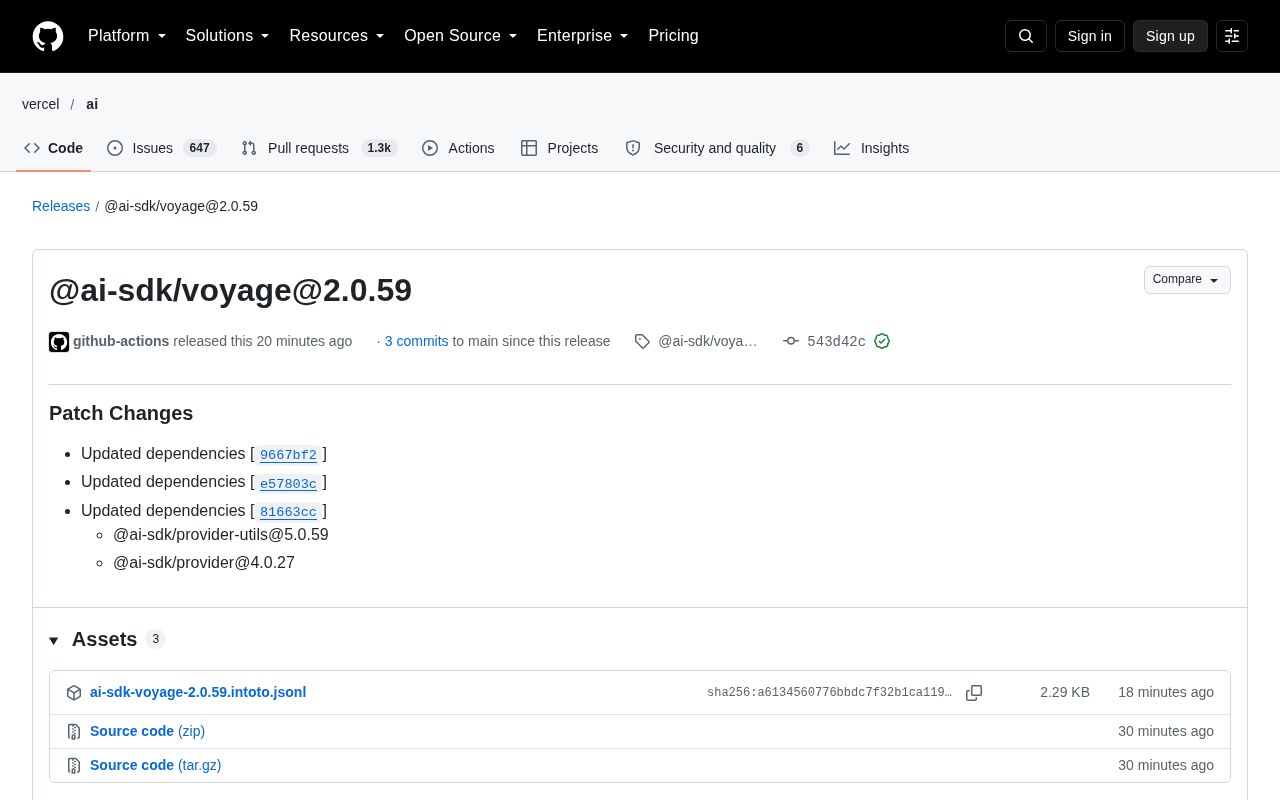
According to the GitHub Releases page, @ai-sdk/voyage@2.0.59 was auto-published by github-actions, contains 3 commits, and belongs to the main branch. The release is tagged as Patch Changes, meaning it introduces no new features or breaking changes—it focuses on correcting and synchronizing dependency relationships.
A Chain Reaction of Dependency Updates
The core of this patch is version bumps for three dependencies, corresponding to three separate commits:
@ai-sdk/provider-utilsupdated to5.0.59@ai-sdk/providerupdated to4.0.27- A third commit (
81663cc) also triggered a dependency update, but the new version number isn't listed separately in the release notes
All three commits are tagged "Updated dependencies," meaning the Voyage provider itself didn't modify any business logic—it's simply aligning with the cadence of upstream packages.
Why Even Patch Releases Matter
@ai-sdk/voyage is the provider package in the AI SDK that connects to Voyage AI's services. Voyage AI is known for its text embedding and rerank capabilities, and has been adopted by quite a few teams for RAG (Retrieval-Augmented Generation) use cases. The provider package itself isn't large in terms of code, but it serves as the adaptation layer between your application and the Voyage API. Mismatched dependency versions can lead to type definition conflicts or runtime behavior differences.
For teams using monorepos or strictly pinning dependency versions, the synchronized upgrades of provider-utils and provider mean: if you're using multiple AI SDK providers in your project, this update helps keep dependencies consistent across providers and reduces the risk of "version hell."
AI SDK's provider architecture: Vercel's AI SDK uses a layered design—@ai-sdk/provider defines the common interface specifications for all AI service integrations (such as language model call signatures, message formats, and streaming response protocols), while @ai-sdk/provider-utils provides the utility functions repeatedly used when implementing these interfaces (such as response parsing, error mapping, retry logic, and stream processing helpers). Vendor-specific provider packages (like @ai-sdk/voyage and @ai-sdk/openai) depend on these two core layers to connect with each vendor's API.
This architecture means that any tweak to the core packages' interfaces requires all provider packages to follow suit—otherwise you'll get type mismatches or runtime protocol misalignment. This is why an apparently trivial core package version bump cascades into simultaneous patch releases across multiple provider packages: they share the same abstraction contract and must stay version-aligned.
RAG and Voyage AI's positioning: RAG (Retrieval-Augmented Generation) is a paradigm that lets large language models retrieve from external knowledge bases before generating responses. The typical pipeline: chunk documents and convert them into vectors via an embedding model, then store them in a vector database; when a user asks a question, vectorize the query and retrieve the most similar document chunks; then use a rerank model to refine the candidate chunks; finally feed the curated chunks as context to the LLM to generate a response.
Voyage AI is a vendor focused specifically on the embedding and rerank stages of this pipeline, and its models are often compared to OpenAI's embedding models for retrieval quality. @ai-sdk/voyage, as the AI SDK's adaptation layer, lets developers call Voyage's embedding and rerank capabilities through a unified SDK interface without dealing directly with the differences between each vendor's REST API.
What the Version Numbers Signal
The fact that @ai-sdk/provider has reached 4.0.27 and @ai-sdk/provider-utils has reached 5.0.59 shows that the AI SDK's core abstraction layer has been iterating for quite some time. The two packages have different major versions (4.x vs. 5.x), indicating different API stability strategies—provider-utils, as the utility layer, may introduce adjustments more frequently.
The Voyage provider releasing patches in step with these versions reflects a "fast sync, small releases" strategy adopted by Vercel's AI SDK team. The github-actions auto-publishing confirms this: the entire process is highly automated, with almost no human intervention from commit to npm publish.
What Developers Should Do
If your project depends directly on @ai-sdk/voyage, a standard npm update or pnpm update will pull in 2.0.59. Since it's a patch version, there are no breaking changes under SemVer semantics.
But there's one detail worth noting: this update bumps both provider and provider-utils. If you've exact-pinned these packages in your package.json, you'll need to manually check whether to loosen the version ranges accordingly—otherwise you may run into a conflict where the Voyage provider depends on the new utils while your project pins the old utils.
In CI environments, it's recommended to run a full type check (tsc --noEmit) and embedding-related test cases after updating—type incompatibilities triggered by dependency updates sometimes don't surface at runtime but will fail at the compile stage.
Summary
@ai-sdk/voyage@2.0.59 is a standard dependency-sync patch release. It introduces no new features, but for teams maintaining AI SDK multi-provider projects, keeping up with these updates helps keep the dependency tree clean. For most users, the upgrade cost is minimal and the risk is manageable.
One-line Summary
@ai-sdk/voyage@2.0.59 patch released, syncing core dependencies to keep multi-provider projects consistent.
Paragraph Summary
@ai-sdk/voyage@2.0.59 is a patch version auto-published by github-actions, containing 3 commits with no new features or breaking changes. Its core changes are upgrading @ai-sdk/provider-utils to 5.0.59 and @ai-sdk/provider to 4.0.27—a typical dependency-sync release. Since the Voyage provider is the adaptation layer between the AI SDK and Voyage AI's embedding/rerank services, such updates matter especially for projects using multiple providers—they help keep the dependency tree consistent and reduce the risk of version conflicts. The article recommends developers perform routine updates; teams that exact-pin dependencies should check version ranges and run type checks and embedding tests in CI to catch potential compile-time incompatibilities.
Related articles

Frontend to AI Agent Development: A Frontline Architect Explains Career Paths and Opportunities
A frontline AI architect explains the industry changes and practical paths for frontend developers transitioning to AI Agent development: why pure frontend jobs are disappearing, why Agent + full-stack has become mainstream in hiring, and three transformation routes—Agent development engineer, FDE, and remote contracting—along with corresponding learning strategies.

How to Choose an AI Agent Development Course: Five Pitfall-Avoidance Guidelines
A mechanical-engineering career changer's two-year pitfall-tested checklist for screening AI Agent development courses: complete delivery pipeline, resume-worthy projects, real development perspective, update frequency, and coaching feedback—with concrete judgment methods and pitfall-avoidance tips.

Coze AI Agent Building for Beginners: A Zero-Code AI Agent Development Guide
Coze, ByteDance's one-stop AI application development platform, supports zero-code drag-and-drop AI agent building. This article outlines Coze's core concepts, three advantages, differences between the domestic and international versions, and the distinction between agents and apps, helping beginners quickly get started with AI Agent development.