@ai-sdk/voyage 2.0.63 Patch Release: Dependency Updates

@ai-sdk/voyage 2.0.63 is a non-breaking dependency sync patch with low upgrade risk but worth following.
The article interprets the release of @ai-sdk/voyage 2.0.63 in the Vercel AI SDK ecosystem. This package is the adapter layer connecting AI SDK to Voyage AI's embedding models, sitting upstream in RAG retrieval pipelines. This patch-level update only bumps @ai-sdk/provider to 4.0.30 and @ai-sdk/provider-utils to 5.0.63, with no new APIs or breaking changes. The author notes that synchronized upgrades of the two shared packages usually indicate upstream internal alignment in type definitions, request wrappers, or error code normalization, with the benefit of more consistent behavior across providers. The article recommends explicitly pinning versions, checking dependency conflicts with other provider packages, and verifying peer dependency satisfaction, while emphasizing that dependency version drift can affect vector result consistency and RAG reproducibility.
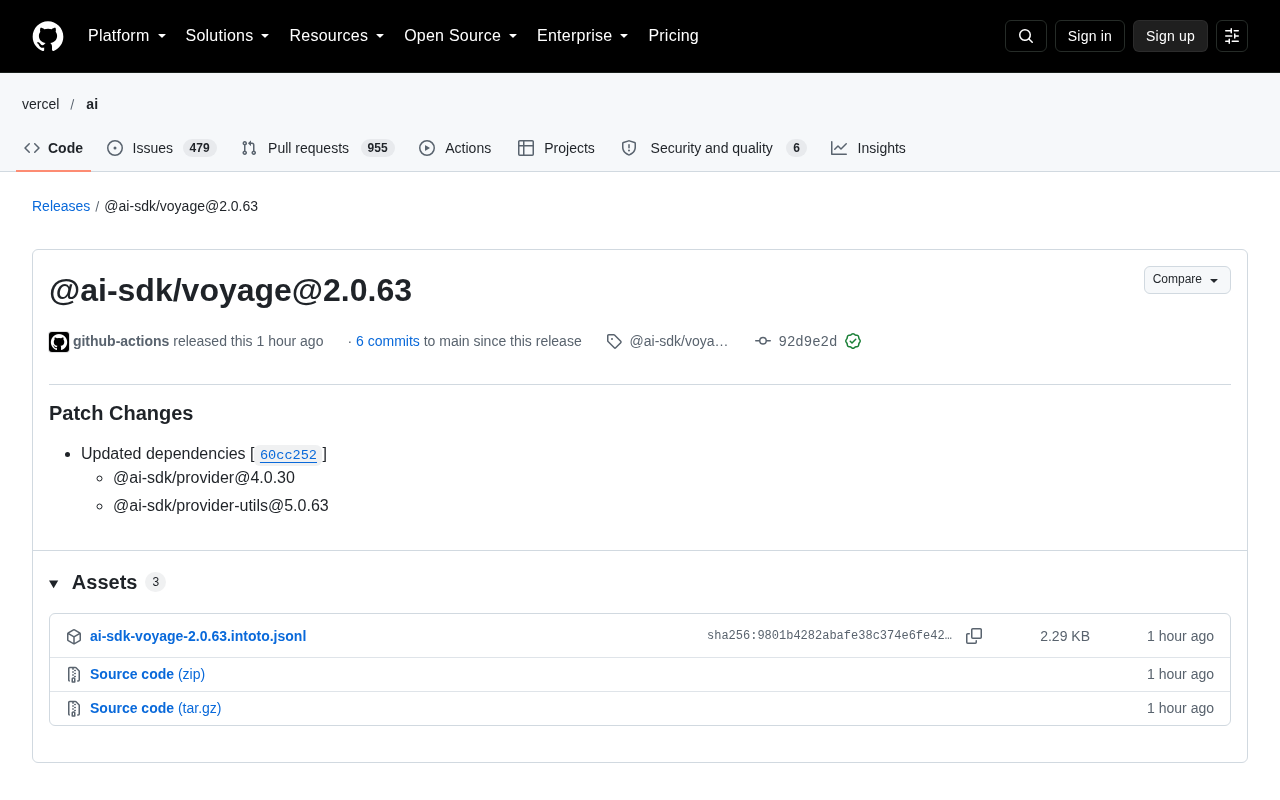
A routine patch, but from the Vercel AI SDK supply chain
@ai-sdk/voyage has released version 2.0.63, a patch-level update. Judging from the release notes, the change is quite restrained: it only updates the dependencies @ai-sdk/provider to 4.0.30 and @ai-sdk/provider-utils to 5.0.63. There are no new APIs and no breaking changes.
Releases like this are common in the AI SDK ecosystem. What's really worth paying attention to isn't "what functionality changed" but "who maintains it and whether the dependency chain is healthy." @ai-sdk/voyage is the adapter layer that connects AI SDK to Voyage AI's embedding models, and it's a member of the Vercel AI SDK's provider family. Voyage has a stable user base in vector retrieval and RAG scenarios, so although this package is small, it sits upstream in the inference pipeline.
The engineering signals behind dependency synchronization
The roles of provider and provider-utils
@ai-sdk/provider defines the common contract for model provider adapters, while @ai-sdk/provider-utils carries shared utilities such as streaming parsing and error handling. Upgrading both together usually means upstream has done an internal alignment: perhaps type definition adjustments, request wrapper refactoring, or error code normalization. For developers using @ai-sdk/voyage, the most direct benefit after upgrading is behavioral consistency with other AI SDK providers, reducing edge-case differences when switching between providers.
Peer dependencies and overrides/resolutions: AI SDK provider packages typically declare @ai-sdk/provider as a peer dependency, leaving the host project to decide the actual installed version rather than having each provider package nest its own copy. This ensures all providers share the same contract types and avoids duplicate instances that are "the same type yet mutually incompatible." pnpm uses overrides, while npm and yarn use resolutions to force version unification, but if a provider package's declared peer range doesn't overlap with the new version, the package manager will warn or even fail to install. Therefore, when upgrading @ai-sdk/voyage, you should also check the actually resolved version of @ai-sdk/provider in the dependency tree.
Why patch versions are still worth following
The stability of the embedding model interface directly affects the reproducibility of RAG pipelines. Dependency version drift can introduce subtle serialization differences, which in turn affect the consistency of vector results. Keeping @ai-sdk/voyage on the latest patch is a low-cost way to reduce the risk of "recall fluctuations caused by environment inconsistency." This is especially true for team collaboration projects, where unifying the lockfile to 2.0.63 can reduce occasional discrepancies between CI and local environments.
RAG and embedding models: RAG (Retrieval-Augmented Generation) is an engineering paradigm in which a large model first retrieves relevant snippets from an external knowledge base before answering, then inserts those snippets into the prompt. It can significantly reduce hallucinations and support private data. Its retrieval step relies on embedding models to map text into high-dimensional vectors, then uses metrics such as cosine similarity to recall nearest neighbors; models like Voyage AI's voyage-3 belong to this category. Once embedding results are written to a vector store, they are often not recomputed, so the same text producing different vectors in different environments causes misalignment between the index and query spaces, manifesting as recall drift. This is exactly the engineering reason the article emphasizes pinning dependency versions and maintaining consistent serialization behavior.
Practical impact on users and recommendations
Assessing upgrade cost
Since there are no interface changes this time, the upgrade risk is very low. It's recommended to explicitly pin the @ai-sdk/voyage version in your dependencies and simultaneously check whether @ai-sdk/provider conflicts with other provider packages (such as @ai-sdk/openai). If the project uses pnpm or npm's overrides/resolutions, confirm that peer dependencies are satisfied.
When not to rush the upgrade
If the current version runs stably and there's no need to share a toolchain across providers, you can update at your usual pace and don't need to issue a release specifically for a single patch. But if you're planning to integrate a new AI SDK provider soon, or encounter strange behavior in the request wrapper layer, this dependency alignment is worth including as one of your troubleshooting items.
Summary
@ai-sdk/voyage@2.0.63 is a typical dependency synchronization patch: low-key, non-breaking, and focused on ecosystem consistency. It reminds us that the upstream supply chain of AI applications also requires version discipline—even a tiny update to the embedding adapter layer can affect the determinism of retrieval systems.
Related articles

AI Digital Twin in Action: Using DOT to Automatically Track Bugs and User Feedback
DOTS engineers demonstrate how AI digital twin DOT collects cross-platform user feedback, categorizes issue themes, opens threads to investigate bug root causes, and submits PRs—showcasing a complete AI agent workflow for defect triage with auditable design.

Why Transistors Are No Longer Flat: The Evolution from Planar to Gate-All-Around
Transistor evolution from planar to FinFET to gate-all-around: why gates went from three-sided to four-sided wrapping to suppress short-channel effects and leakage current, extending Moore's Law.

Swarm Intelligence = a Single RL Agent? A Proof of Multi-Armed Bandit Equivalence
A paper proves that collective decision-making through local imitation in swarms is mathematically equivalent to single-agent reinforcement learning: N blind imitators act as N parallel environment samples, with an effective learning rate of 1/N. This article explains the derivation and implications of the Maynard-Cross Learning algorithm.