AI SDK Vue 2.0.278 Patch Released: Core ai Package Synchronized

@ai-sdk/vue releases patch 2.0.278, only syncing core ai package to 5.0.278.
@ai-sdk/vue has released patch version 2.0.278, with the only change being synchronization of the underlying `ai` core package to 5.0.278. This reflects the Vercel AI SDK's monorepo follow-up release strategy, keeping the framework adapter layer version-aligned with the core package to ensure consistent type definitions and runtime behavior. For Vue developers, the impact is minimal and projects using caret dependency ranges will fetch it automatically; after upgrading, it is advisable to focus on validating streaming responses and tool calling. High-frequency patch releases reflect project activity and also remind developers to plan dependency locking and upgrade strategies sensibly.
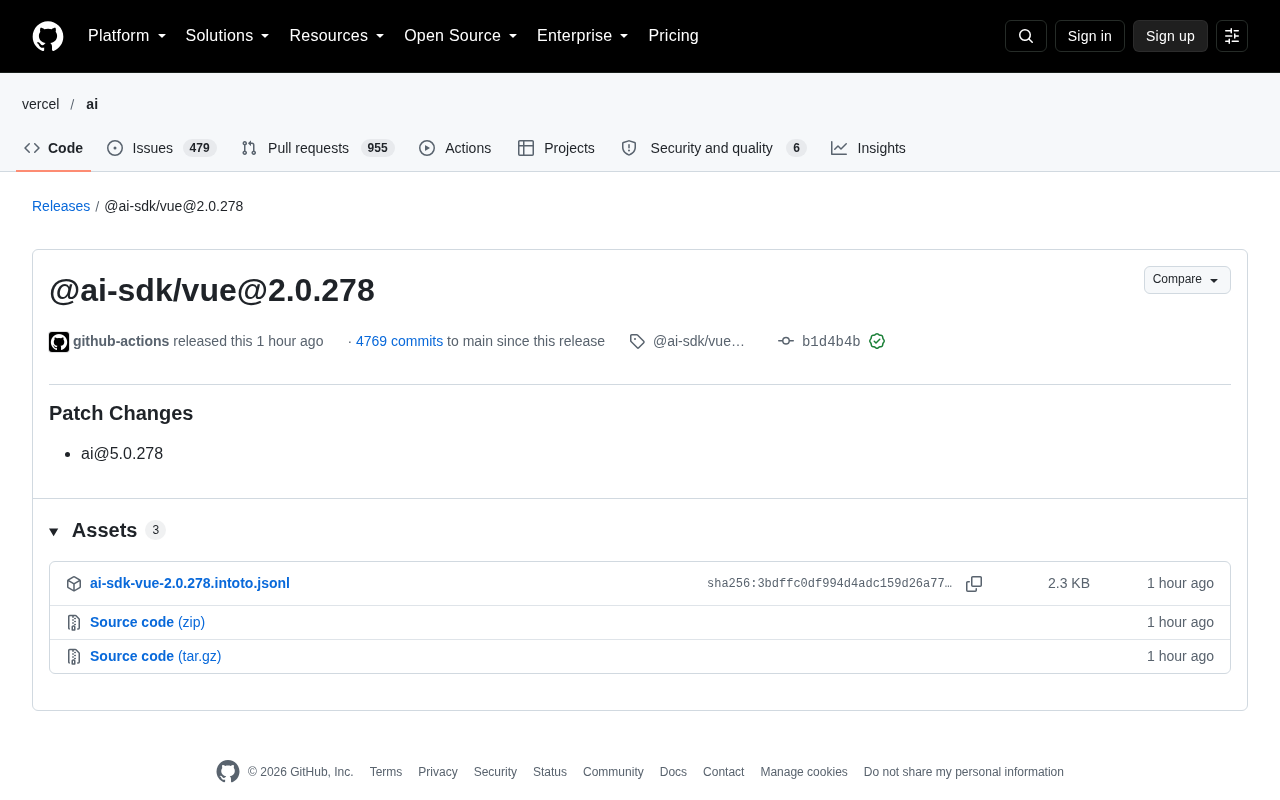
The AI SDK ecosystem continues its rapid version iteration. The @ai-sdk/vue repository on GitHub has released version 2.0.278, a routine patch update whose core change is synchronizing the underlying ai package to version 5.0.278. For developers building Vue applications with the Vercel AI SDK, this type of minor version update typically means dependency consistency fixes rather than API-level changes.
Specifics of the Patch Update
According to the GitHub Release page, @ai-sdk/vue@2.0.278's Patch Changes contains only one entry: ai@5.0.278. This indicates that the release introduces no new features and fixes no independent issues in the Vue adapter layer itself; instead, it aligns the dependency on the core SDK version to the same release batch.
This "follow-up release" approach is common in the AI SDK's multi-framework adaptation strategy. The Vercel AI SDK uses a monorepo, with the ai core package and framework binding packages such as @ai-sdk/vue and @ai-sdk/react sharing a release cadence to ensure type definitions and runtime behavior remain consistent between the framework layers and the core layer.
Release Cadence Behind the Version Numbers
The version number 2.0.278 shows that this package has gone through a large number of minor iterations. With 4769 commits accumulated on the main branch, the project is clearly in a continuously active state of development. High-frequency patch releases mean, on one hand, that issues can be addressed quickly; on the other hand, they require development teams to maintain a certain discipline in dependency management—locking versions or upgrading regularly to avoid hidden compatibility issues caused by version drift.
Vercel AI SDK is an open-source TypeScript toolkit for building AI-driven applications, led by Vercel. It provides a unified API for calling a variety of large language models (such as OpenAI, Anthropic, Google, etc.) and handles common needs such as streaming responses, tool calling (Function Calling), and structured output. The SDK is divided into the core package ai and a series of framework adapter packages, such as @ai-sdk/vue, @ai-sdk/react, and @ai-sdk/svelte, which wrap the core capabilities into idiomatic interfaces for the corresponding frameworks. This design lets developers avoid dealing directly with low-level HTTP details and reuse most of their logic when migrating between frameworks.
monorepo is an engineering practice of managing multiple related software packages in a single Git repository. The Vercel AI SDK's use of a monorepo means that the ai core package and adapter packages such as @ai-sdk/vue and @ai-sdk/react share the same build, test, and release process. The advantage is that cross-package changes can be committed together and tested in coordination, and releases ensure that all packages reference the same batch of core code, reducing type mismatches or runtime behavior differences. The trade-off is that release cadences are bound together, so a small change in any package may trigger a patch version bump across all packages.
Practical Impact on Vue Developers
For the vast majority of projects, this update will not bring visible behavioral changes. Patch versions of the ai core package typically include internal fixes, minor type adjustments, or edge-case handling, while the Vue adapter layer, as a thin wrapper, is mainly responsible for mapping the core SDK's capabilities to Vue's Composition API.
If your project uses a caret range in package.json (such as ^2.0.0), a routine dependency installation will fetch this version. If the project strictly locks versions, you will need to upgrade manually. After upgrading, it is advisable to run your existing test cases, especially scenarios involving streaming responses and tool calling, because these features span both the core package and the framework adapter layer and are the interaction points most worth watching when aligning versions.
Whether to Upgrade Immediately
Patch versions usually contain no breaking changes, so upgrade risk is low. However, if the current version runs stably and you have not encountered known issues related to the ai core package, there is no need to force an upgrade just to stay current. A rational approach is to watch for substantive fixes related to the Vue adapter in subsequent versions before deciding whether to follow up.
caret range (such as ^2.0.0) is a dependency version declaration in npm Semantic Versioning (SemVer) that allows installation of the latest version in the 2.x.x series but does not automatically upgrade to major version 3.0.0 or above. When using a caret range in package.json, running npm install or yarn will fetch the latest patch version within that range. For patch updates like @ai-sdk/vue@2.0.278, if the project declares ^2.0.0, reinstalling dependencies will automatically fetch it. If using exact versions or a lock file (such as package-lock.json), you need to manually update the version number or run npm update to upgrade.
Engineering Approach Behind AI SDK Multi-Framework Adaptation
This release also reflects a characteristic of the AI SDK's engineering organization: core capabilities are concentrated in one package, while framework adapter layers remain lightweight. This layering lets developers across different tech stacks such as React, Vue, and Svelte share the same underlying logic while each getting an API shape that fits their framework's conventions.
The trade-off is that adapter layers must keep pace with the core package's release cadence; otherwise version mismatches can easily occur. The patch updates to @ai-sdk/vue are necessary actions to maintain this consistency. For developers who follow the AI application development toolchain, understanding this release mechanism helps them plan dependency upgrade strategies more rationally rather than passively following every version number change.
Key Takeaways
- @ai-sdk/vue@2.0.278 is a patch version whose only change is synchronizing
ai@5.0.278 - The release uses a monorepo follow-up strategy, keeping the framework adapter layer aligned with the core package
- Impact on existing projects is minimal, and projects using caret dependency ranges will fetch it automatically
- When upgrading, focus on validating streaming response and tool calling functionality
- High-frequency patch releases reflect project activity and also highlight the importance of dependency locking strategies
One-line Summary
@ai-sdk/vue releases 2.0.278 patch, only synchronizing the core ai package to 5.0.278.
Paragraph Summary
@ai-sdk/vue has released patch version 2.0.278, with the only change being synchronization of the underlying ai core package to 5.0.278. This reflects the Vercel AI SDK's monorepo follow-up release strategy, in which the framework adapter layer stays version-aligned with the core package to ensure consistent type definitions and runtime behavior. For Vue developers, this update has minimal impact and can be fetched automatically when using caret dependency ranges; after upgrading, it is advisable to focus on validating streaming response and tool calling scenarios. High-frequency patch releases reflect project activity and also remind developers to plan dependency locking and upgrade strategies sensibly.
Related articles

Uber Deploys ChatGPT Work Company-Wide: AI in the Workplace Enters the Scaled Implementation Phase
Uber deploys ChatGPT Work to 30,000+ employees, extending it from engineering to all roles. We analyze its expert-engineer pairing, end-to-end automation, and questions of AI control and power concentration—insights for scaling AI in the workplace.

Shift at Midnight Hands-On: When "ID Verification" Becomes Alien Hunting
Shift at Midnight blends ID verification with horror survival in a four-player co-op game. We break down its inspection mechanics and chaotic humor.

Zelensky Recounts the Outbreak of War: I Need Ammunition, Not a Ride
Zelensky recalls the first day of war in a YouTube interview: farewell to family, rejecting Biden's evacuation offer with "I need ammunition, not a ride," and how Bucha shaped his stance on compromise and peace talks.