@ai-sdk/vue 3.0.313 Patch Release: Ecosystem Signals Behind a Dependency Update

@ai-sdk/vue 3.0.313 updates dependencies and aligns with the core package, reflecting AI SDK's high-frequency minor-version maintenance strategy.
@ai-sdk/vue 3.0.313 is a patch that only updates three dependencies and aligns with ai@6.0.313, with no API or breaking changes. Such "dependencies-only" releases are common in monorepo-managed SDKs, where thin adapter layers must follow core package versions. The Vue adapter provides composables like useChat for streaming chat state. Developers should check dependency diffs, use lockfiles for canary regression testing, and follow core package release notes.
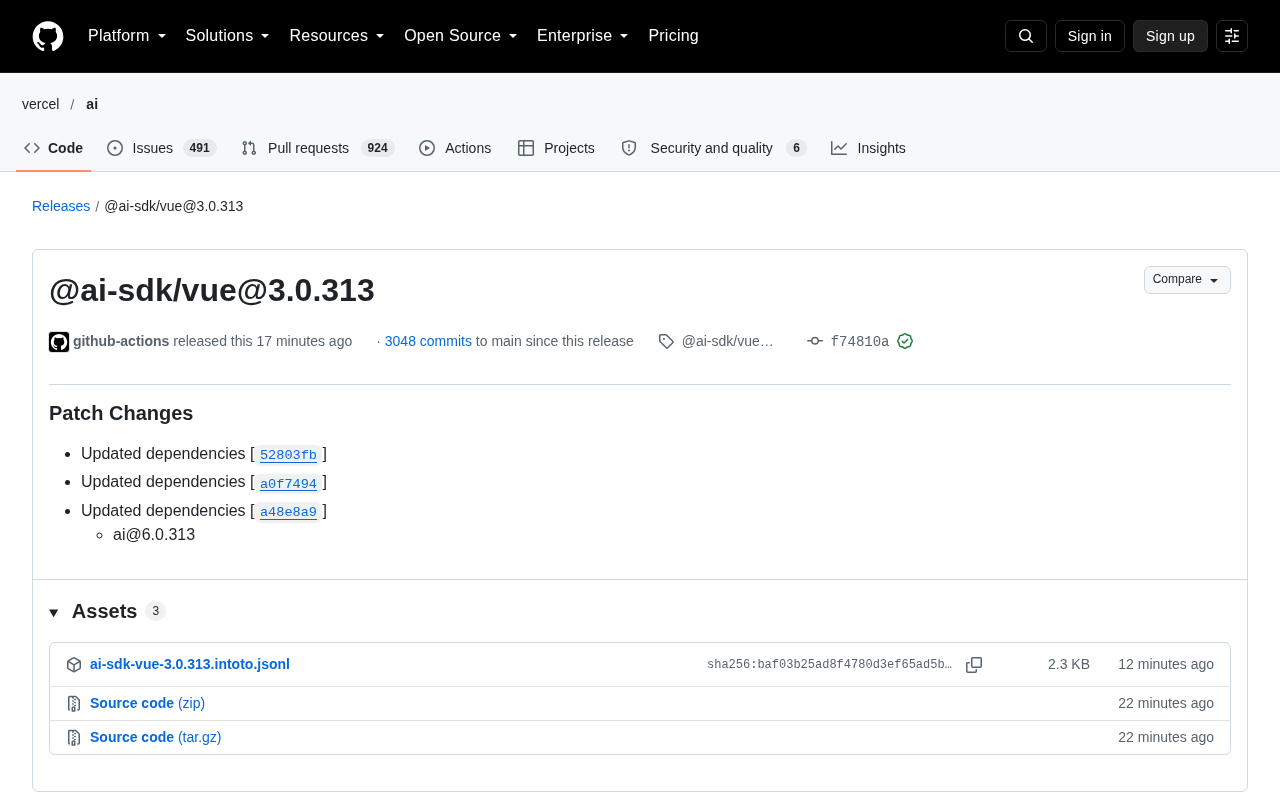
Vercel's AI SDK family has another minor iteration. @ai-sdk/vue@3.0.313 was released as a patch version on GitHub, with a single core change—three dependencies updated and aligned to ai@6.0.313. For developers familiar with this ecosystem, these "dependency update" patches are often not noise, but a signal worth a quick scan.
What a "dependencies-only" patch means
From the release notes, this is a standard Patch Changes release: the dependencies corresponding to three commit hashes (52803fb, a0f7494, a48e8a9) were updated, ultimately aligning @ai-sdk/vue with ai@6.0.313. No API changes, no breaking changes, no new features.
This release pattern is very common in monorepo-managed SDKs. AI SDK maintains the core package ai separately from framework adapters (Vue, React, Svelte, etc.); adapters typically only bridge core capabilities into the corresponding framework's reactivity system. So when the core package fixes bugs or adjusts internal implementation, adapters need to follow the dependency version to keep both ends behaving consistently.
For teams using @ai-sdk/vue, the direct value of such patches is: upgrade cost is minimal, but it avoids hidden compatibility issues caused by version drift between the core package and the adapter.
monorepo is a development pattern that manages multiple related packages in a single code repository. AI SDK uses this approach, placing the core package ai and various framework adapters (@ai-sdk/vue, @ai-sdk/react, etc.) in the same repository. The benefits: cross-package changes can be committed at once, tested uniformly, and dependency versions are easier to align. In a monorepo, tools like pnpm workspace or Turborepo are often used so sub-packages share lockfiles and build processes. When the core package releases a new version, maintainers can automatically trigger adapter dependency updates—which is why patches often contain "dependency-only" changes. For consumers, this structure reduces the risk of version fragmentation, but it also means the adapter's release cadence is highly dependent on the core package.
The Vue adapter's role in AI SDK
@ai-sdk/vue provides composables like useChat, wrapping streaming responses, message state, and error handling into Vue reactive refs. Its existence lets Vue developers integrate LLM chat capabilities without hand-writing fetch stream parsing and state machines.
Precisely because it's a thin bridge layer, its version number often follows the core package. The version 3.0.313 itself reveals limited information, but its synchronization with ai@6.0.313 shows maintainers are still consistently aligning dependencies. For long-term maintained projects, this regular minor-version cadence is more predictable than occasional major-version jumps.
Composables are the core pattern of Vue 3's Composition API—functions starting with use that encapsulate reactive state and lifecycle logic. useChat is a typical example: it returns reactive refs like messages, input, and handleSubmit, letting components use streaming chat data like local state. Composables integrate deeply with Vue's ref, computed, and watch, so when the server returns streaming increments, the UI updates automatically. Similar to hooks in the React adapter, composables are the "translation layer" that brings framework-agnostic core logic into Vue. Understanding this explains why the adapter itself has little code but must closely track the core package's internal implementation—it relies on the streaming iterator and state machine interfaces exposed by the core package, and any internal adjustment may affect composable behavior.
How developers should handle these updates
First, prioritize the dependency diff. The risk of patch versions is mainly in transitive dependencies. Before upgrading, confirm whether the three dependency updates involve runtime behavior changes, especially packages related to streaming parsing and fetch wrapping.
Second, use the lockfile for canary rollouts. In CI, first run a round of lockfile updates and tests, confirm there's no regression in useChat streaming behavior or error retry logic, then merge to the main branch.
Third, follow the core package release notes. Adapter changelogs are usually brief; the real behavioral changes are often recorded in the ai package's release notes. Tracking both repositories' release cadences together is more effective than watching only the adapter.
A lockfile is a dependency version locking file automatically generated by package managers (such as pnpm's pnpm-lock.yaml or npm's package-lock.json), recording each dependency's exact version and download URL to ensure a consistent dependency tree across environments. When upgrading a patch version, the lockfile diff visually shows which transitive dependencies changed. The canary upgrade approach: first update the lockfile on a separate branch and run the full test suite (especially integration tests for useChat streaming parsing and error retry), then merge after confirming no regressions. In CI, configure --frozen-lockfile to detect whether the lockfile is consistent with package.json, avoiding unexpected drift. For frequently released SDKs, consider splitting dependency updates into separate PRs, isolated from business code changes, to make issue localization faster.
Ecosystem cadence observations
This release reveals AI SDK's maintenance strategy: decoupled core and framework adapters, high-frequency patches, and automated dependency synchronization. For teams choosing a frontend integration solution for AI applications, this "small, fast steps" release cadence is a plus—it means fixes propagate quickly to each framework layer, while also requiring consumers to establish automated dependency update and regression testing processes.
Viewed alone, @ai-sdk/vue@3.0.313 is just routine maintenance; placed in the broader AI SDK iteration context, it reflects a mature open-source project's stable delivery capability at scale.
Semantic Versioning (SemVer) is a versioning specification widely adopted by the open-source community, in the format major.minor.patch. Patch versions (such as the 313 in 3.0.313) theoretically contain only backward-compatible bug fixes and should not introduce breaking changes. AI SDK's adapter version has long stayed at 3.0.x with ever-increasing patch numbers, showing maintainers strictly follow SemVer: as long as the core package has no breaking changes, the adapter only releases patches. This strategy lets consumers confidently auto-upgrade patch versions while concentrating manual review on minor and major versions. However, since adapters depend on the core package, patch versions can still introduce behavioral changes through transitive dependencies—so the article's advice to "check the dependency diff" isn't superfluous, but a pragmatic supplement to SemVer's boundaries.
One-line Summary
@ai-sdk/vue 3.0.313 updates dependencies and aligns with the core package, reflecting AI SDK's high-frequency minor-version maintenance strategy.
Paragraph Summary
@ai-sdk/vue 3.0.313 is a patch version that only updates three dependencies and aligns with ai@6.0.313, with no API changes or breaking changes. The article notes that such "dependencies-only" releases are common in monorepo-managed SDKs; adapters, as thin bridge layers, need to follow the core package version to avoid compatibility issues. The Vue adapter provides composables like useChat that wrap streaming chat state. When upgrading, developers should first check the dependency diff, use the lockfile for canary regression testing, and also follow the core package release notes. Overall, AI SDK adopts a strategy of decoupling the core package from framework adapters and releasing high-frequency minor versions—a plus for teams choosing a solution, but it also requires establishing automated dependency update processes.
Related articles

GPT-Next Leak, Gemini 4 Argon Imminent: AI News Roundup
GPT-Next leak suggests extreme efficiency; OpenAI's 28-day shipping pledge boosts speed 50%; Gemini 4 Argon nears release; Anthropic subscription value report sparks debate.

GPT-Next Leaked, Gemini 4 Argon Speeds Up, Fable 5.5 May Launch Today
OpenAI's GPT-Next model leaks, expected to be extremely low-cost and possibly part of the 28-day release plan; Gemini 4 Argon internal testing accelerates, NanoBanana 2.1 is live; Semi Analysis tests show Claude Max's equivalent API value is about 5 times that of ChatGPT Pro; Fable 5.5 may launch today.

Gemini 4 Argon Launches Globally: Key Highlights from the AI Daily Brief
Google opens Gemini 4 Argon globally across Pro and Ultra subscriptions and the API, and demonstrates robot control. This article rounds up open-source models, Agent infrastructure, cost transparency, and safety governance updates.